

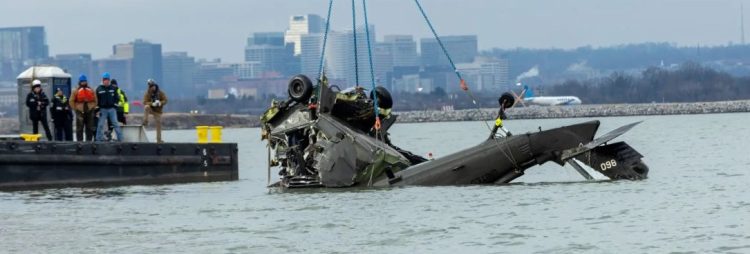
JUST IN: Radio transmission to the Black Hawk helicopter may have been “interrupted” moments before it collided with the American Airlines flight carrying over 60 people.
NTSB chair Jennifer Homendy says there is conflicting information regarding the Black Hawk’s altitude.
The… pic.twitter.com/kJ1yd7Hlm3
— Collin Rugg (@CollinRugg) February 15, 2025
Night Operations: The Role of Night Vision Goggles
The use of night vision goggles (NVGs) by the Black Hawk helicopter crew is emerging as a key factor in the investigation of the deadly collision with an American Airlines jet near Washington, D.C., on January 29, 2025. According to NTSB Chair Jennifer Homendy, early findings suggest that the helicopter pilots were likely wearing NVGs throughout the flight. This detail is particularly significant because the Black Hawk was conducting an annual training flight and a night vision goggle check ride for one of the pilots at the time of the crash.
NVGs are widely used in military aviation to enhance visibility in low-light conditions, improving operational safety and situational awareness. However, they also come with limitations that may have played a role in the accident. One of the biggest challenges is their limited field of view—NVGs typically provide a much narrower visual range than the human eye, restricting how much a pilot can see at once. This can make it more difficult to detect surrounding aircraft, especially in congested airspace like that near Washington, D.C. Additionally, depth perception issues can affect a pilot’s ability to accurately judge distances and altitudes, which is critical when flying in close proximity to other aircraft. Lastly, reduced peripheral vision means pilots must actively scan more often to compensate for what they can’t see naturally. This could have made it harder for the Black Hawk crew to spot the approaching jet in time to avoid the collision.
To better understand how the NVGs may have impacted visibility, the NTSB plans to conduct a specialized study analyzing what the helicopter pilots could actually see through the goggles in the moments leading up to the crash. This will help investigators determine if the limited visibility contributed to the accident and whether the pilots were able to recognize the oncoming danger.
While NVGs provide a major advantage for night operations, they require extensive training to use effectively. They can also increase a pilot’s workload, particularly during complex maneuvers or high-traffic flight paths. Investigators will likely examine the crew’s experience and proficiency with NVG use, as well as whether any equipment malfunctions or training deficiencies played a role in the incident.
As the investigation continues, the role of NVGs will be closely scrutinized. If they are found to be a contributing factor in the collision, the findings could lead to new safety recommendations for their use, especially in civilian airspace.
Airspace Complexity: Navigating “Helicopter Alley”
The airspace surrounding Reagan National Airport is notoriously congested, often referred to as “helicopter alley.” This area requires precise coordination between various aircraft to prevent conflicts. The proximity of helicopter operations to fixed-wing aircraft approaches necessitates clear and unambiguous communication. Any lapse, such as a missed ATC instruction, can have dire consequences. The recent collision has intensified scrutiny on the congested skies surrounding Reagan Airport and routes that bring helicopters into close proximity to jets carrying passengers.
Moving Forward: Enhancing Safety Measures
In the wake of this tragedy, several measures could be considered to prevent similar incidents in the future:
- Improved Communication Protocols: Ensuring that all aircraft operating in congested airspace have access to clear and reliable communication channels. Implementing technologies that can detect and prevent stepped-on transmissions may also be beneficial.
- Advanced Altitude Monitoring: Regular calibration and maintenance of altimeters, along with the integration of redundant systems, can help provide accurate altitude information to pilots.
- Enhanced Training for Night Operations: Providing comprehensive training for pilots using NVGs, emphasizing the limitations and challenges associated with their use.
- Airspace Management Revisions: Reevaluating flight paths and operational procedures in congested areas like “helicopter alley” to minimize the risk of midair collisions.
Wrap Up
The January 29 collision over the Potomac River reminds us of the critical importance of clear communication, accurate instrumentation, and situational awareness in aviation operations. As the NTSB investigation continues, it is imperative that the lessons learned from this tragedy lead to meaningful improvements in aviation safety protocols to prevent future tragic occurrences.








COMMENTS