
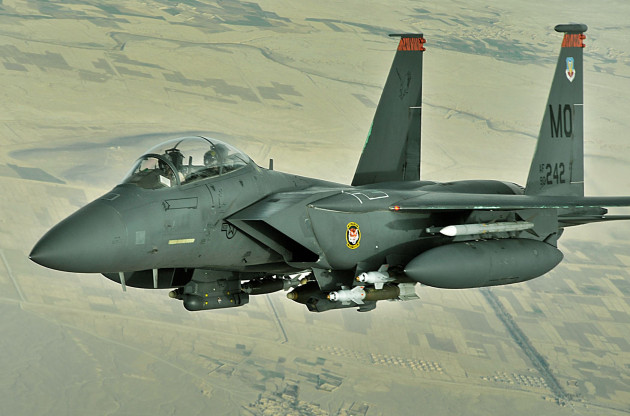
A U.S. Air Force F-15E Strike Eagle has been shot down inside Iran. One crew member has been recovered by U.S. forces. The second is on the ground, evading, with U.S. forces working to reach him.
This is the first confirmed loss of a U.S. manned aircraft over Iranian territory during Operation Epic Fury. No on-the-record statement has been issued by the Pentagon or CENTCOM. All confirmations remain from unnamed officials. This is what is known at this point.
The Shootdown
U.S. officials confirm the aircraft was shot down during combat operations earlier today over Iran. The jet was a two-seat F-15E assigned to the 494th Fighter Squadron, 48th Fighter Wing, RAF Lakenheath.
The squadron deployed around January 17, 2026, with twelve F-15E aircraft and two air spares. The forward operating location has been geolocated as Muwaffaq Salti Air Base in Jordan.
Wreckage imagery shows the “LN” tail code and red tail band tied to the 494th.
Iranian state media initially claimed it had shot down an F-35 and released images of wreckage to support it. Those images, along with analysis of the tail section and ejection seat, point to an F-15E instead. Iran knew it had hit an aircraft. It did not correctly identify it.
Iranian sources claim a “new” air defense system was used. No system has been confirmed. The working assessment is a shootdown. The exact cause of the loss has not been established on the record.
Crash Location
The aircraft came down in southwestern Iran.
Evidence points to Kohgiluyeh and Boyer-Ahmad Province and neighboring Khuzestan Province. Kohgiluyeh and Boyer-Ahmad sits roughly 500 kilometers southwest of Tehran. The population is about 600,000, largely ethnic Lur farmers and nomadic tribesmen across mountainous terrain.
CNN geolocated combat search-and-rescue footage to a bridge over the Karoon River in Khuzestan, approximately 470 kilometers south of Tehran.
The terrain is broken, rural, uneven, and populated just enough to turn a recovery mission into a hunt.
Crew Status
Both crew members ejected.
One has been recovered by U.S. forces and is receiving medical care. The second remains on the ground.
Reporting indicates U.S. forces may be in contact with the second crew member and are waiting for nightfall to attempt extraction. That places the situation in an active evasion and recovery phase.
Air Force aircrew train for this scenario long before they ever strap into a jet. Survival, Evasion, Resistance, and Escape, known as SERE, prepares pilots and weapons systems officers to operate alone in hostile territory after a shootdown. That training covers immediate actions after ejection, moving under concealment, avoiding both military forces and civilians, signaling friendly aircraft, and staying alive long enough for recovery. It is built around buying time, staying hidden, and not making mistakes when the margin for error is gone. In a situation like this, that training is not theoretical; it is the difference between recovery and capture.
The Ground Fight
Iranian state television went on air, urging civilians to locate and report a downed American pilot. An initial on-screen crawl told viewers to shoot American personnel on sight before later shifting to instructions to hand them over alive. The sequence reflects a system reacting in real time rather than executing a controlled message.
Local traders in Kohgiluyeh and Boyer-Ahmad Province offered a reward of 10 billion tomans, approximately $76,000, for finding the crew alive. An Iranian soccer player offered medals he won with Persepolis FC as an additional reward.
Tasnim reported that nomadic tribesmen and villagers moved into the mountains and plains with personal weapons to search for American personnel.
U.S. combat search-and-rescue forces are operating inside Iranian territory. HH-60G Pave Hawk helicopters and HC-130J refueling aircraft are involved. Reports indicate that Pave Hawks took small-arms fire during the operation.
Unconfirmed footage suggests possible support from MQ-9 drones, F-35 aircraft, and A-10 platforms in the Sandy escort role. These elements fit a standard high-risk CSAR package but remain unverified.
Iran’s Narrative Versus Reality
Iranian media continues to push conflicting claims. Initial reports described an F-35 shootdown. Later claims suggested a pilot had been captured or killed. None of those claims has been confirmed.
The wreckage identifies the aircraft as an F-15E. U.S. officials confirm one crew member recovered and one is still unaccounted for.
Iran has issued multiple false shootdown claims earlier in this conflict. This incident stands apart because there is physical evidence and U.S. confirmation.
A separate, unconfirmed report indicates a U.S. Air Force F-16 operating near the Iraq-Iran border squawked 7700, the general emergency code, during the same timeframe. The connection to this incident is unclear and may represent a separate event.
Why This Changes the Fight
This is the first confirmed shootdown of a U.S. manned aircraft inside Iran during the current war.
Public statements in recent days described Iranian air defenses as degraded. This loss contradicts that assessment.
Retired Air Force Colonel Jeffrey Fischer told Military.com he was concerned after observing F-15Es engaging Shahed drones at low altitude and slow speed. That flight profile reduces maneuver options and increases exposure to air defense systems.
CBS News reports that the United States has lost at least 16 MQ-9 Reaper drones over Iran since the conflict began. That indicates a persistent and capable air defense environment.
CENTCOM spokesperson Capt. Tim Hawkins stated that as of March 31, 13 U.S. service members have been killed in combat operations tied to Epic Fury, with 348 wounded. Most have returned to duty. Six remain seriously wounded.
The airspace is contested. The cost of operating inside it is no longer theoretical.
What Happens Next
The outcome now depends on the second crew member.
If recovery succeeds, this remains a contained incident with operational consequences. If the airman is captured, the situation escalates immediately.
Israel canceled planned strikes in Iran to avoid interfering with the rescue effort. Israeli intelligence is assisting in locating the second crew member.
No diplomatic channel with Iran is currently open. A captured U.S. airman would trigger immediate pressure in Washington for a response and likely force a formal war powers debate in Congress.
Operational changes are likely. Expect adjustments in flight profiles, increased electronic warfare support, and renewed focus on suppressing Iranian air defenses.
What We Know Right Now
A U.S. F-15E has been lost over Iran. One crew member has been recovered. One remains on the ground. U.S. forces are actively attempting recovery inside hostile territory.
Additional reporting will follow as new information becomes available.








COMMENTS