Flying at treetop height with cold-war iron and nerves of steel, Ukraine’s Mi-24 crews have turned an aging “Flying Tank” into a blunt instrument of precision and audacity, proving that in this war, skill and nerve still matter more than the calendar on the airframe.
Read the full article for more on:
Important insights and detailed analysis
Expert commentary on current events
Breaking developments and updates
Updating summary...
Ukraine’s Mi-24 “Crocodile” Gunships in Action
Warren Gray
Speed
1x
Listen
COMMENTS
Flying at treetop height with cold-war iron and nerves of steel, Ukraine’s Mi-24 crews have turned an aging “Flying Tank” into a blunt instrument of precision and audacity, proving that in this war, skill and nerve still matter more than the calendar on the airframe.
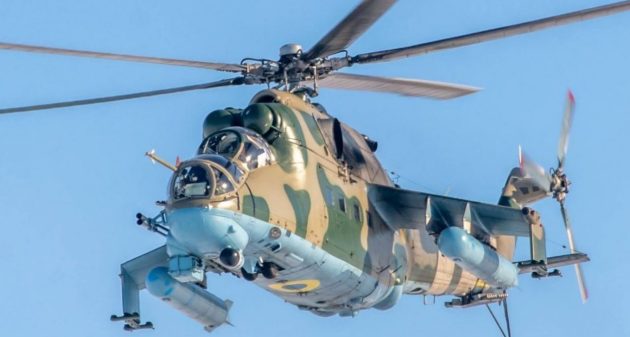
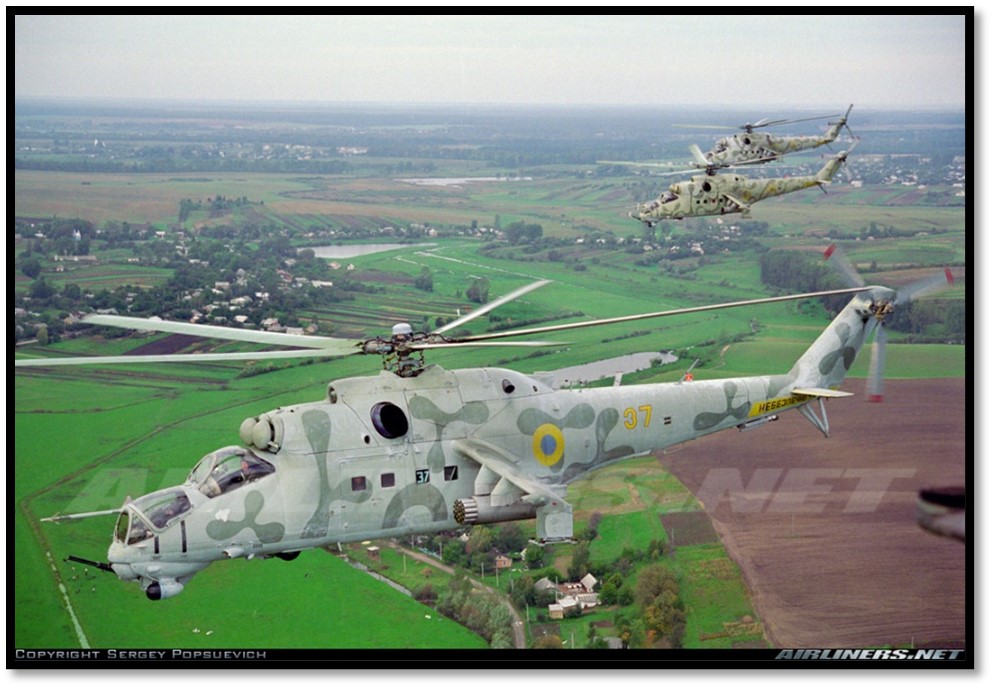
Ukrainian Mi-24P Hind-F/“Crocodile” gunship. Photo credit: General Staff of Ukraine.
“The tactic used by the Ukrainian (Mi-24) pilots is pretty clear: they have flown at ultra-low level to avoid detection by the Russian Aerospace Forces’ radars until they have reached the target area, where they have used what appears to be S-8 unguided rockets, before egressing the area at low level.” — David Cenciotti, The Aviationist, April 1, 2022.
The Russian Federation has aggressively employed its Mi-24/35M1 Hind-E/F (“Hind” is the British/Irish term for a doe, a female deer) helicopter gunships, its Mi-28N Havoc-Bs, and its newer, Ka-52 Hokum-B/Alligators during the ongoing invasion of Ukraine. They have lost at least 71 of these heavily-armed, attack helicopters (including 18 Mi-24/35s) so far to Ukrainian combat action, plus 12 more damaged.
Advertisement
The Ukrainian Army Aviation Service has been fighting back with its own fleet of Mi-24 Hinds. At the beginning of the 2022 invasion, they had 34 Hinds (now increased to 45) in service, also known to its pilots as the “Flying Tank” or the Krokodil (“Crocodile”), while Afghan insurgents have respectfully referred to it as Shaitan-Arba (“Satan’s Chariot.”) At least 15 Ukrainian Mi-24/35s have been confirmed as lost in combat (plus four damaged) over the past four years, with the latest loss on December 17, 2025.
The Ukrainian Army inventory consists primarily of Mi-24V Hind-E (with .50-caliber Gatling gun) and Mi-24P Hind-F (with a twin-barrel, 30mm cannon) models, with smaller numbers of Mi-24VP (armed with a twin-barrel, 23mm cannon in the chin turret) Hind-E Modified gunships, and eight or nine older Mi-24K/R Hind-G1/G2 reconnaissance variants. Those have been stripped of their special equipment and retrofitted with weapons.
There are also an unspecified number (probably a half-dozen) of locally-upgraded, Mi-24PU-1 Hind-F models produced in 2016 (three) and 2021 (second batch). These modernized aircraft have upgraded engines for more speed, power, and maneuverability, improved countermeasures systems, Polish THL-5NV helmets with PNL-3 night-vision goggles, Garmin GPSMAP-695 full-color GPS navigation systems, new gunsights, radios, and laser designators, all at an overall cost of $1.1 million per helicopter.
Advertisement
Ukraine’s Hind-E/F gunships are assigned to the 11th Separate Army Aviation Regiment at Kherson International Airport (10 to 12 aircraft), the 16th Separate Army Aviation Regiment (“Fighting Bees”) at Brody Air Base (10 to 12 aircraft), and the 7th Separate Army Aviation Brigade at Novyi Kalyniv Air Base (nine aircraft, with four more permanently deployed to Poltava Air Base, farther east.) These helicopters have been known to forward deploy to Kharkiv and Dnipro during recent combat operations.
The Hind-E/F attack helicopter is a long, sleek, heavily armed gunship that was introduced in the 1970s and rose to prominence during the Soviet-Afghan War of 1979 to 1989, where it was the most-feared helicopter in the world at that time. It has tandem cockpits for the pilot (in back) and weapon systems officer/gunner (in front) with bubble canopies, a passenger compartment (usually empty) for up to eight armed soldiers, twin, overhead, turbine engines, a five-blade main rotor assembly, and a three-blade tail rotor.
Advertisement
Considerable attention was paid to making it fast, including retracting tricycle landing gear to reduce drag. At high speeds, the small, stub wings provide one-quarter of the total lift of the aircraft. The Mi-24 fuselage is heavily armored, with titanium tubs around both cockpits and beneath the passenger cabin floor. It also has titanium rotor blades and ballistic-resistant windscreens, all capable of sustaining a direct hit from a .50-caliber machine gun with minimal damage.
The standard weapons load for Ukraine’s deadly “Crocodile” gunships consists of up to four B-8V20 20-round pods loaded with 80mm S-8 unguided rockets, although UPK-23-250 gun pods may be substituted. Each carries a twin-barrel, GSh-23L 23mm cannon with 250 rounds of ammunition. Bomb loads may include up to 10 220-pound iron bombs or four larger bombs for hitting hardened targets. Finally, either four or eight radio-command-guided, tube-launched, supersonic 9K114 Shturm (“Storm,” or AT-6B/C Spiral, in NATO terminology) anti-tank missiles may be carried on the outboard wing stations.
The Mi-24V Hind-E, introduced in 1976, mounts a rapid-fire, four-barrel, Yakushev-Borzov Yak-B 12.7mm (.50-caliber) Gatling gun in a rotating chin turret. It has 1,470 rounds of ammunition, aimed by the gunner’s monocular, helmet-mounted sight (HMS) and display system. The export version is designated the Mi-35 Monsoon.
Advertisement
The subsequent Mi-24P (“P” for Pushka, meaning “Cannon”) Hind-F model entered production in 1981, and replaced the nose-mounted, Gatling gun turret with a fixed, twin-barrel, 30mm GSh-30-2K autocannon on the right side of the cockpit area. It is otherwise unchanged from the Hind-E. The powerful, 30x165mm weapon is quite heavy and carries only 750 rounds of ammunition, with bone-jarring recoil.
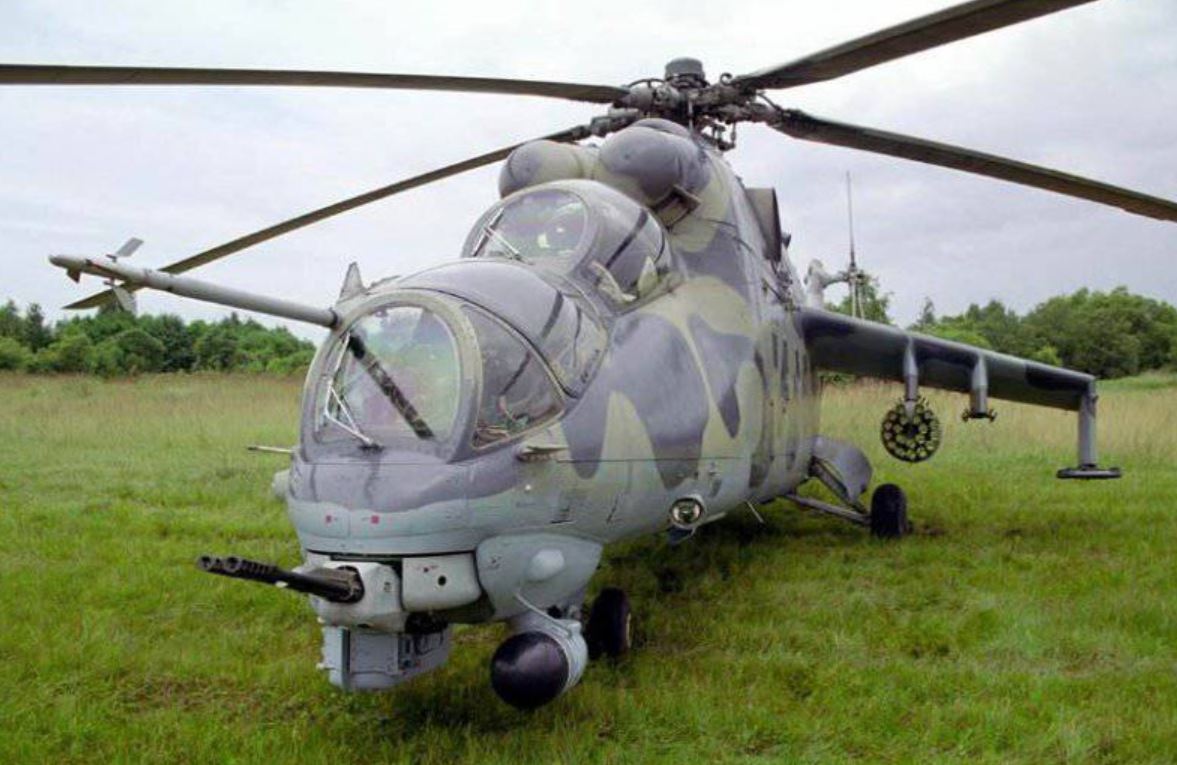
In 1989, the Mi-24VP Hind-E Modified was created, which was essentially a standard Hind-E; however, the small Gatling gun was replaced by a GSh-23L twin-barrel, 23mm cannon in the nose, with 450 rounds of ammunition. Ukraine has at least two of these gunships in its assault helicopter inventory.
Ukrainian Mi-24VP with 23mm nose cannon. Image Credit: topwar.ru
Ukrainian “Crocodile” aircrews wear the locally produced, full-sized, Fort-14TP service pistol in 9x18mm Makarov with a 4.84-inch barrel and 16+1 rounds of ammunition on their survival vests. This has been the standard-issue handgun of Ukrainian forces since 2014.
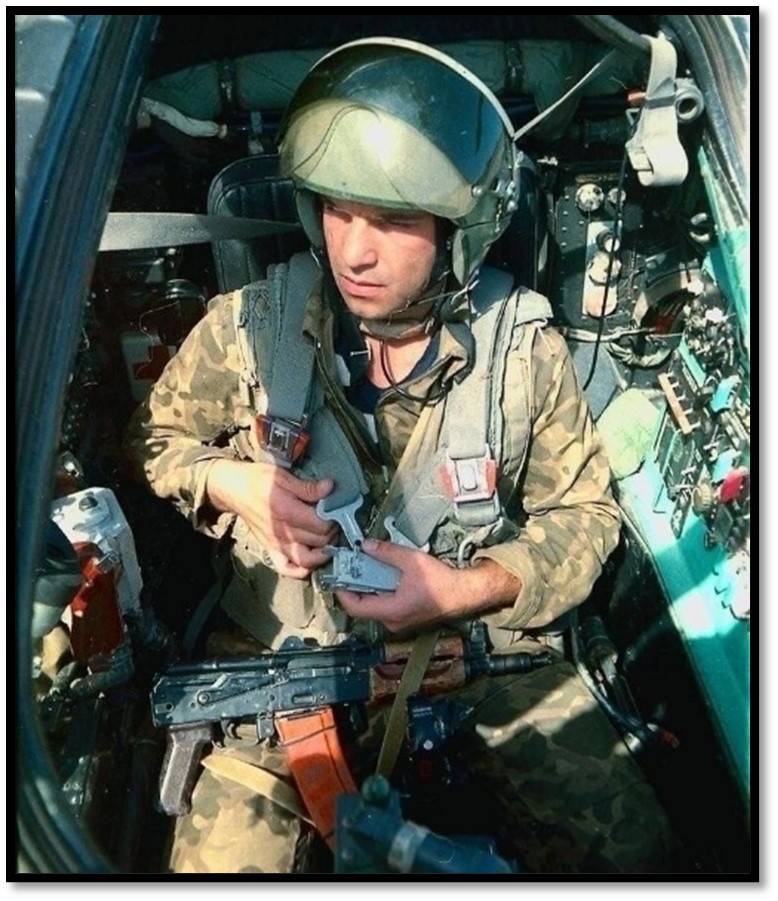
In addition, Russian Hind crews, and probably Ukrainians as well, typically carry the short, ultra-compact, Kalashnikov AKS-74U carbine. It is also favored by tank crews and SpetsNaz commandos in combat situations, shoved down beside their cockpit seats or across their chests as a personal-defense/survival weapon in case they are shot down in battle.
The AKS-74U, in service since 1979, is a six-pound weapon with an 8.1-inch barrel, measuring only 19.7 inches long with the side-folding stock folded. It uses 30-round magazines of 5.45x39mm ammunition. Kalashnikov has recently produced ultra-compact, AM-17 carbines to eventually replace the handy AKS-74U, but they have not yet been fielded in significant numbers, and are unpopular due to their polymer receivers. So, the older, combat-proven design continues to soldier on, even 32 years after production officially ended.
Russian Mi-24 Hind pilot, with folding-stock, AKS-74U carbine. Photo credit: slateblackinductries.com.
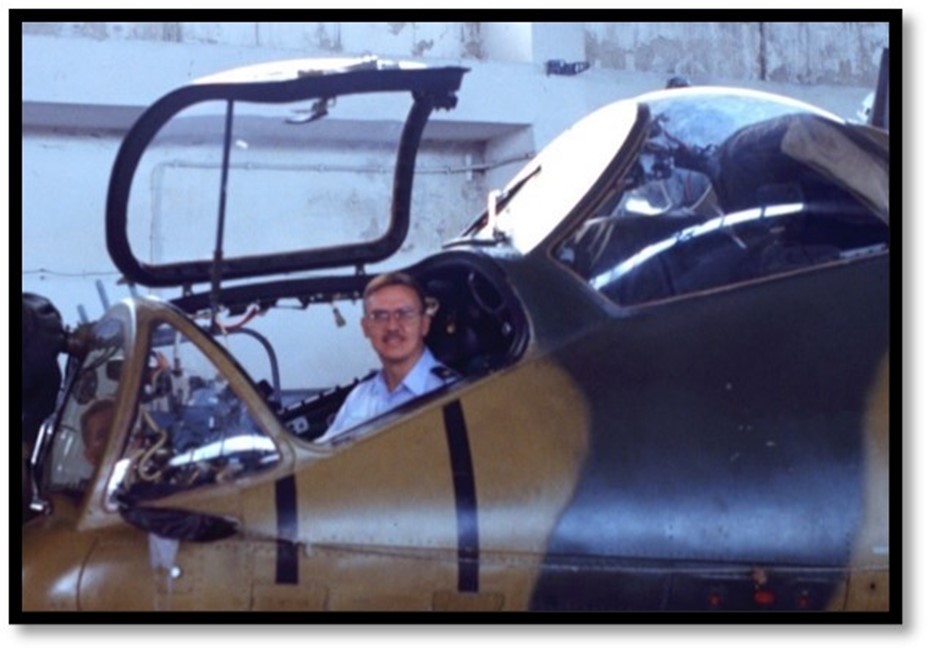
On July 20, 2000, this author had the opportunity to inspect and climb aboard an Mi-24V Hind-E of the 87th Combat Helicopter Regiment of the Hungarian Land Command at an air base near Veszprém, Hungary. Despite its age and lack of sophistication by modern standards, the Hind-E was still a potent, impressive, and very deadly machine. This unit was later disbanded in 2004.
Ukrainian “Crocodile” gunships definitely fought in the Battle of Hostomel in late February 2022, supporting a ferocious counter-assault against Russian paratroopers that seized Antonov Airport in the suburb of Hostomel, just outside Kyiv, with repeated rocket attacks.
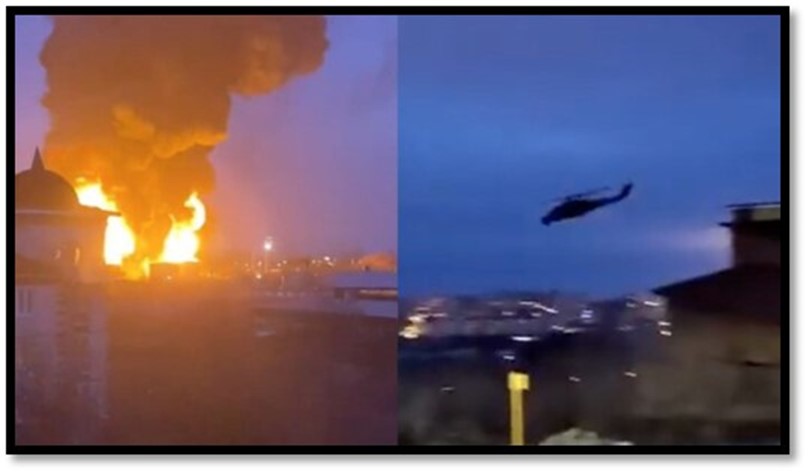
Then, at 5:00 AM on the morning of Friday, April 1, 2022 (“April Fools’ Day”), a pair of blacked-out, Ukrainian Mi-24 attack helicopters (probably upgraded Mi-24PU-1 models, flying from Kharkiv) attacked a large, oil-storage facility in Belgorod, Russia, 24 miles north of the Ukrainian border and 50 miles from Kharkiv, at very low altitude, firing salvoes of 80mm rockets and resulting in huge, impressive explosions from at least eight oil storage tanks. Only two Russians were injured, and no one was killed.
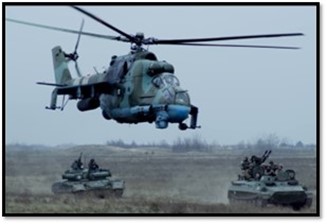
Ukrainian Mi-24P Hind attacking Belgorod, Russia, on April 1, 2022. Photo credit: Twitter.
This was an extremely daring and risky raid into heavily-defended, Russian airspace, a significant achievement by any standard, disrupting enemy fuel supplies and highly embarrassing the Russian armed forces and their air defense network.
But the Ukrainian government swiftly disavowed any responsibility for the incredibly audacious, pre-dawn attack, possibly to avoid escalation of the conflict. Ukrainian Foreign Minister Dmytro Kuleba said that, “I can neither confirm nor reject the claim that Ukraine was involved in this,” so the Mi-24 raid had all the earmarks of a low-key, plausibly-deniable, covert operation.
Later, on Thursday, May 26, 2022, the U.S. government officially announced that the Czech Air Force was donating its last remaining Hind gunships (five Mi-24Vs and 10 upgraded Mi-35s) to Ukraine in anticipation of soon receiving four AH-1Z Viper helicopter gunships and eight UH-1Y armed transports as used by the U.S. Navy. With the brutal Russian invasion dragging on and no end in sight, these well-maintained Czech aircraft were certainly a welcome addition to Ukraine’s vaunted “Crocodile” gunship fleet, boosting its numbers by a substantial 45 percent.
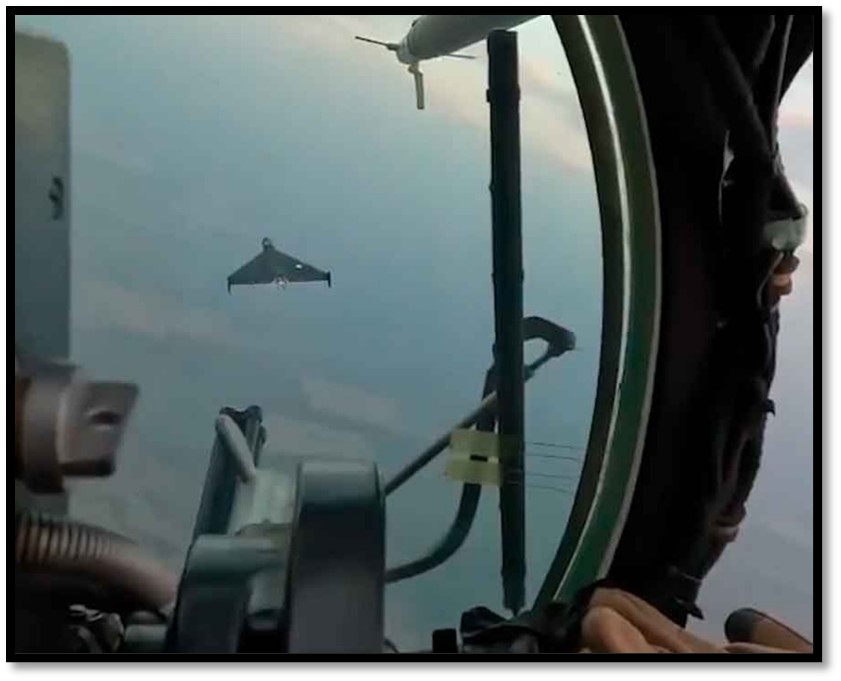
More recently, Ukrainian Mi-24V Hind-E attack helicopters have taken on the additional task of hunting Russian drones over Ukrainian territory, bringing down swarms of Shahed or Geran-2 drones with their .50-caliber Gatling guns. A helicopter can fly very close to a Russian drone, undetected, from behind, so closely that one or two short bursts are sufficient, and this eliminates the more costly necessity of shooting them down from the ground with missiles.
These drone-hunting, helicopter teams each consist of two Mi-24Vs and one Mi-8MTV-2 Hip-H transport, searching for aerial targets. The Mi-8 crew typically films the attacks for confirmation purposes.
Cockpit view from Mi-24V intercepting a Russian Geran-2 drone. The quad, Gatling-gun barrels are visible just below the drone. Photo credit: Telegram @infomil_live.
Ukraine’s aging Mi-24V/P Hind-E/F helicopter gunship fleet remains relevant and highly effective, even in the very latest combat action against the world’s most formidable adversary, the mighty Russian Federation, while the Russians have lost four times as many of their own attack helicopters in battle, due to flawed tactics and a frontal-assault mindset. This is a glowing testament to the courage, skill, tenacity, and bold determination of Ukrainian Mi-24 pilots in a seemingly endless war.
The author in a Hungarian Mi-24V Hind-E gunship, July 2000.
—
** Editor’s Note: Thinking about subscribing to SOFREP? You can support Veteran Journalism & do it now for only $1 for your first year. Pull the trigger on this amazing offer HERE. Final two days.– GDM
Advertisement
What readers are saying
Generating a quick summary of the conversation...
This summary is AI-generated. AI can make mistakes and this summary is not a replacement for reading the comments.










COMMENTS