

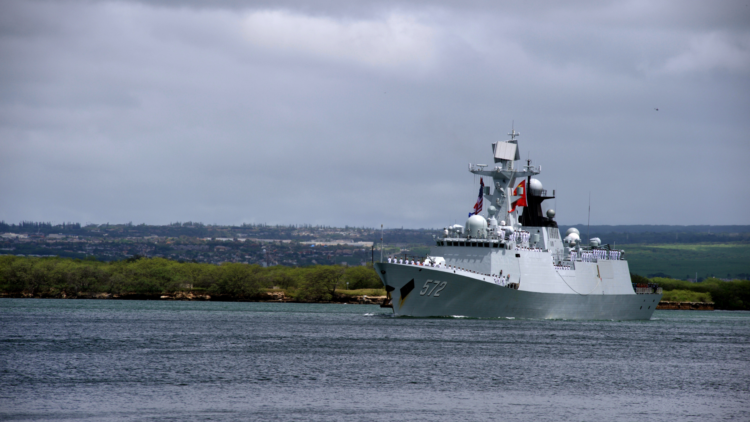
Additionally, both nations have clashed over disputed Chinese claims in the South China Sea, and there has been a struggle for influence in the South Pacific.
General Flynn pointed to specific incidents exemplifying China’s “more aggressive” behavior.
Last month, the United States released footage of a Chinese fighter plane dangerously approaching an American B-52 bomber, coming within three meters and posing a risk of collision.
Chinese coast guard vessels have also engaged in confrontations, ramming and using water cannons against Philippine boats in their exclusive economic zone.
China's military warns Philippines warship, intensifying tensions between the two nations
On October 30, the People’s Liberation Army (PLA) Southern Theatre Command claimed that a Philippine vessel "illegally entered" the waters around Huangyan Island, also known as Scarborough… pic.twitter.com/JOhNpdJCZg
— Spotlight on China (@spotlightoncn) November 1, 2023
General Flynn characterized these actions as “irresponsible,” “insidious,” and indicative of China’s increasing aggression.
US Response and Pacific Strategy
In response to China’s military rise and assertive behavior, the United States has been actively working to bolster alliances in the Asia-Pacific region.
General Flynn emphasized the importance of countering China’s perceived bullying of smaller neighbors, citing the US commitment to the region despite significant spending on conflicts in Ukraine and Gaza.
As part of its Asia-Pacific strategy, the US aims to strengthen partnerships and alliances to maintain stability and counterbalance China’s influence.
General Flynn expressed confidence in the resources available to him despite global conflicts, asserting that the US would continue its established path over the past few years.
He emphasized a desire to avoid further conflicts and underscored the United States’ commitment to the Pacific region.
Implications and Global Dynamics
The evolving dynamics between the US and China significantly affect global geopolitics.
As two of the world’s major powers vie for influence and supremacy, the Asia-Pacific region has become a focal point of strategic competition.
The rise of China’s military capabilities, coupled with its assertive behavior, poses challenges to regional stability and the established balance of power.
The incidents highlighted by General Flynn, such as close encounters between military aircraft and confrontations at sea, underscore the potential for unintended escalation and the need for diplomatic solutions.
Watch below General Charles Flynn’s previous interview with Hudson Senior Fellows last September, where they discussed the important role of the US Army in the Indo-Pacific region and how long-term campaigning can help America compete with and deter China.
The ongoing struggle for dominance in the South China Sea, coupled with China’s claims on Taiwan, adds layers of complexity to an already tense situation.
The United States’ commitment to strengthening alliances in the region reflects a broader strategy to counterbalance China’s influence. However, this approach requires careful navigation, as it seeks to maintain stability without escalating conflicts further.
The global community watches closely as the US-China rivalry unfolds, knowing that the repercussions extend beyond the Pacific.
~
General Charles Flynn’s recent remarks offer a sobering assessment of China’s military trajectory and its implications for the Pacific region.
The combination of rapid advancements in China’s military capabilities and an increasingly assertive stance raises concerns about the potential for escalation and conflict.
As the US seeks to navigate this complex landscape, the importance of diplomacy, strategic alliances, and a nuanced approach cannot be overstated.
The evolving dynamics between the two superpowers will continue to shape the future of global geopolitics, with the Asia-Pacific region serving as a critical arena for their strategic competition.
—
Check out:










COMMENTS