

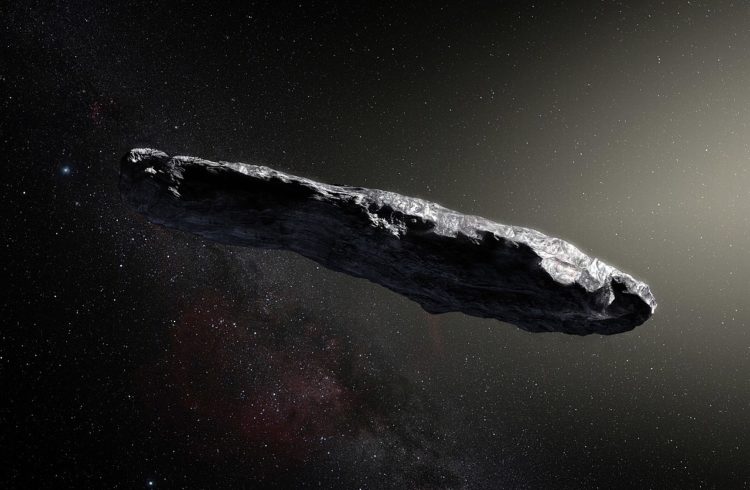

“It was really fast, and so I was like: ‘Oh my God, this could be an interstellar meteor,’” Siraj said. “It was hiding in plain sight. It wasn’t that we had to dig to find this database. It was more that there hadn’t been an interstellar object until 2017. As a result, no one had a reason to think that there could be meteors that were from outside of the solar system.”
Siraj mapped out the path of the object and discovered its orbit was unbound. This means that rather than revolving around the sun, it had been slingshotted from outside our solar system.
“Presumably, it was produced by another star, got kicked out of that star’s planetary system, and just so happened to make its way to our solar system and collide with Earth,” Siraj said.
Meteor Research is Now Out of Limbo
Siraj and Loeb submitted their findings to The Astrophysical Journal Letters but were later declined because of missing data withheld from the CNEOS database.
This is because the sensors that detect meteors are used by the Pentagon. The same technologies are used to monitor the skies for possible nuclear warheads. The classified data sent the research into limbo as Siraj and Loeb tried to get the US government to confirm their findings.
After years of navigating government bureaucracy, they finally received official verification that CNEOS 2014-01-08 was indeed interstellar. The confirmation came from the Deputy Commander of Space Command, John Shaw.
“Dr. Joel Mozer, the Chief Scientist of Space Operations Command, the United States Space Force service component of U.S. Space Command, reviewed analysis of additional data available to the Department of Defense related to this finding. Dr. Mozer confirmed that the velocity estimate reported to NASA is sufficiently accurate to indicate an interstellar trajectory,” wrote Shaw in the letter.
The news came as a surprise to Siraj, who had already moved on to other research.
“I thought that we would never learn the true nature of this meteor, that it was just blocked somewhere in the government after our many tries, and so actually seeing that letter from the Department of Defense with my eyes was a really incredible moment,” Siraj said.
Unfinished Business
Since hearing the news of the confirmation, Siraj has assembled a team to renew efforts that will hopefully get their research published this time around. He believes that the scientific community can build upon their initial findings with more specialized research.
“Given how infrequent interstellar meteors are, extra-galactic meteors are going to be even rarer,” Siraj warned.
”But the fact of the matter is, going forward, we won’t find anything unless we look for it. We might as well take it upon ourselves as scientists to build a network as extensive as the U.S government’s sensor network, and use it for the purposes of science and fully use the atmosphere.”








_Loeb.jpg)
COMMENTS