

Navy officials and industry leaders described the results as a key step toward operational readiness.
The Navy’s Most Unconventional Destroyer
USS Zumwalt has never fit neatly into traditional categories. Named after Admiral Elmo Zumwalt, the former chief of naval operations who championed innovation and reform, the ship was designed from the keel up to challenge assumptions about surface warfare.
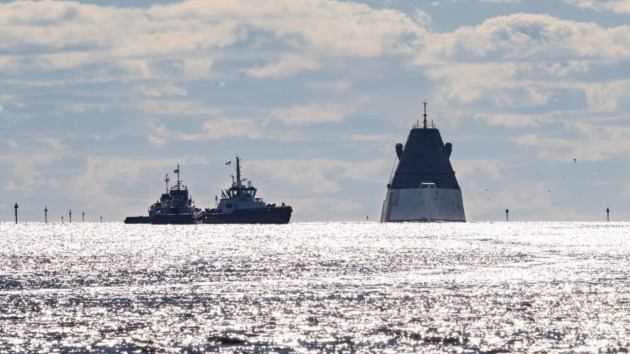
At 600 feet long with a displacement of about 16,000 tons, Zumwalt is one of the largest destroyers ever built for the Navy. Its wave-piercing tumblehome hull and enclosed deckhouse sharply reduce radar signature, giving it a profile often compared to that of a small fishing boat. Automation allows the ship to operate with a crew of roughly 158 sailors, far fewer than earlier destroyers.
Powering the ship is an integrated electric propulsion system driven by Rolls-Royce MT30 gas turbines that generate up to 78 megawatts of electricity. That output supports propulsion speeds above 30 knots and feeds advanced sensors, combat systems, and future weapons.
The ship also carries 80 vertical launch cells and aviation facilities for helicopters such as the MH-60R Seahawk, reinforcing its multi-mission design.
From Costly Experiment to Hypersonic Platform
The path to this point has been long. Laid down at Bath Iron Works in 2011, Zumwalt launched in 2013 and commissioned in October 2016. Early sea trials in 2015 highlighted both its promise and its complexity. Homeported in San Diego, the ship joined the Pacific Fleet and completed its first operational deployment in 2022.
Yet the class faced sustained criticism. High costs and shifting requirements reduced the planned fleet to just three ships. The lack of an effective main gun mission left questions about relevance.
The decision to convert the class into hypersonic strike platforms fundamentally altered that trajectory.
With the installation of CPS missile tubes, Zumwalt now occupies a unique niche. The destroyer is positioned to deliver fast, long-range conventional strikes, adding a new dimension to surface warfare and giving combatant commanders a powerful option short of nuclear weapons.
What Comes Next
Following the completion of builder’s sea trials, Zumwalt remains at Ingalls Shipbuilding for post-trial inspections and evaluations. Navy and industry teams are reviewing data from the tests and finalizing preparations before the ship returns to operational service.
Once back with the fleet in San Diego, Zumwalt will resume underway operations as the first of its class configured for hypersonic missions. Similar upgrades are underway or planned for the remaining Zumwalt-class destroyers, extending the transformation across the small but high-profile fleet.
USS Zumwalt (DDG 1000) Zumwalt-class guided missile destroyer coming back into Pascagoula, Mississippi from sea trials – January 16, 2026 SRC: FB- Justin Brewster pic.twitter.com/nzvV683OBD
— WarshipCam (@WarshipCam) January 16, 2026
For a ship that has spent much of its life as a symbol of ambitious design and unfinished promise, the latest trials mark a turning point. USS Zumwalt is no longer an experiment searching for a mission. It is emerging as a frontline platform built for the Navy’s next generation of warfare.








COMMENTS