You do not get to choose your defenders.
You never forget the first time a GRAD rocket lands close enough that you feel it in your chest. The Russians named the system Grad, hail, but the sound is closer to an old Soviet song played in reverse. Katyusha as a funeral hymn. First the whistle. Then the pause. Then the earth lifts and cracks.
It was May 2022. I was fighting with the Norman Brigade near Velyka Novosilka, dug deep into a trench line we hoped was sufficient. A full salvo can erase a grid square. That day, the rockets landed two to three hundred meters west of us. Close enough to pray. I did. We survived.
We were not the intended target.
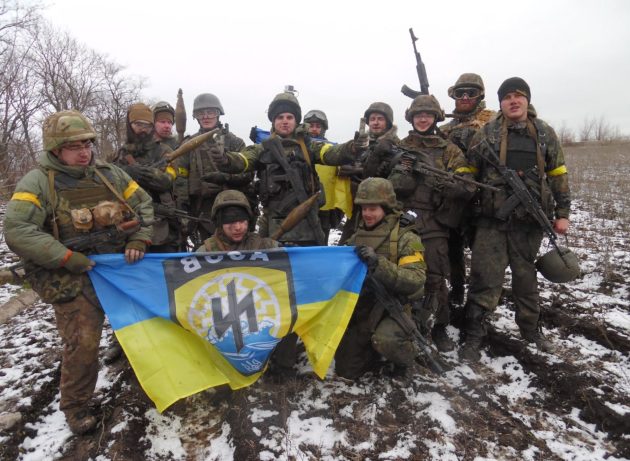
Most of the bombardment fell a kilometer farther west, where Azov was dug in on the high ground. That hill dominated the entire area of operations. If the Russians had taken it, Velyka Novosilka would have become a shooting gallery. Eighty miles southeast, in Mariupol, another contingent of Azov was making its last stand inside Azovstal, bleeding onto steel and concrete so the rest of Ukraine could consolidate its defenses. That delay mattered. Wars are often decided by who buys time at the highest cost.
This is the part many on the Western left refuse to confront honestly.
I have written at length about the far right in Ukraine. The history matters. Yes, Azov emerged in 2014 as a far-right movement. When a state is collapsing, when oligarchs are funding militias and prison doors are being opened, you do not get to curate defenders through the moral lens of a Berkeley seminar. You take the men willing to stand and fight, because the alternative is national death.
Yet a decade later, critics still recycle the same claim. Ukraine is a Nazi sympathizing state run by a Jewish president, with Azov as proof. The argument is stale, intellectually lazy, and strategically useless.
I have worked alongside Azov fighters. I have shared trenches with them. In 2025, Azov is not what it was in 2014. Its politics have been diluted by mass mobilization, institutional pressure, and war itself. Does far-right residue still exist in parts of the movement? Yes. War does not purify men. It concentrates them. But that is not the question that matters.
Here is a better way to understand Azov.
Imagine Ukraine in 2014 as a thirteen-year-old boy trapped in an abusive household. The mother is trying to leave. The father, Russia, has always beaten the child. The neighbors know it is happening, but do not want to get involved.
Already have an account? Sign In
Two ways to continue to read this article.
Subscribe
$1.99
every 4 weeks
- Unlimited access to all articles
- Support independent journalism
- Ad-free reading experience
Subscribe Now
Recurring Monthly. Cancel Anytime.
Azov is the older brother who ran away at sixteen. He is rough. Tattooed. Smokes cigarettes. Listens to punk. He learned early that nobody was coming to help. When the father comes back and starts beating the younger brother again, the older brother shows up and puts him on the ground.
After that, the older brother sticks around. Not because he is perfect, but because he is present. He steps in every single time the beating starts again. No speeches. No hesitation. Meanwhile, the neighbors hold meetings about values.
Would you love that brother?
That is the question Western critics never answer, because answering it requires abandoning the luxury of moral distance. Azov exists because Ukraine was left alone when it mattered most. You do not get to manufacture saints in a war of survival. You get men who stand, and you judge them in motion, not from the safety of peace.
History will decide what Azov becomes. Anyone who wants to understand why it exists must first understand what it did, under fire, on terrain that mattered, while others debated whether Ukraine was worth defending at all.










COMMENTS