

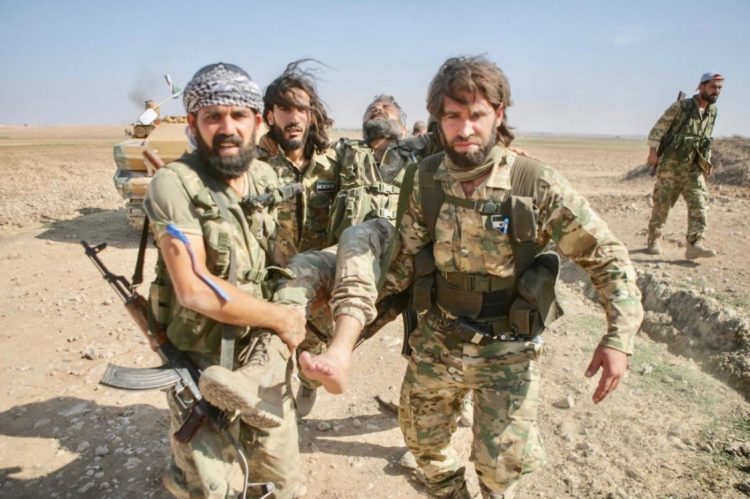
Iran and Russia, while seemingly on the same side of this conflict, have different priorities. Although both are fighting to protect the Assad regime, Assad is much more important to Tehran than to Moscow, despite outward appearances.
Intelligence analysts tend to believe that the Iranians have become increasingly more influential in Assad’s inner circle. Iran needs to have the major highways under the control of the Syrian government so it can use them as a land bridge to funnel arms and missiles from Iran, through Iraq and Syria to its proxies in Lebanon.
The Russians have long been an ally of Syria and they want to maintain their control over the Syrian ports as well as their strategic airbases in the country. Through the years, they’ve carefully cultivated many high-ranking military officers. With Assad becoming more influenced by Tehran, he could quickly become replaceable.
Putin has seen that the Turkish hand was forced and that Turkey was willing to go to war. It has flooded troops over the border and has shown that it will not back down. Russia has worked hard to create a relationship with Ankara and Erdogan in order to subvert the influence that the U.S. has with the government. Putin doesn’t want to risk that over Idlib, especially since the Turks haven’t shown any inclination of moving further into Syria, something which would threaten Assad’s regime.
With Russia now reducing its presence in the area, especially the provision of a protective umbrella of air cover for the Syrian army and Iranian proxies, Syrian hopes of pushing into Idlib have now ground to a halt. The Iranians know they can’t sustain any long-term military operation as their economy is a mess, especially with the crippling U.S. sanctions. To top things off, Iran is facing increasing protests against the regime and an epidemic of coronavirus, which just adds to its woes.
The Iranians misjudged what the Turkish and Russian response would be and are now struggling to come up with alternatives. Some believe that the Russians played this perfectly since the bloody nose the Syrians suffered could lessen the influence that Quds Force have within the government.
Tehran is now struggling to counter the Russian ceasefire and is trying to involve Turkey directly in talks. While the Iranians weren’t invited to the meeting in Moscow, their foreign ministry has invited both Assad and Turkey to a meeting, freezing out the Russians.
What is the purpose of this proposed meeting? It seems to be mainly a power play by Tehran to keep their influence over Assad and downplay the Russians’ ability to push them further from the source of power.
But Iran’s ability to project power with the Quds Force, without the protection of the Russian Air Force in Idlib, is pretty much non-existent at this point. Iran knows that if it and the Syrians attempt to take on the Turkish military they’d take a beating. Therefore, they are now going to try the end-around and engage Turkey and Syria politically.
It will be intriguing to see if the ceasefire in Idlib holds up. Most analysts don’t believe it will. It is doubtful that the Russians or Turks, who have agreed to joint patrols will break it. So, would the rebel forces engage the Syrian army? Or will the Syrians or Iranian proxies try to inflame the violence again? That could be a risky proposition for the Assad regime.








COMMENTS