

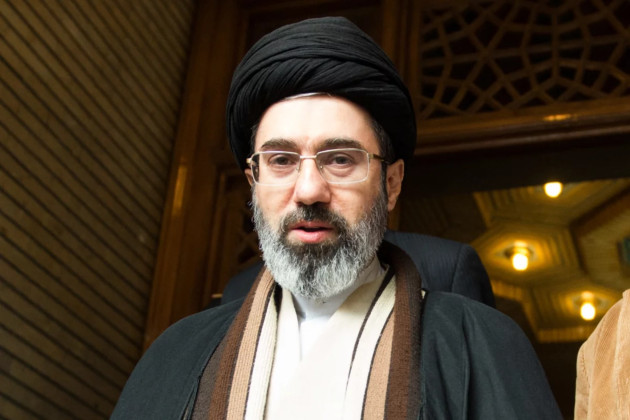
That role gave Mojtaba unusual influence despite his relatively modest clerical rank. It also meant that many of the relationships shaping his rise formed within the institutions responsible for enforcing the Islamic Republic’s authority.
When the regime faced a sudden leadership crisis, those networks moved quickly.
War Credentials and Revolutionary Networks
Like many sons of Iran’s revolutionary elite, Mojtaba Khamenei’s early biography includes service during the Iran–Iraq War. Open-source reporting indicates that he volunteered with the Revolutionary Guard during the final phase of the war, reportedly serving with the 27th Mohammad Rasulullah Division, a Tehran-based formation that participated in some of the conflict’s most intense campaigns.
Few detailed accounts of Mojtaba Khamenei’s wartime activities appear in public sources. Profiles published over the years acknowledge that he volunteered during the conflict but provide little description of his role in the field. That absence is notable in a political system that routinely elevates the battlefield exploits of Revolutionary Guard commanders as proof of revolutionary credibility.
The Iran–Iraq War remains the defining formative experience for a generation of Iranian leaders. Commanders who fought in the conflict went on to dominate key positions across the country’s military, intelligence, and economic institutions. Within the Revolutionary Guard, wartime service functions as a powerful source of political legitimacy, and the regime has long celebrated its war veterans as symbols of sacrifice and national resistance.
Against that backdrop, the lack of detailed accounts surrounding Mojtaba’s participation suggests his wartime presence may have carried more symbolic than operational significance. Even so, service within a Guard formation during the conflict placed him inside the networks that later shaped much of Iran’s security establishment.
Mojtaba’s association with those networks appears to have created relationships that endured long after the war ended. As the Guard expanded its influence across Iran’s political system in the decades that followed, figures connected to its leadership gained increasing importance inside the regime’s inner circles.
Those connections help explain why the Guard’s leadership responded quickly after the strike that killed Ali Khamenei.
The Security State Candidate
The Islamic Republic’s first Supreme Leader, Ruhollah Khomeini, derived authority primarily from religious scholarship and revolutionary charisma. Ali Khamenei, who succeeded him in 1989, relied on a combination of clerical status and political experience gained during his years as president.
Mojtaba represents a different model.
His influence developed less through Iran’s traditional clerical hierarchy than through proximity to the institutions that enforce the regime’s survival. While he pursued religious studies in Qom and holds the clerical rank of Hojatoleslam, he never achieved the scholarly stature typically associated with the highest levels of religious authority.
Instead, Mojtaba built influence through the networks surrounding the Supreme Leader’s office and the security institutions that support it. For years analysts of Iranian politics described him as a central figure linking the clerical leadership to the Revolutionary Guard’s expanding political and economic apparatus.
That reputation shaped the response to his succession. Rather than debating alternative candidates drawn from the senior clerical establishment, the regime’s power structure rallied behind a figure whose authority rested firmly within the security ecosystem that sustains the Islamic Republic.
In choosing Mojtaba Khamenei, the regime effectively signaled that the future of the system would depend less on religious consensus and more on the institutions capable of preserving it.
Aghazadehs and the Legitimacy Problem
Mojtaba Khamenei also inherits a legitimacy problem that has been building inside Iran for years. Many Iranians increasingly use the term aghazadeh to describe the children of powerful officials who enjoy wealth and privilege far removed from the economic realities faced by the broader population.
The phrase has become shorthand for a ruling class that demands sacrifice from the public while maintaining access to international wealth and influence. Images of elite families traveling abroad, studying in Western universities, or appearing in luxury settings in cities such as Dubai and Monaco periodically circulate across Iranian social media and often provoke widespread anger.
Investigative reporting has reinforced those perceptions. A recent inquiry by Bloomberg traced a network of overseas investments linked to intermediaries associated with Mojtaba Khamenei, including high-value property in London and real estate in Dubai. The assets were not held directly in his name but through layers of corporate ownership and trusted associates.
Such arrangements are not unusual for wealthy individuals operating under international sanctions. Nevertheless, they reinforce a broader perception inside Iran that members of the political elite maintain access to global wealth even as ordinary citizens face inflation, sanctions, and economic stagnation.
For a regime that built its identity on revolutionary austerity and opposition to the excesses of the Shah’s monarchy, that perception has created a growing credibility problem.
Mojtaba now inherits that problem as well.
(Editor’s note: This compelling Instagram content exposes the hypocrisy of Iran’s elite. Children of IRGC commanders and regime officials, including Khamenei family members, often live lavish, unveiled lives abroad in places like Dubai, London, Monaco, Europe, and the US, flaunting supercars, yachts, parties, and Western freedoms denied to ordinary Iranians. Viral reels highlight this stark contrast amid repression and hardship at home. It underscores a regime that has become a hereditary dictatorship under Mojtaba Khamenei, the opposite of the 1979 Revolution’s fight against dynastic rule and corruption.)
View this post on Instagram
What the Succession Means
Mojtaba Khamenei assumes leadership at a moment when Iran’s security establishment faces intense external pressure. Months of military strikes and covert operations have targeted elements of the Revolutionary Guard and the infrastructure supporting it.
The Guard remains the most powerful institution in the Islamic Republic, but the conflict has exposed vulnerabilities within the system that sustains the regime’s authority. In that environment, Mojtaba’s elevation may represent an attempt to consolidate the state around the institutions most capable of maintaining internal control.
His long association with Guard networks may strengthen the cohesion of the security establishment during the immediate crisis. Yet the strategy carries risks. A Supreme Leader closely identified with the regime’s coercive core may also reinforce the perception among Iran’s adversaries that the leadership itself forms part of the security architecture they are attempting to weaken.
Early signals from Washington suggest that Mojtaba’s elevation has done little to ease tensions. Recent reporting indicates that Donald Trump reacted negatively to the decision, viewing the succession as evidence that Tehran intends to double down on confrontation rather than pursue negotiations.
If that perception takes hold, Mojtaba’s rise could narrow the already limited space for diplomacy between Iran and its adversaries.
The Risks of Choosing a Hardliner
The regime chose Mojtaba Khamenei because he represents continuity with the security state that has sustained the Islamic Republic for decades. His rise consolidates the Revolutionary Guard’s influence and signals that Tehran intends to fight rather than compromise.
But that decision carries consequences.
To the United States and Israel, Mojtaba is not simply a cleric who inherited power. He is a long-standing participant in the security apparatus they are trying to dismantle.
If Operation Epic Fury continues to focus on the leadership structure of the regime, Mojtaba Khamenei will almost certainly rank near the top of that list.
The Islamic Republic believes it hardened itself by choosing him.
It may have only clarified the next target.








COMMENTS