


The Pentagon and Space Force emphasized that commanders are expected to maintain the highest standards of conduct, particularly regarding nonpartisanship. The Pentagon’s chief spokesperson, Sean Parnell, issued a public statement declaring, “Actions to undermine the chain of command or to subvert President Trump’s agenda will not be tolerated at the Department of Defense”. This statement was widely shared on social media and in official press releases, making clear the zero-tolerance policy for any perceived deviation from the administration’s policies by military leaders.
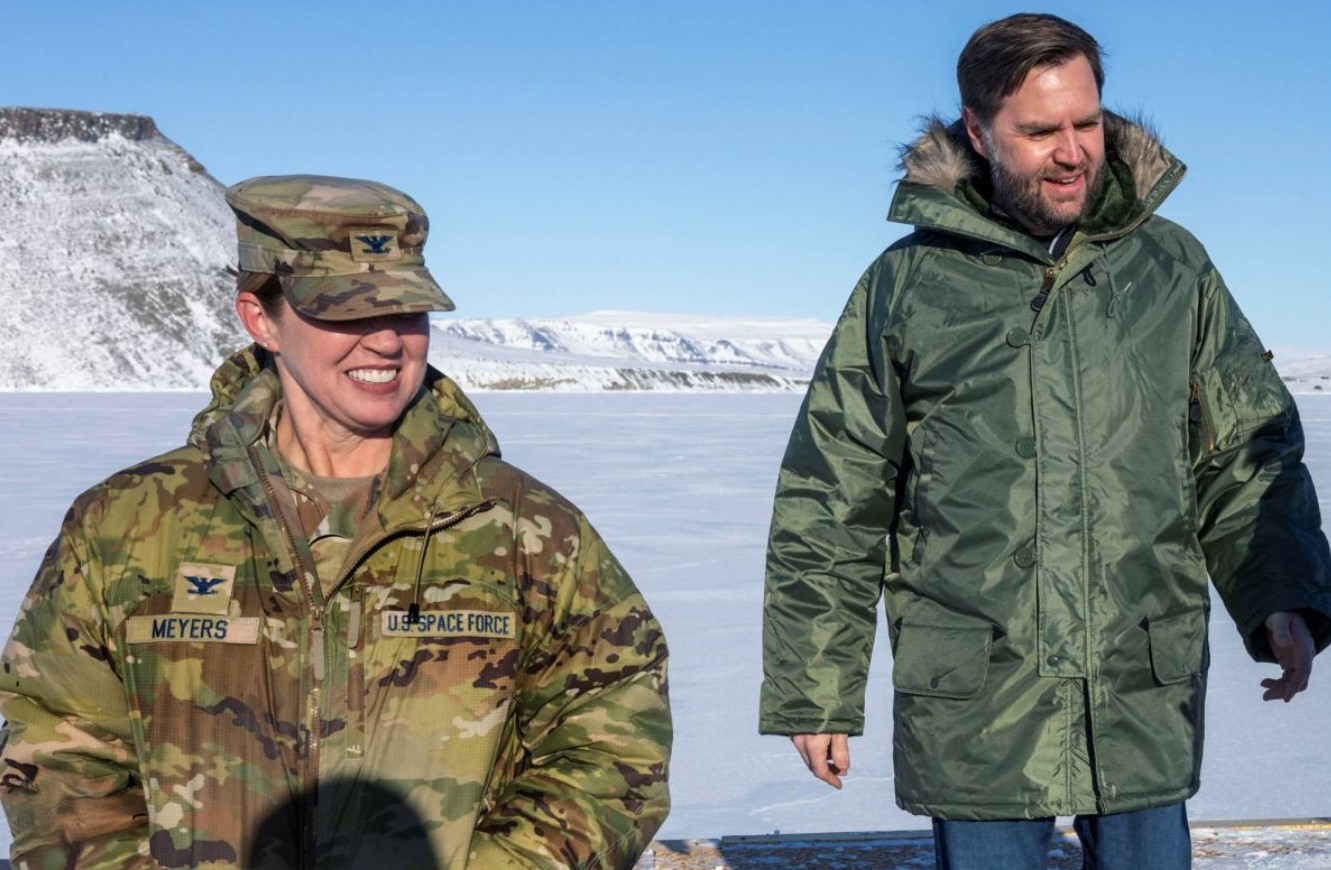
Colonel Kenneth Klock, commander of Space Base Delta 1, made the official decision to remove Meyers, and Colonel Shawn Lee was immediately appointed as her replacement. Meyers was reassigned from Space Operations Command and removed from all leadership responsibilities. The Pentagon’s rapid action demonstrated its commitment to enforcing civilian control and political neutrality within the military chain of command.
Broader Implications
The removal of Colonel Meyers from command at Pituffik Space Base in Greenland has broader implications that reach beyond the individual case. It highlights key issues in civil-military relations, military leadership, domestic politics, and international diplomacy. One of the most striking aspects is how clearly the Pentagon reinforced its expectation that military leaders remain strictly nonpartisan. They spared no time in swinging the axe. No warning shots were fired.
The incident also underlines the principle of civilian control over the military. Even though Meyers’ intent appeared to be maintaining morale among a diverse and multinational staff, her email was viewed as stepping outside the bounds of acceptable conduct. This signals that any perceived disagreement with the administration, even in private or internal communication, may lead to swift disciplinary action. Anyone paying attention to the news over the past several months should be aware of this.
Domestically, the case quickly became politicized. Republican lawmakers called for investigations, while Pentagon officials reaffirmed their alignment with President Trump’s policies. This points to a growing trend in which military leadership decisions are entangled with partisan politics. It also sets a precedent—commanders may now feel they must avoid even subtle expressions of disagreement with civilian leaders to protect their careers.
Internationally, the removal of Meyers could strain relationships with key Arctic allies. Her original message aimed to reassure Danish, Greenlandic, and Canadian personnel after the Vice President criticized Denmark’s stewardship of Greenland. Instead of smoothing tensions, her dismissal may now send a signal that the U.S. military leadership will prioritize political alignment over diplomatic sensitivity.
This could complicate relations with allies and shape how both partners and adversaries perceive the reliability and independence of U.S. military leaders stationed abroad.
Greenland, a semi-autonomous territory of Denmark, has expressed opposition to U.S. acquisition, with a majority of Greenlanders favoring independence but not U.S. control.
Looking Forward
Colonel Meyers’ removal highlights the tension between military leadership and political agendas. Her attempt to maintain unity among international personnel at Pituffik Space Base clashed directly with the administration’s objectives, leading to her dismissal. Surely the colonel didn’t think she could say what she did, in a widely distributed email, and think she would have no repercussions. In today’s world, words have consequences.
As the U.S. continues to assert its interests in the Arctic, the balance between military professionalism and political directives remains a contentious issue, and SOFREP will be there to cover all future fallout.








COMMENTS