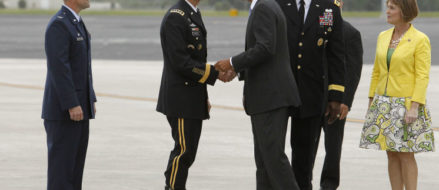
Washington, D.C. – In what was billed as the final major national security address of his administration, President Barack Obama took a victory lap for his counterterrorism achievements in remarks made to Special Operations and Central Command officials at MacDill Air Force Base. The Dec. 6 speech also doubled a thinly veiled rebuttal to the […]
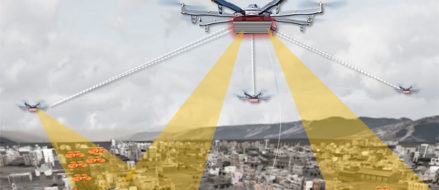
Our air traffic control system successfully monitors thousands of aircraft per day. Yet, no such system for monitoring drones exists, yet. And UAVs are not required to report their location, as aircraft does. Even so, drones are quickly becoming ubiquitous in our society, making it less likely for us to know if the flier has ill intentions, until it’s too late. A group of no-goodniks could easily fly an explosive-laden drone, or half a dozen of them, into an office building, a park, city square, or even a stadium full of spectators.
Looking largely “over there.” Both nominees are focused on transnational terrorism, especially the threat from the Islamic State group. Clinton proposes ongoing air strikes, working with local forces in Iraq and Syria, and collaborating with allies to dismantle “the global network of terror that supplies money, arms, propaganda, and fighters.”
Trump wants to “bomb the shit out of them,” and as he said in his terrorism speech, “aggressively pursue joint and coalition military operations to crush and destroy [the Islamic State group], international cooperation to cut off their funding, expanded intelligence sharing and cyberwarfare to disrupt and disable their propaganda and recruiting.”
Even their plans for the Islamic State group are nearly identical. When it comes to counterterrorism, the Democratic and Republican nominees are presenting the same ideas, couched in language tailored to different parts of the electorate. And therein lies a much more troubling fact – it’s not just what they’re saying; it’s what they’re not saying.
Muslim officers working for London’s Metropolitan Police were often racist toward white officers. But few people take seriously the claim that a minority can be racist against a non-minority. What’s often called “reverse racism” is dismissed as being racist itself. The conversation, it would seem, is closed on this issue. Only whites can be racist. If minorities have negative views of whites, it must be because of their history of oppression.
Dealing with a terrorist threat that is more atomized and pervasive will require a new approach — one that relies much more on communities, families, peers, and those closest to would-be terrorists. Law enforcement agencies can arrest suspected terrorists, but they cannot extinguish the underlying ideologies and grievances that motivate scores of recruits to join extremist groups and that elicit the sympathies of many more. Preventing future attacks, then, will mean empowering communities to detect threats to public safety and intervene quickly to deflect someone from the path of radicalization.
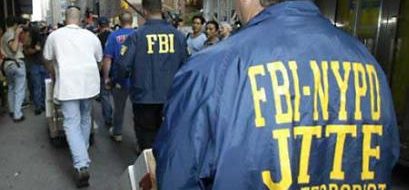
The Intelligence Division Undercover [UC] Program is arguably the most unique in the world. It consisted of young officers – typically 22-26 years old – almost all born abroad or first generation Americans, all U.S. citizens, and all with native fluency in languages ranging from Bengali to Urdu. Over time, the cadre consisted of men and women with roots in over a dozen countries, mostly South Asia, the Middle East, and North Africa. Instead of using experienced detectives who couldn’t blend in with investigative subjects, these rookies entered the Department via the Intelligence Division rather than the Police Academy. Hand chosen, they were smart, highly motivated, and fully understanding of the complexity of what they were about to do as professionals.
Interior Minister Bernard Cazeneuve said that Wednesday’s arrest was part of French authorities’ efforts to target people vulnerable to “calls to carry out killings, led by a certain number of actors in Syria.” But he didn’t elaborate on any direct links between the boy and the IS group.
The extremist group “uses encrypted means to encourage increasingly young” individuals, he said, citing the messaging application Telegram.
France is currently in “an exceptional level of mobilization” following two failed attacks in six days, he added.
“Every day, the intelligence services, the police, gendarmes, are foiling attacks, unraveling Iraqi-Syrian networks. The threat today is maximum and we are a target, everyone understands that.”
Valls said 700 French jihadis were believed to be fighting with Islamic State in Syria, among them more than 200 women. French intelligence services were watching 15,000 people suspected of being radicalized.
The Defense Department’s own Africa Center for Strategic Studies, a research institution dedicated to the analysis of security issues on that continent, drew attention to skyrocketing terrorism fatalities there in recent years. It also published a map of “Africa’s Active Militant Islamist Groups” that showed 22 organizations menacing the continent
Investigators have discovered mortar round shrapnel and the remnants of an IED in the preliminary findings of the post-blast analysis from the scene of the explosion. Bunching munitions together, such as mortar round, and tying them together, most typically on an electrical circuit/initiation system, and in conjunction with land mines, artillery shells, and/or homemade explosives (HME), such as pentaerythritol tetranitrate, more commonly referred to as PETN.
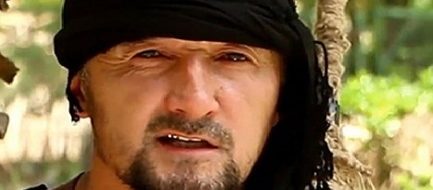
Col. Gulmurod Khalimov, a former Tajik special operations officer, police commander, and military sniper, received American counterterrorism training before joining ranks of jihadi group in May • State Department says Khalimov is a “key” ISIS leader.