
The Taliban’s letter added that ”The Islamic Emirate [of Afghanistan] does not consider the multiplicity of jihadi ranks beneficial either for jihad or for Muslims.” It continued: “Your decisions made from a distance will result in [the Islamic State] losing support of religious scholars, mujahideen… and in order to defend its achievements the Islamic Emirate will be forced to react.” The letter was signed by the Taliban’s deputy leader Mullah Akhtar Muhammad Mansoor. (Panda, The Diplomat, June 18)
The fight against the Afghan insurgency
“Two men enter. One man leaves.”—Mad Max 3, “Beyond Thunderdome”
The Afghan insurgency has proven to be made up of a resilient force. They often battle their enemies in sandals with rusty rifles and little support. It is important to note here that the misinterpretation of the Afghan insurgency as a single entity and the application of the term Taliban as a catch-all reference to a monolithic force is a misinterpretation of the threat against the Afghan national government.
The attribution of Taliban as an umbrella term for what is at best a cobbled and loose national alliance of anti-government forces does a disservice to analytical understanding of the threat to the Afghan government. The insistence on characterizing the threat to the Kabul government as a movement further erodes understanding of the individual (and oftentimes competing) motivations of the myriad groups that constitute the “insurgency” as a whole.
The conflation of the terms Taliban and Afghan insurgency has done a disservice to understanding the motivations and goals of other groups opposed to the government in Kabul. The motivations of the Haqqani Network and other groups often dovetail with those of the Taliban, but do not entirely converge with the guidance of spiritual leader Mullah Mohammad Omar. In this, many groups that oppose the government in Kabul have divergent goals and motivations, even as they may cooperate on specific attacks or in certain areas.
Many (including myself) would caveat these remarks by asserting that the rules of engagement and political constraints on our operations in Afghanistan have effectively tied both hands behind our backs, but there remains much to be spoken of the insurgents’ capacity to reconstitute, reconsolidate, and return to the field of battle. It’s not entirely outside our abilities to respect the enemy we’ve been tangling with for nearly a decade and a half.
Of course, North Atlantic Treaty Organization (NATO) forces were and are happy to oblige the Taliban’s embrace of martyrdom. NATO forces have repeatedly stamped ‘approved’ on Taliban tickets to the afterlife and have provided ample open road for thousands of their misguided, sinister compatriots to take the express lane to Hell as they have attacked little girls with acid, burned down schools, attacked mosques full of peaceful Afghan worshipers, and blown up cars of Afghan families on the country’s new roads.
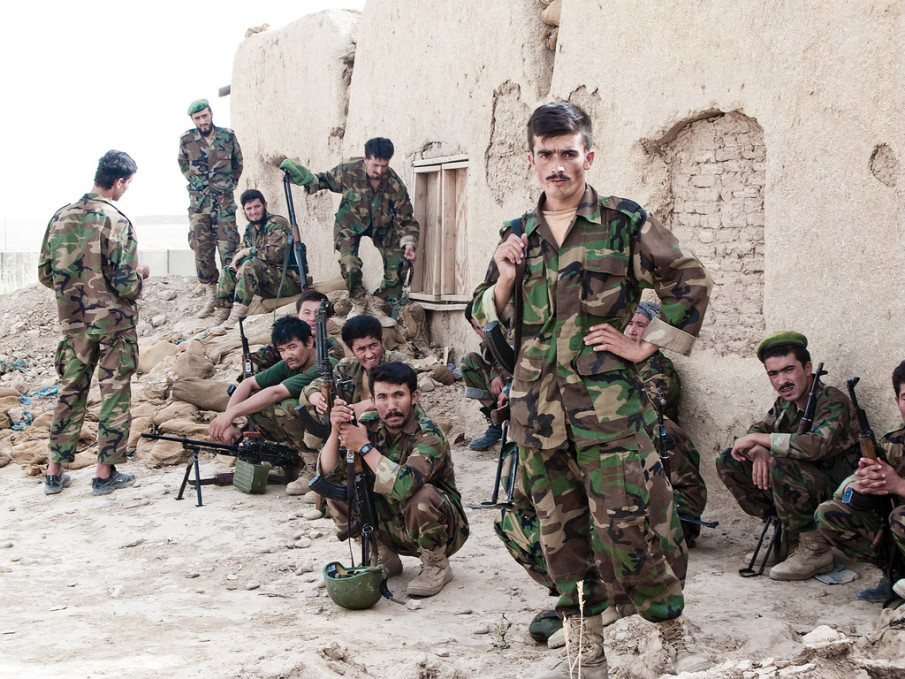
In recent weeks, ANSF forces have taken the fight to the Taliban and other insurgent groups in impressive ways. Although Iraqi military forces withdrew as ISIS bore down on Ramadi, abandoning their positions and retreating in the face of an enemy, ANSF has done quite the opposite. Even as casualties among ANSF mounted into the dozens, Afghanistan’s security forces have consistently rebounded to return to the fight, pushing back insurgent groups—throughout the northern provinces of Kunduz and Badakhshan in particular—even as the battles have ground to a comparative stalemate. Amidst the conflict emerging between ISIS and the Taliban, the Afghan government under the leadership of President Ashraf Ghan and Chief Executive Officer Abdullah Abdullah has renewed its commitment to destroying the insurgency, publicly stating their intention to target key senior leaders of insurgency groups.
ISIS would be well advised to note history’s lessons as they begin to wade into battle in Afghanistan. Afghanistan has earned its reputation as “The Graveyard of Empires” for centuries of battle against invaders: its wars against the ancient Greek armies of Alexander, the forces of Great Britain in the 19th century, and the Soviet occupation in the 1980s. The Afghan people are a nation that thrives off of coalescing to battle invasions and external threats. Many recent battles waged by the Afghan military have burgeoned the hope of both Afghans and the world that the fight for the future of the country is in capable hands with the Afghan Army.
Lost amidst all of the hand-wringing over ISIS in Iraq has been the apparent growth of ANSF in Afghanistan. Afghans are not Iraqis, and the Taliban are not the Iraqi military. ISIS is prancing merrily into a meat grinder. Many of us will no doubt be spending time happily toasting news of mutual destruction between the two groups. Many will be cheering if the “Graveyard of Empires” seeks to add “Graveyard of Caliphates” to its lengthy historical resume. If there is a silver lining to the recent insurgent push in Afghanistan, it has been the willingness of the Afghan Army and other security service personnel to absorb casualties, return to the battlefield, and punch back.
Contrary to public perception, a war still rages in Afghanistan. Fortunately, the Afghan Army appears to be up to the challenge of fighting it.








COMMENTS