
The former intelligence officer pointed out how foreigners like retired Australian General Mike Hindmarsh, as well as the Spear Operations Group contractors place themselves within the Emirati military to provide themselves with some legal top cover. “But again what does that mean if you are doing lethal ops on behalf of a foreign military,” the former intelligence officer said. “You getting military retirement benefits? You give up your citizenship yet? A lot of sketch going on. The game that I keep hearing is that we are working for a Emirati company or a Aussie company so we’re good. They set these companies up in the free trade zones and the UAE has like fifty of them. But the problem is that everyone snitches.”
The former American intelligence officer described a colorful cast of characters active in the contractor scene in the UAE and Yemen to include former CIA officer Larry Sanchez and former mayor of New York City Rudy Giuliani who is known to broker deals for the Emiratis. He also said that several former CIA NOCs, Non-Official Cover, operatives have been working there as freelancers, at least one of them playing fast and loose with the rules. “One NOC is in the UAE and is considered to be a snake and not to be trusted. These are guys who don’t have the understanding and are reckless. Their god is money,” he told NEWSREP.
The big problem he described is that the Emiratis are hungry to develop intel and Special Operations capabilities that they don’t have the institutional maturity for at this time. Furthermore, “their risk calculus is about zero” he said of the Emirati government, particularly the crown prince Mohammed bin Zayed Al Nahyan known as MBZ. “Without maturity and command authority you will just cause chaos over there, it is insanity,” the former intelligence officer said in regards to Americans helping the UAE develop JSOC or CIA type capabilities.
Comstock’s adventure in Yemen began when he received phone calls from Golan whom he had worked for previously in South Africa and in Hong Kong where he provided close protection for a wealthy investment banker. The former Delta operator flew to San Diego to meet with Golan, who asked him to be a strategic advisor for the Yemen contract. Isaac’s role would be more in the business development sphere since he worked well with clients while Comstock would oversee and manage the day to day aspects of the mission.
“Part of it was to conduct training for the Emirati military and to help them prosecute targets,” Comstock said. Agreeing to the arrangement, Comstock met the rest of the team at a hotel in New York a few weeks later. “It was like a scene out of the movie Ronin,” he recalled. Golan told them what the mission would be and gave everyone the opportunity to walk away at that point if they chose to. None did. They boarded a private jet and trans-loaded into other planes at remote airfields before finally landing in Aden.
Comstock was told that the contract was on the up and up because the UAE is a part of a coalition that includes the United States and that the International Traffic in Arms Regulations (ITARs) which also covers military training, had been cleared with the Department of State.
The job got off to a rocky start as the team was picked up by a Emirati intelligence officer who equipped them with rusty non-serviceable Chinese weapons. He had been given money to purchase quality weapons and equipment, but Comstock suspects he bought garbage on the black market and pocketed the rest. There was also the issue that some of the Emiratis resented having American contractors edging in on their turf, but some of these issues were later smoothed over and the contractors received quality weapons and equipment.
The American contractors were given a target deck that had been prepared by the Emirati intelligence service, one that the contractors vetted to the best of their ability. Missions they conducted included close target reconnaissance on a number of occasions. On one mission they attempted to intercept a terrorist leaving from the airport. One important High Value Target that all of the Americas were keen to secure was a terrorist involved in the planning of the USS Cole bombing. The team was also less than 24 hours away from taking out a terrorist bomb maker, but a Yemeni rebel group got to him first.
The mission featured prominently in this week’s BuzzFeed article depicts the contractors, although Comstock does not object to the term mercenary in this case, targeting Anssaf Ali Mayo, a local leader of the Al-Islah political party. The UAE considers Al-Islah to be a terrorist group associated with the Muslim Brotherhood. In conversations with a retired intelligence community officer, he said that, “Islah was not considered a terrorist organization by the CIA, we knew they were Muslim Brotherhood though.” The lines between a terrorist and a political leader can blur quite quickly as it turns out. What constitutes a legitimate target?
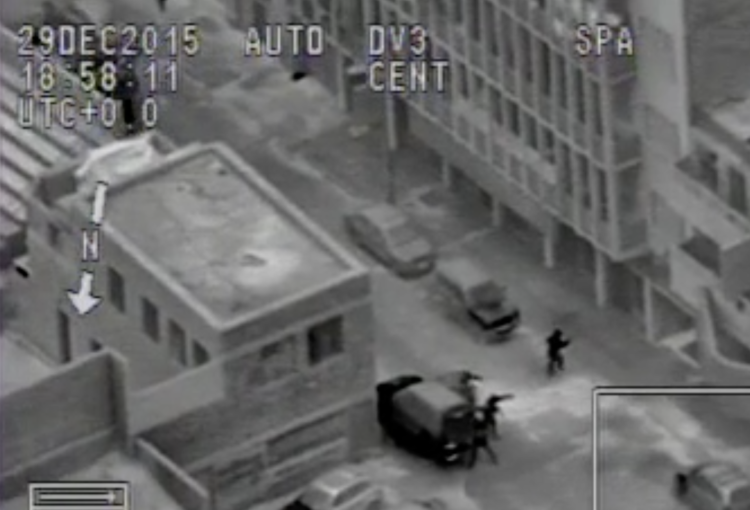
Comstock related how their convoy drove through a neighborhood filled with Al Qaeda members as they rolled towards a small office were Mayo was located, confirmed by both the drone operator and a HUMINT source on site. Arriving in front of the target building, an Emirati officer got out of one of the armored vehicle and was shot in the foot. “We were taking fire right off the bat,” Comstock said. “As soon as we got out they were on us.”
Gilmore got out and began engaging, but Comstock didn’t know what he thought he was shooting at. Then another former SEAL got out of the vehicle with a MAG58 [similar to a M240B machine gun used by the US military] and began laying down suppressive fire. Comstock grabbed the IED he had built and ran to the breach point.
“This is where things get even weirder,” he said. “I wasn’t supposed to go to the breach point alone. Both Isaac and Abraham Golan were supposed to go with me.” Isaac didn’t leave the vehicle, claiming he had a jam in his rifle, but Comstock refutes this saying he had a backup AK-47 that he could have grabbed and gotten back into the fight.
“My job was to go in there and eliminate the threat,” Comstock said. “I was going to go in and be as surgical as I could but they had locked the door. That was when I heard gunfire from inside…I placed the charge, the IED, on the front of the door to cover my withdrawal and hopefully to get the target.” Comstock disputes reports that it was some kind of large meeting taking place in the office that night, and that it was really just Mayo, an assistant, and two bodyguards, none of whom were innocent parties. Drone footage confirmed to them that Mayo was still in the building and had not left.
“It wasn’t like we were a bunch of inept idiots out there just winging it. It was calculated, it was planned, we were responsible to make sure we were not going to hurt anyone else,” Comstock said. The biggest misconception that Comstock wanted to clear up was that his team was not some kind of murder squad and that they were only targeting terrorists.
The charge detonated, sending a directed blast into the office. How Mayo survived is unknown but Comstock speculated that he may have been inside an alcove when it went off. The vehicle that they blew up in the street was also destroyed with an IED built by Comstock, but he was not completely sure why it had to be destroyed, he was just told that the vehicle could not come back with them.
The operation was not really a success as the High Value Target was not killed, but Comstock contends that American Special Operations Forces also hit dry holes all the time and that this is a normal occurrence on these types of operations. For the contractors, they picked up with follow on missions, left the country for a few weeks, and then came back for a second deployment.
“Isaac was a terrible leader. He makes himself sound like a hero but really he was the zero. He was the weakest link on the team. He was out sunbathing…telling grown men, soldiers, to go get his coffee,” Comstock said. He confronted Isaac and told him that he needs to lead by example and can’t mistreat the Emirati soldiers as their mission success and security in a firefight is largely based on them having good rapport with the locals. Apparently his point was not taken well and Comstock and another former SEAL soon walked off the job due to these frictions with Gilmore. Golan was out of the country working on other endeavors at the time.
“Truth be told, I think most of us went over there to take the fight to the bad guys,” Comstock said, “and the money was okay.”
Or as the former intelligence official put it, “Ain’t no jobs programs for Captain America.”
We interviewed Dale Comstock at length about the Yemen contract for a episode of SOFREP Radio.








COMMENTS