

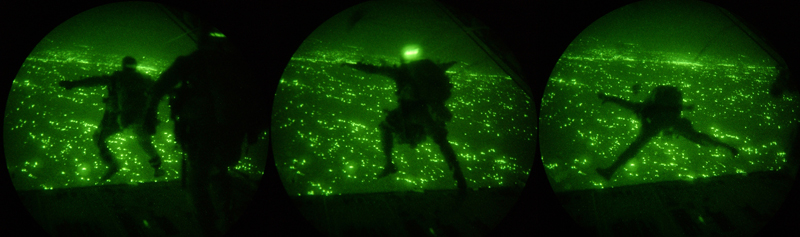
When the Marine Corps first implemented the parachute insertion program, the purpose was the clandestine insertion of troops to prevent enemy counter movement.
The reasoning behind the July 23 mission was along similar lines, according to Maj. Douglas B. Davis, Hercules aircraft commander, Marine Aerial Refueler Transport Squadron 234, Marine Aircraft Group 16, 3rd Marine Aircraft Wing. Davis was in charge of the Hercules aircraft that delivered the group of six pathfinders to their destination.
“We were called in for this mission because the ground inserts were attracting a lot of attention and taking a lot of fire,” the 36-year-old, McAllen, Texas native said. “They wanted to go in by parachute in order to avoid detection.”
Although the historical implications of the drop were important, the Marines had an important mission to complete, said Smalenberg.
“We did an infiltration into an objective area to conduct an initial internal guidance of two CH-46E (Sea Knights),” the 39-year-old Oscoda, Mich., native explained of his team’s mission. “We were to all insert clandestinely to the area to conduct counter (improvised explosive devices) ambushes.”
IED attacks on convoys and ground patrols are one of the problems coalition forces are facing in the ongoing struggle to secure and stabilize Iraq. This mission is one of many that are being used to counter this threat, Smalenberg mentioned.
Overall, the mission was considered a success by those involved, claimed 1st Lt. Ken M. Karcher, airborne direct air support center, Marine Air Support Squadron 1, 3rd MAW, who relayed information for the recon teams once they hit the ground.
“It was a pretty simple mission and it went over pretty well,” the 26-year-old Raleigh, N.C., native said. “It was very well coordinated by the ground unit.”
“They went in, they were blacked out and we left,” he added. “They didn’t have enemy contact when they hit the ground. To me, that’s success.”
The jump was something the enemy might not have expected, claimed Smalenberg, but the group took extra precautions in the choice of their jump by opting for the high opening.
“The reason we chose to do a HAHO vice a (high altitude low opening) jump was the stand off distance the aircraft would be from the drop zone as well as the noise of the parachutes opening at 10 thousand feet vice four thousand feet is not even close,” he explained. “The sound of a parachute opening at four thousand feet is quite distinct, but there is no noise of a parachute opening at 10 thousand feet.”
The mission itself was exciting for all involved, because even though units train for this in peacetime operations, it doesn’t happen often, claimed Sgt. Lee A. Davis, loadmaster, VMGR-234.
“It went great,” the 21-year-old Arlington, Texas native claimed. “It’s really rare for us and we don’t get to do it that often so we really love it when we get the chance.”
The older recon pathfinders, none of whom were under the rank of staff sergeant, may have been even more excited than the younger loadmaster, he noted.
“These guys were waiting their whole careers to do this in combat,” he said.
The insertions made in past efforts by the recon Marines have varied from using ground and aquatic vehicles to just plain walking. Smalenberg also down played the excitement a bit by mentioning that a parachute insertion seemed like the method of choice for the Marines.
“Every time we roll out of the camp in vehicles, the enemy knows,” he said. “I feel safer doing this than driving my vehicle out of the camp. This is the best means (of insertion). Besides, it’s just another way to get to work.”
++++++++++++++++++++++++++++
Semper Fi
Bill Janson is a former Recon Marine and is the founder of Eleven 10, a tactical gear manufacturer.








COMMENTS