

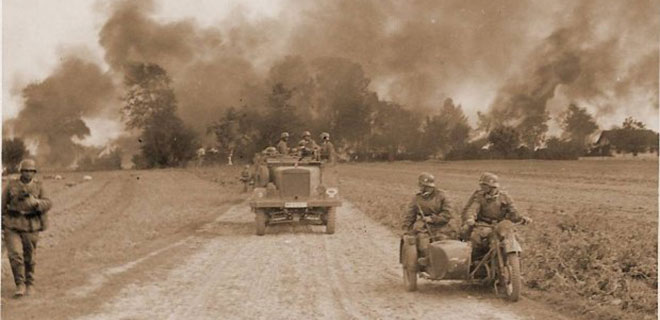
Guderian received his orders to advance through Wizna towards the town of Brzesc, early on the 8th. Soon, the rumblings of hundreds of tanks were heard through the valley. The Poles along the line steeled themselves for the task ahead, unaware that just beyond their sight, as the sun began to rise, 350 tanks and over 42,000 men were preparing to move towards them, a man-to-man ratio of 58 to 1.
The die was cast.
Aircraft appeared overhead. The Poles braced themselves for the screech of bombs dropping, but instead viewed thousands of leaflets gently floating down. Picking them up, they read of how most of Poland was now in the hands of Germany and further resistance would be futile. They responded to the surrender offer by crumpling up and discarding the paper. Morale was high, continued exhortations by Raginis and others reinforced that. No way were they going to give up before a battle even started, especially after Raginis and his second in command swore to their men they would never leave their post under any circumstances.
With their refusal signaled by the absence of men emerging from the hills with hands up, a scream of dive bombers was heard descending on the Poles. Bombs rained down by the dozens, blasting huge clouds of earth among the positions. In the meantime, 19th Corps deployed and began advancing on the line’s flanks from the north and south. A simultaneous attack erupted shortly after an artillery bombardment ceased, and gunfire and explosions clapped the valley in a deafening roar as the Germans stormed toward the first set of bunkers.
The Poles fought back with a tenacity seldom seen by the Germans. Riflemen took careful aim as machine gunners swept their fire amidst the enemy trying to move his way through the obstacles. They drove back each German attack no matter how many of their own fell, often yards from being overrun. The supporting fire by tanks did little to faze the Poles, as German shells bounced harmlessly off bunker walls or rained chunks of dirt down onto the defender’s bloodstained uniforms.
In the north, the Poles were literally on the verge of being encircled at times, yet their withering fire threw off the invader’s grasp and sent him reeling. Returning a short while later and much stronger, the Germans made headway. Running low on ammunition, the commander of the bunkers received word to abandon his position. He and his men got away just before the first of the bunkers was taken, leaving the enemy with only a few of their dead comrades as a symbol of victory. The frustrated Germans began preparing themselves for the move towards the next set bunkers as daylight began to wane. Perhaps it was now that they realized something unusual. The strongpoints appeared too far apart and lacked the ability to support each other. Bloody though it may be and with enough firepower, they knew they could isolate each position without interference from the next.
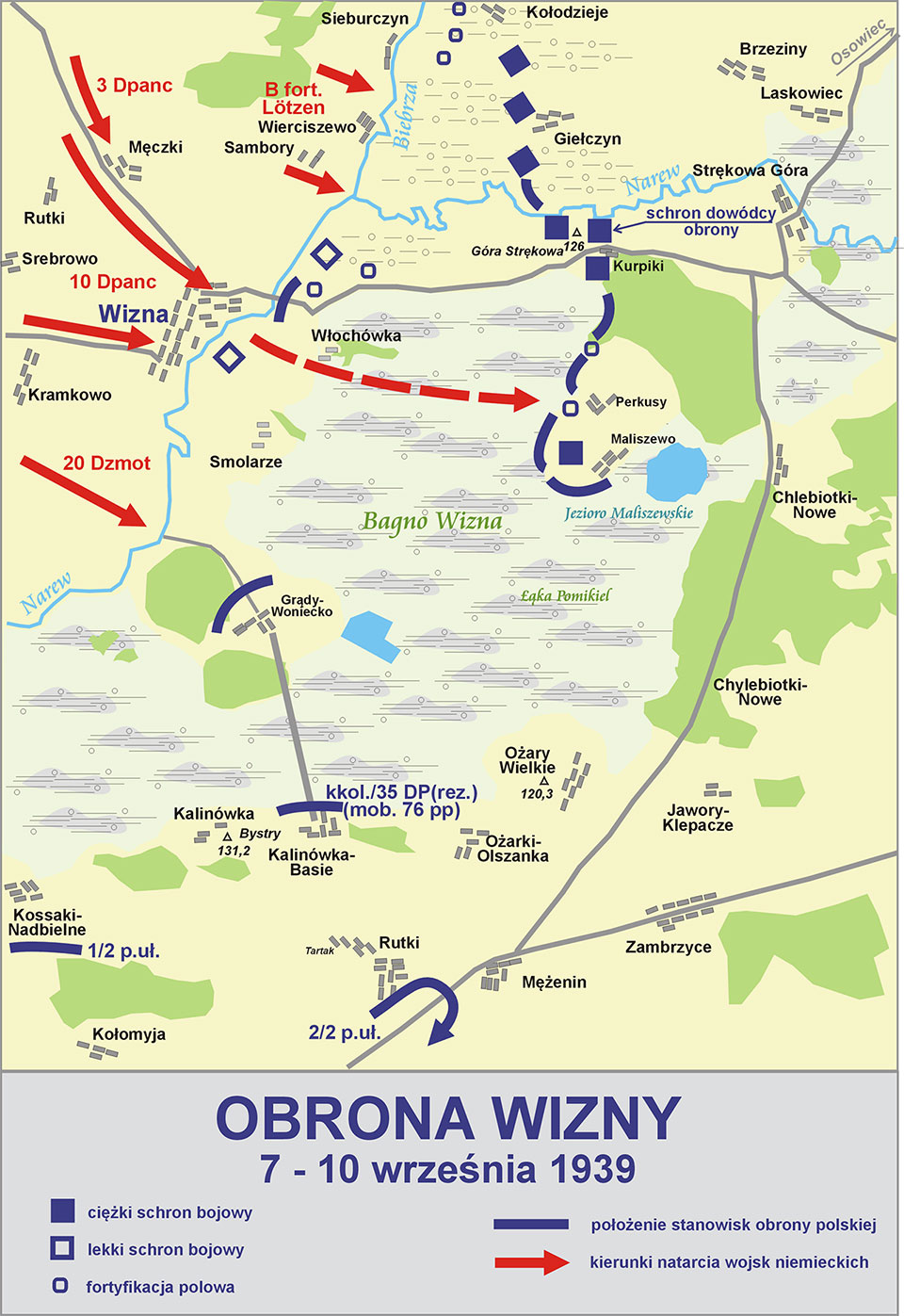
In the south, the flaw was recognized as well. Despite a bloody stalemate, the bunkers were assaulted again and the last defenders eliminated by six o’clock, with few prisoners taken. Like the north, a small foothold had been achieved, although with staggering loss of life on both sides.
In the center strongpoints, the Poles continued to rain down fire on German infantry that dared attack the front of the line not long after the flank attacks started. They kept the Germans pinned and bleeding until after sunset, when the last assaults lost steam and flares began swaying from the sky. Each side studied the situation and reached the same conclusion. All in all, the Germans had suffered terribly this day, and the line had held.
Guderian remained confident though. Something else was happening unbeknownst to the Poles. His Panzers were now moving around the flanks and continuing toward their original objectives. As soon as possible, he wanted to get the infantry and artillery beyond here as well, and was committed to ending the fighting as soon as possible.
The morning of the tenth opened with heavy attacks as the flanks were squeezed and drawn inward by combined infantry and tanks. They continued isolating each strongpoint with both sides enduring heavy casualties, all because the defenders chose to fight to the death. Numb and catching their breath, the Germans moved out once more, reinforced by more arriving infantry. At a crawling pace and often pinned down several times, they targeted still more bunkers and trenches, exploding them with satchel charges and grenades. Once they poured into the position, they stumbled over dozens of corpses, some with their fingers still on the trigger.
At eleven o’clock, the final two bunkers were isolated and destroyed. The Poles in other positions nearby still refused to surrender and continued exchanging shots until out of ammunition, or until they were gunned down.
Raginis, now nursing a severe wound, received a message from Guderian, which said essentially “Surrender or die.” He ignored the ultimatum and the fighting continued for another hour until another overture arrived in the form of a truce flag. A ceasefire was agreed upon and lasted until one thirty. Recognizing the end was near, with no hope of rescue and little ammunition remaining, he ordered his remaining men to surrender to the Germans. Then he walked back inside his bunker, pulled the pin on a grenade and waited for his enemy to enter. When they did, he released the safety spoon and blew himself up.
In a nearby bunker, his subordinate committed a similar act.
No more than 70 Poles were taken prisoner. Most would not survive the war. Some 650 others had fought to the end and achieved a decisive task in that their efforts to delay the Germans. This allowed Independent Operational Group Narew enough time to break out of the area and escape encirclement.
As the fires on the hills behind Wizna crackled and smoke stung the nostrils of the victor as he passed over bodies of his fallen, the battle faded from memory. Poland descended into five long years of suffering and thoughts turned to surviving the ordeal. More than 4 million Poles would die before the nightmare ended. And though the Warsaw uprising overshadowed the resistance at Wizna, the name later became a symbol of Polish courage against insurmountable odds. For here, In the early days of history’s greatest calamity, there stood a few young men who meted out punishment in the form of 1,500 dead invaders and whose courage is spoken of in Poland’s storied past even to this day.
(Featured Image Courtesy: wyborcza.pl)








COMMENTS