

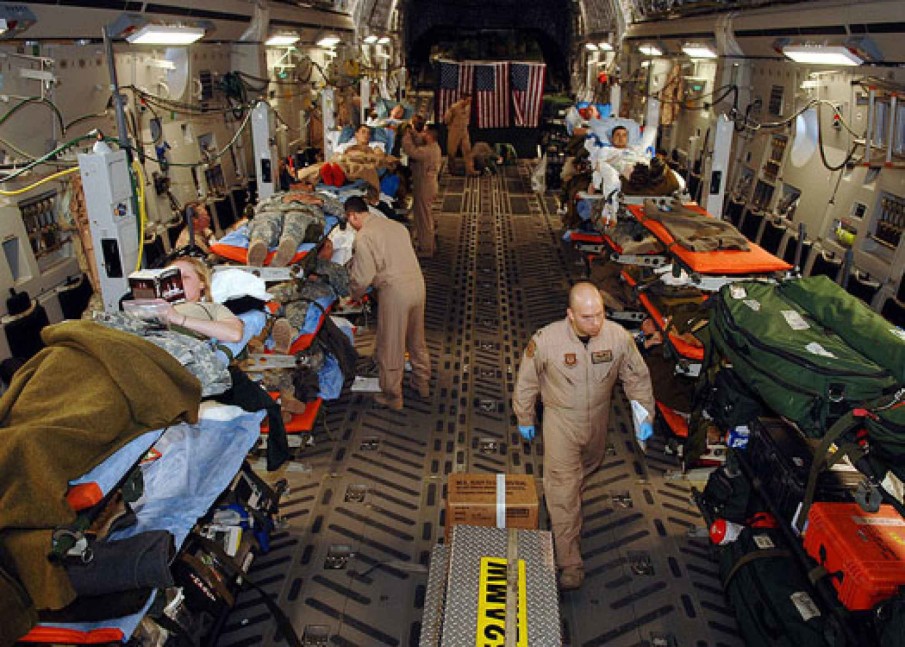
In the period before America’s most recent span of prolonged warfare, pre-2001, battlefield trauma care methodology was based on non-combat trauma courses and did not include a tactical context for rendering care. However, consideration of battlefield conditions is critically important.
In other words, non-combat trauma care courses failed to account for the fact that combat medics were treating their patients in the middle of a firefight. This is a significant point when rendering care and trying to enable both the medic and the casualty to survive. If the enemy is still shooting at you, it may be advisable for the medic (and the casualty) to eliminate the threat before stopping and rendering medical care. It took TCCC to bring this point home and make it standard procedure.
In addition to the lack of a focus on the combat portion of ‘combat medicine,’ earlier civilian trauma courses frowned on the use of tourniquets, and in fact deemed them dangerous because it was thought they would result in preventable tissue death and loss of limbs.
This was wrong.
More lives have probably been saved by tourniquets in Iraq and Afghanistan than any other single pre-hospital medical intervention.
Additionally, battlefield medicine before 9/11 employed combat-ineffective methods of fluid resuscitation, pain relief, and airway management, in addition to discouraging tourniquets. In short, pre-hospital trauma care guidelines before September 11th were not where they needed to be to most effectively save our battlefield wounded.
What changed?
The catalyst for change had already arrived before the September 11 attacks, in 1996, with the publication of a paper entitled, “Tactical Combat Casualty Care in Special Operations,” (published in the Military Medicine Supplement, written by Navy Captain Frank K. Butler, et al). While the TCCC guidelines were first employed by the Navy SEALs, Army Rangers, and Air Force Pararescue starting in 1997, the guidelines would not be widely adopted by the big USMIL before 9/11/2001. There was simply no pressing need.
That would all change, of course, on a clear Tuesday morning in September, 2001.
Fast forward to 2005. The war in Afghanistan and Iraq showed no sign of an end for U.S. forces. The need had arrived. Through the combined efforts of USSOCOM, the Army Institute of Surgical Research, and the U.S. Central Command, the U.S. military began to get the picture about rethinking battlefield trauma care. As of today, TCCC is used throughout the entire U.S. military, as well as in allied forces and the U.S. civilian sector.
What did TCCC change in battlefield medicine?
The most significant changes involved aggressive use of tourniquets, hemostatic dressings (which help stop blood loss), changes in intravenous (IV) fluid administration, use of intraosseous (IO) fluid infusion (put directly into bone), changes in airway management, battlefield antibiotics, advanced pain relief, and junctional (applied to the torso) tourniquets for non-extremity wounds.
The adoption and sustained use of this relatively small subset of techniques, procedures, and guidelines has led to a dramatic change in military medicine, and to the increased survival rate of America’s war-wounded.
The tourniquet provides an illustrative example. This device did not become widely used in the U.S. military until 2005-2006, and since that time, it has led to a 67 percent decrease in preventable battlefield deaths resulting from ‘bleeding out’ due to arm or leg wounds, which was at one time the leading cause of preventable death on the battlefield. According to a 2013 paper titled, “Saving Lives on the Battlefield” written by Colonel Russ Kotwal, the regimental surgeon for the 75th Ranger Regiment for much of the war, and his co-authors:
“A study of 2,600 combat fatalities incurred during the Vietnam conflict, and a study of 982 combat fatalities incurred during the early years of conflict in Afghanistan and Iraq noted death from extremity hemorrhage was relatively unchanged at 7.4 percent and 7.8 percent, respectively. After the global implementation of the tourniquet recommendations from the TCCC guidelines, a recent comprehensive study of 4,596 U.S. combat fatalities from 2001 to 2011 noted that only 2.6 percent of total combat fatalities resulted from extremity hemorrhage. This dramatic decrease in deaths from extremity hemorrhage resulted from ubiquitous fielding of modern tourniquets and aggressive training of all potential first responders on tourniquet application.”
Additionally, based on research done by Colonel John Kragh, and figures provided to Army Medicine, it was estimated that over 1,000 American lives had been saved by battlefield tourniquet use as of 2008. That number is certainly much larger now.
Published papers by Colonel Kotwal and the Canadian military have also documented unprecedented reductions in preventable combat fatalities as a result of training everyone in combat units—medics and non-medics—in TCCC.
It is now almost universally agreed that these TCCC techniques and procedures are saving lives on the battlefield. Surgeons are seeing double and triple amputees arrive at combat hospitals, with tourniquets applied, who are awake and talking. Fighting men and women are surviving wounds that would have killed them 15 years ago, and senior leaders in military medicine are calling for the expanded use of TCCC.
Not only has TCCC been widely adopted by the U.S. military, but it is continuously and regularly updated, through a committee process, in order to ensure it remains as effective as possible.
Committee on Tactical Combat Casualty Care
The Committee on Tactical Combat Casualty Care (CoTCCC) now regularly puts forward recommendations to improve battlefield trauma care, and develops change papers to support these recommendations. These papers are published in the Journal of Special Operations Medicine.
The CoTCCC is comprised of 42 members from all military services, and its members have 100 percent deployed experience. The committee’s physicians and physician assistants work in fields of trauma surgery, emergency medicine, operational medicine, and critical care. The members also include combat corpsmen, PJs, medics, and combat medical educators.
Although TCCC has proven remarkably successful, Colonel Kotwal’s paper documents that TCCC application and training remains uneven throughout the armed services. Additionally, many ‘TCCC’ courses bear no resemblance to the TCCC course developed by the CoTCCC and the Joint Trauma System.
As the U.S. military moves into the post-war period, this education issue is being addressed. One proposed change that is currently being considered is a plan for the military to work with the National Association of Emergency Medical Technicians (NAEMT) to provide less expensive and higher quality TCCC courses to combat units. This type of continuous drive for improving battlefield trauma care in the U.S. military is an example of why TCCC has been so successful.
Regardless of its growing pains, it is indisputable that TCCC has saved a great many American lives, and for that, we should all be grateful.








COMMENTS