

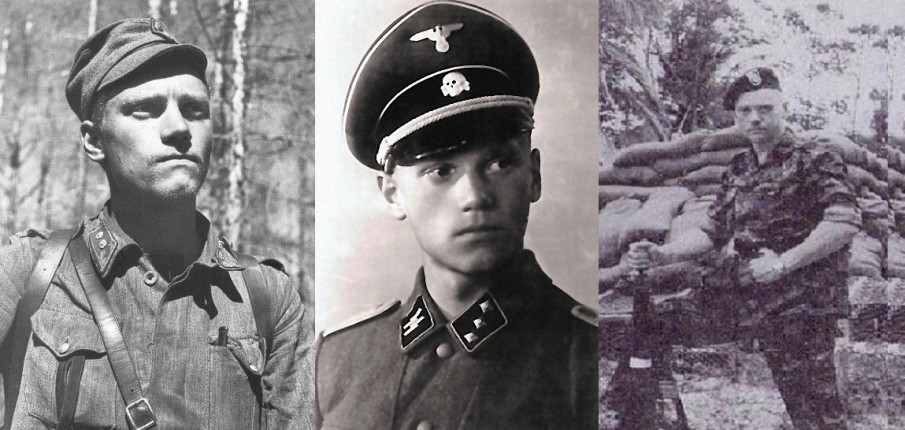
He ended up serving only half his sentence before he was pardoned by the president of Finland in 1948.
Törni’s path to the US Army was paved by crucial legislation from Congress along with the creation of a new military unit: Special Forces.
June 1950 saw the passing of the Lodge-Philbin Act, which allowed foreigners to join the US military and allowed them citizenship if they served honorably for at least five years.
Just two years later, the Army would stand up its new Special Forces unit at Fort Bragg, North Carolina.
More than 200 Eastern Europeans joined Army Special Forces before the Act expired in 1959, according to historian Max Boot.
Among those was Törni, who enlisted in 1954 under the name Larry Thorne.
“The Soviets wanted to get their hands on Thorne and forced the Finnish government to arrest him as a wartime German collaborator,” the account at Arlington Cemetery.net reads.
“They planned to take him to Moscow to be tried for war crimes. Thorne had other plans. He escaped, made his way to the United States, and with the help of Wild Bill Donovan became a citizen. The wartime head of the OSS knew of Thorne’s commando exploits.”
A Special Forces legend
Thorne quickly distinguished himself among his peers of Green Berets. Though he enlisted as a private, his wartime skill set led him to become an instructor at the Special Warfare School at Fort Bragg, teaching everything from survival to guerrilla tactics.
In 1957 he was commissioned a second lieutenant, and he would rise to the rank of captain just as war was on the horizon in Vietnam.
But first he would take part in a daring rescue mission inside Iran. In 1962, then-Captain Thorne led an important mission to recover classified materials from a US Air Force plane that crashed on a mountaintop on the Iran-Turkish-Soviet border, according to Helsingin Sanomat. Though three earlier attempts to secure the materials had failed, Thorne’s team was successful.
According to the US Army:
Thorne quickly made it into the U.S. Special Forces and in 1962, as a Captain, he led his detachment onto the highest mountain in Iran to recover the bodies and classified material from an American C-130 airplane that had crashed. It was a mission in which others had failed, but Thorne’s unrelenting spirit led to its accomplishment.
This mission initially formed his status as a U.S. Special Forces legend, but it was his deep strategic reconnaissance and interdiction exploits with Military Assistance Command, Vietnam Studies and Observation Group, also known as MACV-SOG, that solidified his legendary status.
Read more at Business Insider








COMMENTS