
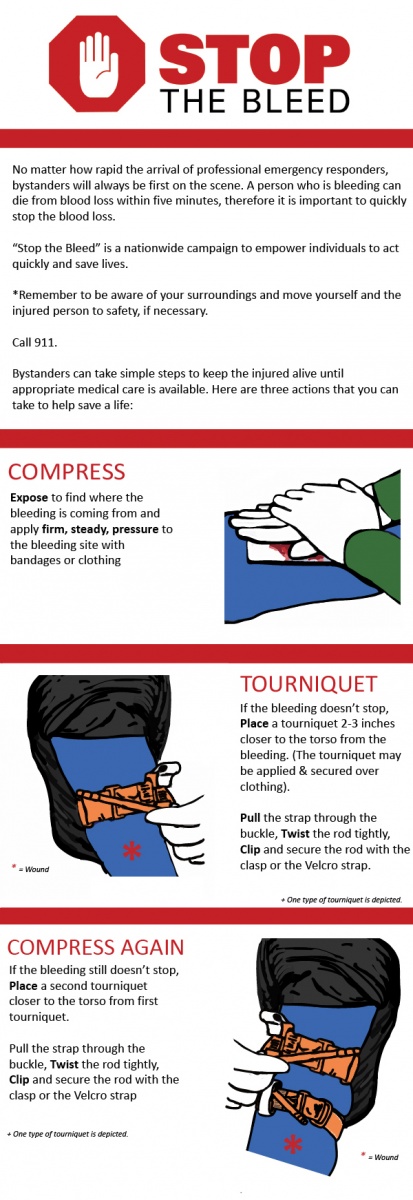
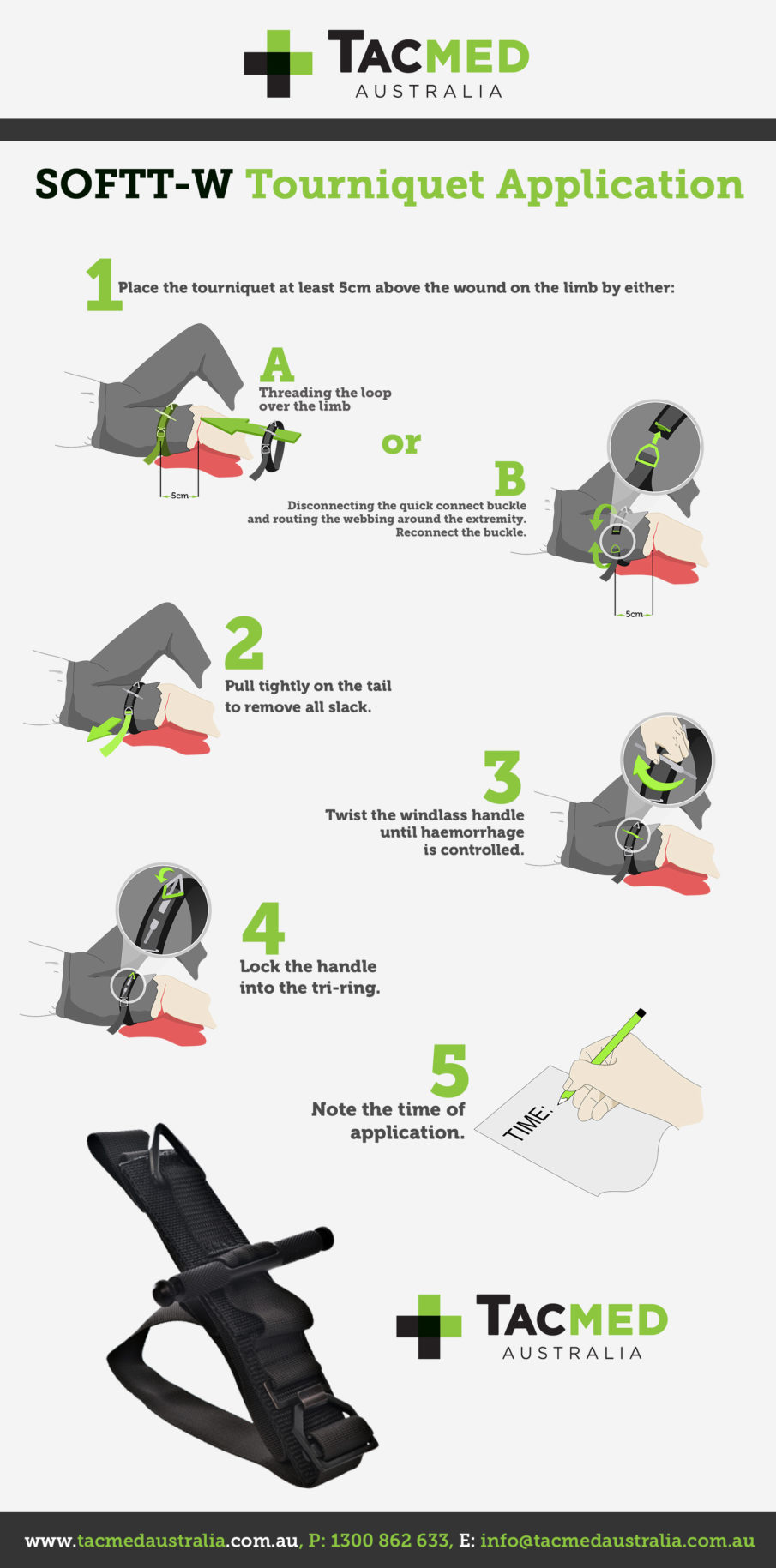
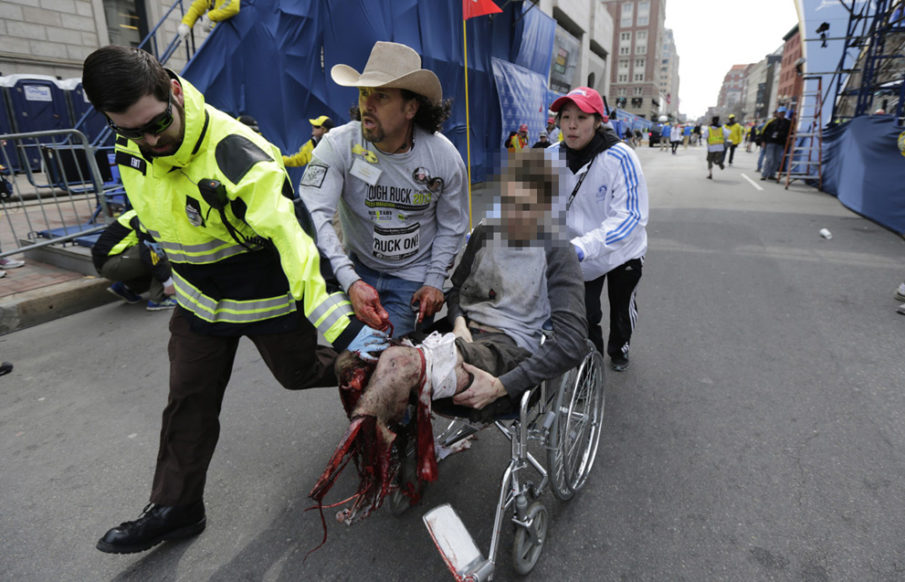
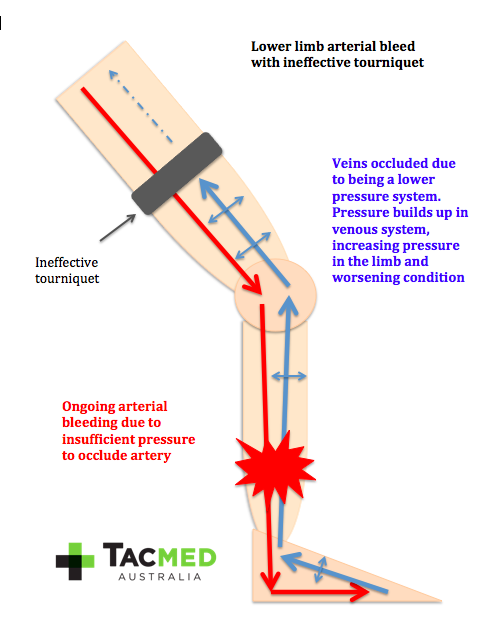
This is not intended to discredit the first responders at the Boston Marathon; their rapid and decisive actions in treating and evacuating the wounded unquestionably saved many lives. The issue, however, with applying an improvised tourniquet to a limb—one that cuts off the venous system but is not tight enough to occlude the arterial system—is that blood will continue to flow into the injured limb, so the wound will continue to bleed, and the remaining blood will be trapped in the limb as illustrated below. This has the unwanted effect of increasing the pressure in the injured limb and actually worsening the prognosis for the casualty.
Research has demonstrated that 99 percent of improvised tourniquets without a windlass will fail to effectively stop arterial bleeding (Altamirano MP 2015), and even with a windlass, around 30 percent of tourniquets will fail (Altamirano MP 2015). The choice of improvised windlass is also crucial, as items such as pencils and small craft sticks have been demonstrated to break 75-80 percent of the time before sufficient pressure has been applied to a tourniquet to occlude arterial blood flow (Kragh JF 2015).
With all of that in mind, I wanted to see whether I could improvise an effective tourniquet from items I had in the boot of my car, to simulate common things that would be readily at hand in a car crash scenario.
Using a length of an old towel and a jack handle, I was able to fabricate an improvised arterial tourniquet that, within 45 seconds, occluded the blood flow to one of my legs (proven by an absence of palpable foot pulses). The technique was as follows:
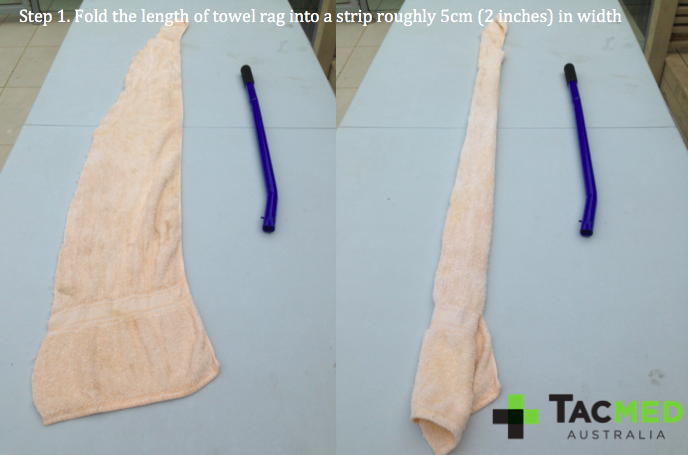
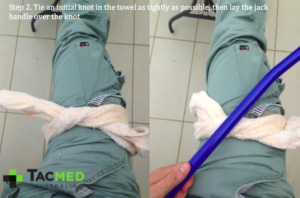
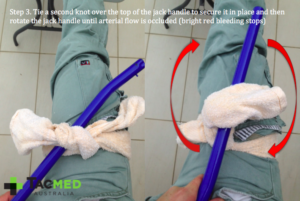
I certainly appreciate that, as a trial of one, done on myself, this experiment holds no scientific credibility (for the science behind improvised tourniquets, please see Altamirano et al. 2015 and Kragh et al. 2015). This was not the point of the exercise; it was simply to demonstrate that an effective arterial tourniquet could be rapidly fabricated and applied in a car crash scenario with items that would be readily available. The goal of this article is to seed the thought in the reader’s mind of what might be used to fabricate an effective tourniquet in an extreme situation where commercially available medical equipment is not at hand.
The choices of equipment one can use for an improvised tourniquet are almost limitless. However, for it to have the best chance of working, a tight band, ideally of 5 centimeter (2 inch) width, needs to be wrapped around the limb, approximately 5-10 centimeters (2-4 inches) above the site of arterial bleeding, and a windlass of appropriate strength must then be used to tighten the device. The windlass must then be held under tension until emergency services arrive to take over, or an effective solution to locking it in place can be fabricated.
It must be noted that this improvised tourniquet was extremely painful when applied to the tension required to occlude arterial flow. The use of such an improvised device would be in extremis only, however, when the chips are down, having the skills to fabricate and apply one might just save a life!
Of course, a better solution to the problem would be to have an appropriately stocked car medical kit. For the contents of such a kit, as compiled by a former special operations soldier and current TacMed Australia colleague of mine, please click on this link.
As always, comments and questions are welcome.
Kind regards, Dan Pronk

References:
Altamirano MP, KJ, Aden JK, Dubick MA 2015, ‘Role of the Windlass in Improvised Tourniquet Use on a Manikin Hemorrhage Model’, Journal of Special Operations Medicine, vol. 15, no. 2, pp. 42-46.
HomelandSecurity 2015, ‘Stop The Bleed’, viewed 10 December 2015,<http://www.dhs.gov/sites/default/files/images/oha/infographic_stopthebleed_02.jpg%3E.
King DR, LA, Ramly EP, BostonTraumaCollaborative 2015, ‘Tourniquet use at the Boston Marathon bombing: Lost in translation’, The Journal of Trauma and Acute Care Surgery, vol. 78, no. 3, pp. 594-599.
Kragh JF, WT, Aden JK, Dubick MA, Baer DG 2015, ‘Which Improvised Tourniquet Windlasses Work Well and Which Ones Won’t?’, Wilderness and Environmental Medicine, vol. 26, no. 3, pp. 401-405.
Naimer, S, Chemla, F 2000, ‘Elastic adhesive dressing treatment of bleeding wounds in trauma victims’, American Journal of Emergency Medicine, vol. 18, pp. 816-819.









COMMENTS