

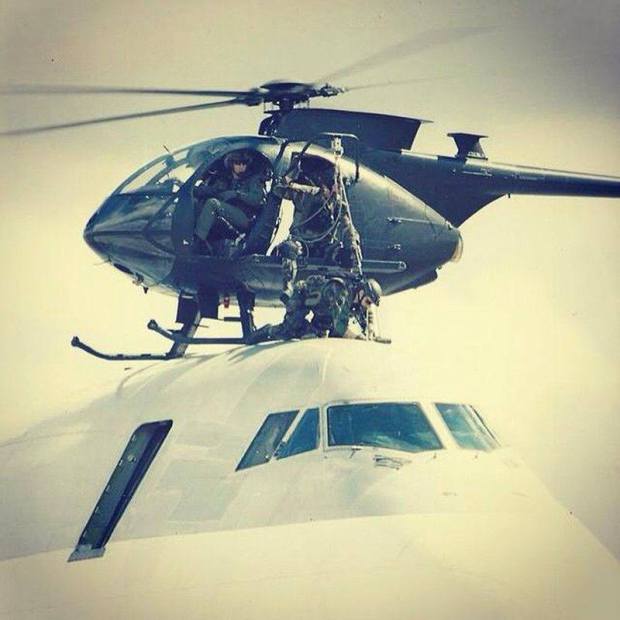
Meanwhile, Delta Force was standing up their own capabilities.
“We view aircraft take downs as nothing more than a linear target on wheels,” Delta Force Sergeant Major Mike Vining said. “We went to experts and they taught us about aircraft systems, we learn the various airport jobs, baggage handling, refueling, emptying the toilets, restocking the aircraft, and so on so we could pass as a worker.” Delta snipers also learned how to shoot through the glass windows of a airplane cockpit.
At Delta, they were often seeking advice from the foreign units who had more experience in counter-terrorism.
“From my observations there was no counter-terrorist forces that were totally complete at the time. The concept was hostage rescue units,” a former Delta Squadron Commander told SOFREP. “Counter-terrorism was the label the unit was formed under but initially there was no idea that we were formed to track them [terrorists] down and kill them in their beds. GSG-9, SAS, and GIGN had some experience formed based on past terrorist actions and active groups such as the Red Army Faction, the PLO at the Munich Olympics, and we got help from them and other organizations. We attended training at special schools and gained access to technical specialists and applied what we learned to what we developed internally,” Jim (not his real name) said.
“A lot of it was on the fly. Target analysis, mission analysis, integration of intelligence and an understanding from the beginning that you had to have a stand-alone intel and analysis capability to that can deploy to a crisis site,” Jim said, which dovetails with Beckwith’s views. “I had learned that from the SAS. They taught me if I was going to do something unique, something very dangerous, then I better have all my own horses. When your life and those of your people are the stakes, you don’t want to have to depend on strangers” (Beckwith, 77).
“No one, including our intelligence agencies had organizations with the specific capabilities we developed,” Jim said about the late 1970’s and early 1980’s.
In July of 1978, Major L.H. “Bucky” Burruss divided his Delta Force Squadron in half at the assembly area. Bucky had served in Mike Force during Vietnam and had also attended SAS selection at Beckwith’s request (Burruss, 252). First Troop moved out to take down an aircraft while Second Troop was assigned to breach a building and rescue hostages being held by “terrorists” inside. There was a lot riding on this one as this was Delta Force’s final validation exercise. Both targets were hit around 4 AM on Camp Mackall.
Approaching from the tail end of the decommissioned National Guard AC-121, first troop silently moved up to the two hatches they had decided to breach. “Padded ladders were softly laid on the fuselage. Two hatches had been selected. In the time it takes to suck in your breath, both doors were blown and the plane taken” (Beckwith, 160). Meanwhile, Second Troop breached the windows of their target building, clearing away the glass with steel pipes, and flooded the structure with operators. “Within seven seconds the terrorists had been taken out and the hostages freed” (Beckwith, 160).
Although there were some hiccups with the validation, recall that the Army had no idea how to evaluate counter-terrorist operations at this time, Delta passed the test receiving high praise from General Mackmull and General Meyer, the later being the deputy chief of staff of operations and plans for the Army.
“Blue Light seemed now, after our evaluation, to be redundant. Delta Force had filled the gap and we could be put on alert. If anything went down, we were ready to handle it” (Beckwith, 163). “General Meyer agreed and Blue Light was deactivated shortly thereafter” (Lenahan, 16).
Today, aircraft hijackings are seen by many as passe, a tactic of the past. However, others believe that different terrorist organizations evolved at different times and under different circumstances, meaning that they are likely to employ different tactics. Ruling out the possibility that America won’t face aircraft hijackings in the future would be a dangerous assumption. Thanks to Colonel Beckwith and Colonel Mountel, America has a force that can respond to such threats as needed.








COMMENTS