The article discusses the differences between .223 Remington and 5.56x45mm NATO cartridges, highlighting their pressure measurements and chamber specifications. While both rounds are similar in dimensions, they are not interchangeable due to safety concerns when firing 5.56 through a .223 chamber.
Key points from this article:
The .223 Remington and 5.56x45mm NATO cartridges have identical external dimensions but differ in pressure measurements and chamber specifications.
How firing 5.56 through a .223 chamber can lead to over-pressure malfunctions, while .223 can be safely fired in a 5.56 chamber, as confirmed by Andrew Tuohy's research.
Why understanding these differences is crucial for firearm safety and performance, especially for users like Bruce, who owns an AR15 chambered for 5.56x45mm NATO.
Updating summary...
Is there a difference between .223 and 5.56?
SOFREP News Team
Speed
1x
Listen
COMMENTS
The comparison between .223 and 5.56 isn’t a new one, so there is a lot of discussion to weed through to learn about the two. Ultimately, because they originated from the same cartridge, they are very similar, but that does not mean that they are necessarily interchangeable. This article discusses three key differences between .223 […]
The comparison between .223 and 5.56 isn’t a new one, so there is a lot of discussion to weed through to learn about the two. Ultimately, because they originated from the same cartridge, they are very similar, but that does not mean that they are necessarily interchangeable. This article discusses three key differences between .223 Remington and 5.56x45mm NATO.
Advertisement
.223 Remington and 5.56x45mm Dimension Measurements
At a glance, the two rounds are indiscernible. Both rounds use a bullet of .224 in in diameter and an overall length of 2.26in. In general, the external dimensions for the two calibers are identical. What’s more significant is the pressure of the two rounds and the difference in the rifle chambering.
.223 Remington and 5.56×45 Pressure Measurements
Advertisement
One of the problems with comparing these two cartridges is that they utilize different methods of measuring pressure. SAAMI (Sporting Arms and Ammunition Manufacturers’ Institute) measures the .223 pressure at the center of the casing, whereas the NATO standard measures the pressure at the throat (or leade) of the chamber. To rectify the two different methods, several have undertaken experiments with their own standardized recording method to compare “apples to apples.” One such thorough study was carried out and recorded in detail by Andrew Tuohy posted via Lucky Gunner Labs (click here to read the full article). Tuohy evaluated various .223 and 5.56 ammo fired through rifles chambered for .223 Remington and 5.56x45mm.
His, and the research of others, confirms that, generally, shooting .223 through a 5.56 chamber results in lower pressure, but still functions (safely). Firing 5.56 through a .223 chamber, however, results in somewhat higher pressures. Although the differences aren’t massive (~5% in the previously referenced study), extensive firing of 5.56 through a .223 chamber could lead to over-pressure malfunctions, such as popped primers or blown cartridge case heads and other firearm malfunctions.
Advertisement
.223 Remington and 5.56×45 Chamber Differences
The most important difference between .223 and 5.56 chambers is the length of the throat (or leade) for each chamber. More specifically, the leade is located at the mouth of the barrel before the rifling occurs. Comparing the NATO and SAAMI regulations, the leade for 5.56 chambers is nearly twice as long as that of a .223 chamber (.162in to .085in, respectively). If a 5.56 round contacts the barrel rifling too early, it can cause pressure spikes (leading to malfunction, and potentially damage) in the chamber. This explains why it is safe to fire .223 through a 5.56 chamber, but not recommended to fire 5.56 through a .223 chamber.
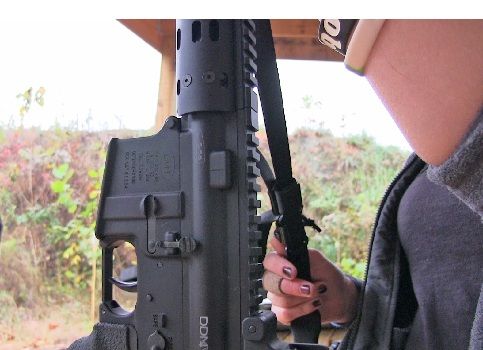
Bruce (my first AR15) is chambered for 5.56x45mm NATO.Which should you choose?
As with so many elements of making a firearm purchase, the “right” option is subjective. If all you intend to purchase are .223 Remington rounds, there is nothing wrong with getting a rifle chambered for .223. However, if you want the option of firing milspec 5.56 through your rifle, you may prefer picking up a 5.56 chambered rifle. After all, you can still fire the .223 through it, safely, if you want. Price and personal preference are also factors to consider when making that decision. What works for you?
Advertisement
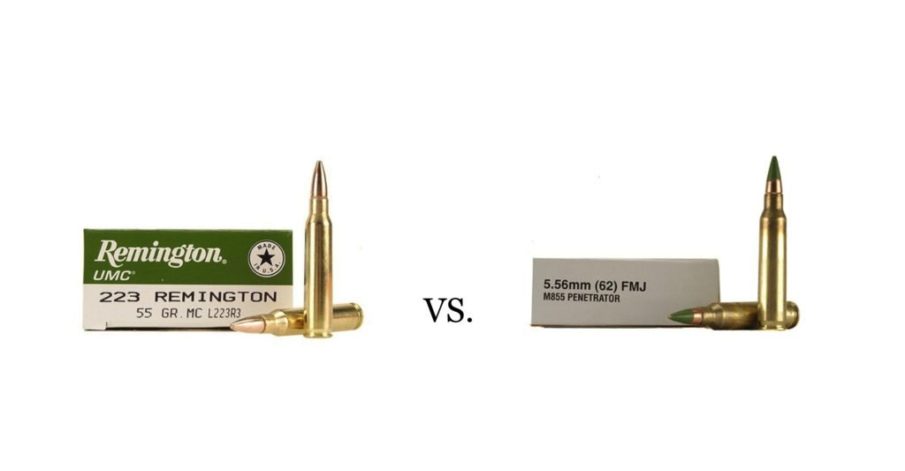
Featured images of Remington UMC and Winchester M855 ammos courtesy of midwayusa.com
The comparison between .223 and 5.56 isn’t a new one, so there is a lot of discussion to weed through to learn about the two. Ultimately, because they originated from the same cartridge, they are very similar, but that does not mean that they are necessarily interchangeable. This article discusses three key differences between .223 Remington and 5.56x45mm NATO.
.223 Remington and 5.56x45mm Dimension Measurements
At a glance, the two rounds are indiscernible. Both rounds use a bullet of .224 in in diameter and an overall length of 2.26in. In general, the external dimensions for the two calibers are identical. What’s more significant is the pressure of the two rounds and the difference in the rifle chambering.
.223 Remington and 5.56×45 Pressure Measurements
One of the problems with comparing these two cartridges is that they utilize different methods of measuring pressure. SAAMI (Sporting Arms and Ammunition Manufacturers’ Institute) measures the .223 pressure at the center of the casing, whereas the NATO standard measures the pressure at the throat (or leade) of the chamber. To rectify the two different methods, several have undertaken experiments with their own standardized recording method to compare “apples to apples.” One such thorough study was carried out and recorded in detail by Andrew Tuohy posted via Lucky Gunner Labs (click here to read the full article). Tuohy evaluated various .223 and 5.56 ammo fired through rifles chambered for .223 Remington and 5.56x45mm.
His, and the research of others, confirms that, generally, shooting .223 through a 5.56 chamber results in lower pressure, but still functions (safely). Firing 5.56 through a .223 chamber, however, results in somewhat higher pressures. Although the differences aren’t massive (~5% in the previously referenced study), extensive firing of 5.56 through a .223 chamber could lead to over-pressure malfunctions, such as popped primers or blown cartridge case heads and other firearm malfunctions.
.223 Remington and 5.56×45 Chamber Differences
The most important difference between .223 and 5.56 chambers is the length of the throat (or leade) for each chamber. More specifically, the leade is located at the mouth of the barrel before the rifling occurs. Comparing the NATO and SAAMI regulations, the leade for 5.56 chambers is nearly twice as long as that of a .223 chamber (.162in to .085in, respectively). If a 5.56 round contacts the barrel rifling too early, it can cause pressure spikes (leading to malfunction, and potentially damage) in the chamber. This explains why it is safe to fire .223 through a 5.56 chamber, but not recommended to fire 5.56 through a .223 chamber.
Bruce (my first AR15) is chambered for 5.56x45mm NATO.Which should you choose?
As with so many elements of making a firearm purchase, the “right” option is subjective. If all you intend to purchase are .223 Remington rounds, there is nothing wrong with getting a rifle chambered for .223. However, if you want the option of firing milspec 5.56 through your rifle, you may prefer picking up a 5.56 chambered rifle. After all, you can still fire the .223 through it, safely, if you want. Price and personal preference are also factors to consider when making that decision. What works for you?
Featured images of Remington UMC and Winchester M855 ammos courtesy of midwayusa.com









COMMENTS