
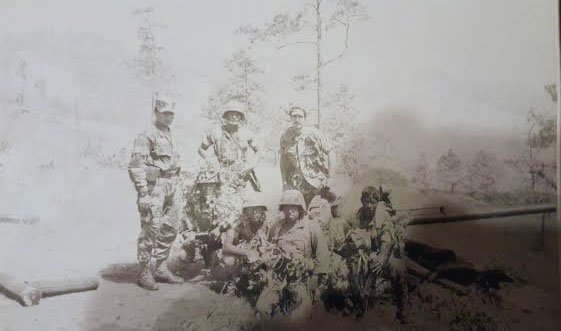
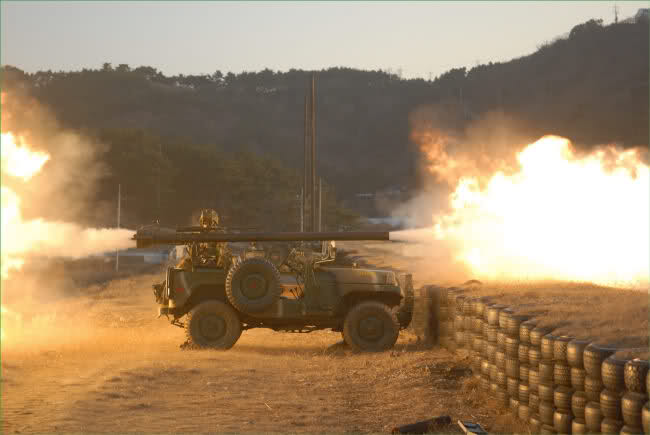
The 106mm RR fired HE (High Explosive), HEAT (High Explosive Anti-Tank), and an APERS (High Explosive Anti-personnel) that fired flechette rounds. There were other types of ammunition but no other type was available for the Honduran troops at that time. The rear end of the cartridge case is perforated, to allow the propellant gas to escape through the vented breech, thus neutralizing recoil. The 106mm RR could penetrate 12 inches of cold rolled steel at 300 meters. The .50 caliber ammo was not the standard issue for the M2 machine gun. But was shorter and specially designed to mimic the flight path of the main gun ammunition.
The weapon was bore sighted by using a cut-down 106mm round with a subcaliber .30 caliber round inserted. This would come into play much later.
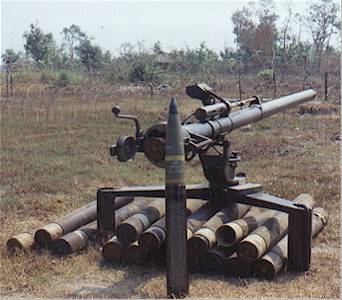
The team prepared by making some coordination with JFKSWC (Special Warfare Center) Weapons Committee. They gave an excellent block of instruction on the 106 and got every member of the team up to standard on the operation, maintenance, and crew drills. We could each perform all the functions of a crew member, boresight the weapon and were then each comfortable enough to teach it to the Honduran troops.
We got to spend a couple of days on the range and put some steel on targets. Range control got really pissed when they specifically told us that an old school bus was danger close and off limits to us shooting at. And of course, one of our guys (I’ll never tell), put a flechette round into it. When the range control guys returned, the bus was still smoking and looked like Swiss cheese. Range Control was hot enough to spit flames at our team leader, but sometimes it is better to beg forgiveness than to ask permission.
We were ready. Our team nearly filled a C-141 with 106mm ammo with a slew of .50 caliber spotting rounds and we flew down to Honduras to get the mission underway. After a day or so to get settled in and get trucks to pack all the ammo and gear up into the mountains, we were underway.
Our initial training schedule had a couple of days for crew drills since we expected them to be pretty sloppy. We began by doing a quick inspection of the guns and they were all in very good to excellent condition. The troops obviously took very good care of them. Which was an encouraging sign.
Next, we broke down the unit into their mounted (Jeep) and fixed gun crews and had them walk thru their crew drills. They then went thru their crew drill at normal (combat) speed. I was on the gun crew next to the one our team leader was with and we made eye contact with one another. His eyebrows went up and without saying anything, I could tell he wasn’t expecting this. These guys looked incredibly smooth, much better than any regular Honduran line unit we had worked with, especially on Day 1.
After running them thru the crew drills a few more times, we had the crews bore sight their weapons and once again they did it without the slightest hitch. We broke for an early lunch at the range and would commence live fire after their break. Our weapons guys were surprised at how smooth they looked and at they seemed to have their act together, which for the Honduran army back then was no easy feat. And we wondered aloud why these troops couldn’t hit the side of a barn. Our questions would soon be answered.
After lunch, the crews broke down with their respective guns and we readied to see how well they could hit their targets. The targets were dugout areas on the side of a ridgeline 400-500 meters away and had logs laid into the 4’ x 6’ area and were painted white for easy identification.
The first gun crew was readying to fire when our senior weapons leader stopped them. “What the fuck are you doing,” he asked? The crew wasn’t loading spotting rounds for the .50 caliber but the .30 caliber device for bore sighting. “We don’t have .50 caliber spotting rounds,” they said. Apparently, according to their Lieutenant, they hadn’t had any in years.
Some visiting straight-leg officer from the US MILGP (Military Group) in the US Embassy who had zero knowledge of the M-40 had told them in lieu of spotting rounds, the sub-caliber device for bore sighting could be used as a spotting round. Mystery solved. For any target farther than 100 meters, you wouldn’t hit jack shit.
We went into the back of our truck and broke out the spotting rounds and they loaded them up (for the first time) into their spotting rifles. The first gun crew fired the spotting round dead center of a target on the ridge in the distance and then fired their main gun. The target exploded with a direct hit. The unit cheered like they just scored a touchdown at the Super Bowl.
After ensuring that each crew had spotting rounds we spent the rest of the afternoon live firing the 106s and there were very very few misses. These guys were just lacking the proper ammunition for their spotting rifles and taking what an American officer had told them at face value. They did what they were told and had failed miserably. After the first day, their morale was sky high. For most of them, this was the first time, they hit a target with their assigned weapon.
Our training outline would have to be changed…obviously. And we got into more advanced training than we ever envisioned we would be able to accomplish. The support guys who set out the targets were told to start making them smaller. The lesser profiles were much harder to hit.
The mounted jeep sections were quickly getting adept at hitting their targets while racing between firing positions. And the others were getting their guns into action much faster getting them off-loaded from trucks.
Two months later, the Estado Mayor were once again called out to the range. They were briefed on the upcoming scenario, on the ridge line in the distance of 400 meters away was an enemy attacking force of armor. But the targets weren’t sized 4’ x 6’ but just 55-gallon drums painted white and much harder to hit.
The jeeps drove up quickly from the dirt road and took up firing positions. They engaged the first line of “tanks” and quickly destroyed every one of them. While they were moving to their secondary firing position, the fixed guns, which had been camouflaged using the brush and unseen from the VIPs opened fire quickly, covering their movement and destroying many more targets on the opposite hill.
The vehicle mounted sections again hit their targets decimating the remaining 55-gallon drums on the far side. As a final scenario, the Honduran LT called out an infantry attack coming up the draw, 150 meters to their left front. That was simulated by having about 50 rifle silhouette targets on a skid. The first gun sections depressed the barrels and gave them a salvo of flechette rounds. The silhouettes disappeared in a flash of dust and debris. Not a single target was left. What a difference from their earlier disaster just a few months earlier.
Was it great training on the SF part or just getting them the correct equipment? We knew the answer. But the LT begged our commander not to say the real reason why as it would make them look bad he said.
The Estado Mayor approached our Team Leader and asked to address our team. They were very pleased they said with the training. They could see the difference in the soldiers’ confidence and attitude. “A few months ago, they couldn’t hit a thing. Now, they can handle anything that comes at them and we thank you for that. Our border area is now safer thanks to you.” He then told our Captain not to let the Anti-Tank unit fire any more flechette rounds. “Save them for the “perro cacerros” when they cross the border.
They then addressed the Lieutenant. “You and your men did a fantastic job today. We can see how hard you’ve worked.” And then with a smile, he added, “Those Green Berets sure taught you how to shoot straight.”
______________
A sad footnote was that less than a week later, while responding to another alert on the border, one of the jeeps carrying a 106, took a corner too fast and rolled. The gun crushed one of the crew killing him and seriously injured two others.
Photos courtesy Author, US Army
This article was originally published on SpecialOperations.com and written by








COMMENTS