
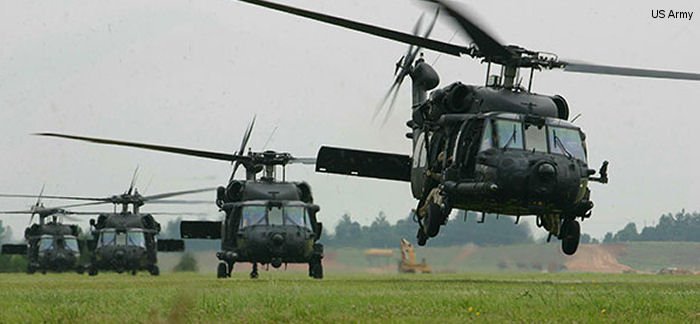

When a pilot completes an additional three to four years as a FMQ, he is then eligible to become flight lead qualified (FLQ). As one can see, the training never stops in the 160th and the experience level of the aircrews is outstanding.
History
After the disastrous 1980 Operation Eagle Claw attempt to rescue American hostages held in Iran, failed, President Jimmy Carter ordered the Pentagon to plan another rescue operation. At that time, there were no U.S. helicopter units trained to conduct a stealth, no-notice special operations mission. Especially one whose specialty was flying during hours of darkness.
The Army looked to Ft. Campbell, KY, home of the 101st Airborne Division, which had the most experience of the service’s helicopter units. The selected units immediately began intensive training in night flying.
This provisional unit was at first dubbed Task Force 158 since most of the pilots were Blackhawk aviators detached from the 158th Aviation Battalion. The new unit was quickly recognized as the Army’s premier night fighting aviation force, and its only special operations aviation force. The unit was officially established Oct. 16, 1981, when it was designated as the 160th Aviation Battalion.
The 160th first saw combat during 1983’s Operation Urgent Fury, the U.S. invasion of Grenada, and has been a part of every major conflict since. They became the first helicopter pilots to use advanced night vision goggles and forward looking infrared devices in night combat.

ADRIATIC SEA (September 21, 2009) An MH-47 Chinook helicopter assigned to the 160th Special Operations Aviation Regiment (Airborne) approaches the guided-missile destroyer USS Higgins (DDG 76) to conduct a fast-rope evolution during exercise Jackal Stone 2009. Jackal Stone is a series of training exercises in various locations throughout Croatia to promote cooperation and interoperability between the special operations forces of the 10 participating nations. (U.S. Navy photo by Chief Intelligence Specialist Louis Fellerman/Released)
In 1986, the unit was re-designated as the 160th Aviation Group, and became the 160th Special Operations Aviation Regiment in May 1990.
In June 1988, the unit executed Operation Mount Hope III. Two MH-47 crews flew 490 miles deep into Chad to retrieve a crashed Russian model Mi-24 Hind medium-attack helicopter.
The Night Stalkers spearheaded Operation Just Cause, the 1989 invasion of Panama, where a Little Bird flying members of Delta Force was shot down just after the operators rescued American Kurt Muse from a Panama City prison.
Less than six months later the Night Stalkers were sent to Kuwait for Operation Desert Shield in the summer of 1990 with follow-on combat operations in Iraq during Operation Desert Storm in 1991.
In 1993 the unit was sent to Somalia for Operation Restore Hope, the humanitarian mission where to support the UN’s mission to bring food and aid to the starving people that had been wracked by civil war. Once the clans run by warlords became too violent, the humanitarian mission turned to combat.
Operation Gothic Serpent (the Battle of Mogadishu) in 1993, was next. One of the Regiment’s most known battles was in Mogadishu, commonly known as “Black Hawk Down” in a book title as well as a feature film.
While supporting a team of Delta operators and Rangers trying to arrest top lieutenants of the clan run by Mohamad Farrah Aidid, the unit lost two Black Hawks to RPG fire from the ground. At the second crash site, only one crewman, pilot CW3 Mike Durant survived. Two Delta snipers, Randy Shughart and Gary Gordon deployed to protect him from a Somali mob numbering into the hundreds.
Despite inflicting severe casualties on the Somalis, both Shughart and Gordon were eventually killed in action while Durant was taken prisoner for a short time. Later both Delta snipers were awarded the Medal of Honor.
The war in Afghanistan, and across the Middle East have spawned the unit’s heavy operational use in Operation Enduring Freedom in Afghanistan and Operations Iraqi Freedom and Operation New Dawn in Iraq.
The unit suffered heavy losses in two separate engagements. During Operation Red Wings in 2005, a Night Stalker Chinook carry a SEAL Team Quick Reaction Force (QRF) on its way to rescue a small 4-man SEAL team under heavy fire was hit by an RPG. All eight SEALs on board and all eight Night Stalkers died in the crash.
Later another Chinook carrying U.S. and Afghan military forces on a night-raid mission in the Tangi Valley of Afghanistan’s Wardak province on August 6, 2011, was shot down by Taliban insurgents using an RPG. Thirty Americans and eight Afghans were killed in the attack and the helicopter’s subsequent crash. Seventeen of the U.S. servicemen killed were Navy SEALs, including 15 commandos from Naval Warfare Development Group (DEVGRU), better known as SEAL Team Six.
But perhaps the unit’s best-known success story was Operation Neptune Spear. A combined force of the 160th’s Chinooks and specially modified “stealth” Black Hawks carried SEAL Team Six (DEVGRU) from Afghanistan into Abbottabad, Pakistan on a mission to kill Osama bin Laden. One of the Black Hawks crashed into the compound and had to be subsequently destroyed by the crew and the SEALs to preserve the stealth secrets and avionics but the unit completed their mission and everyone was returned to Afghanistan safely.
On a personal aside, I’ve flown with Night Stalkers on all three types of their aircraft. We conducted fast rope missions out of Black Hawks and Chinooks and flew on the Little Birds which is an adrenaline rush that may be even better than being a jumpmaster on a C-130. My Night Stalker coin, given to me by a Company Commander in the 160th is one of my prized possessions.
Today there are more than 3,000 specially selected and trained Night Stalkers in the Regiment. So the next time you see a Special Operations unit conducting a high-profile mission on television or read about it in a newspaper, you can be sure who brought them to the target and who brought them home safely. “Night Stalkers Don’t Quit.”
Photo courtesy DOD
This article was originally published on SpecialOperations.com and written by







COMMENTS