Out in the world’s forgotten corners, America’s outposts still bet their lives on walls too thin, warnings too late, and the dangerous illusion that lightning never strikes the same place twice.
Read the full article for more on:
Important insights and detailed analysis
Expert commentary on current events
Breaking developments and updates
Updating summary...
The Next Benghazi: Are U.S. Outposts Still Soft Targets?
Guy D. McCardle
Speed
1x
Listen
COMMENTS
Out in the world’s forgotten corners, America’s outposts still bet their lives on walls too thin, warnings too late, and the dangerous illusion that lightning never strikes the same place twice.
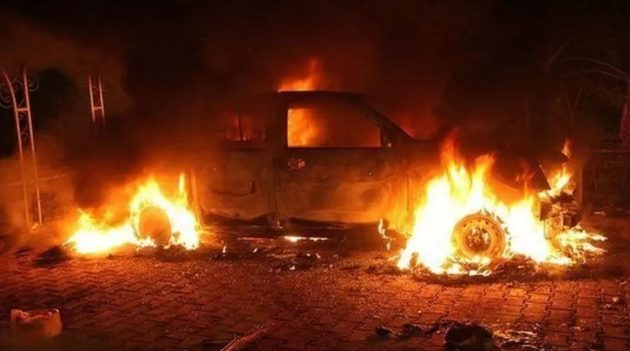
A vehicle burns inside the US consulate compound in Benghazi, Libya on September 11, 2012. AFP Photo
The first job of an overseas outpost is to survive the night. That should be obvious, but history has a habit of reminding us that obvious things can still get people killed. Benghazi did not introduce a new problem. It exposed an old one with brutal clarity: thin security, scattered intelligence, and the belief that American presence alone could ward off the wolves.
Advertisement
Yet here we are again, with small U.S. footprints across Africa, the Middle East, Eastern Europe, and the Pacific operating in the kind of gray zones where the State Department, the Central Intelligence Agency, and the Department of Defense overlap, collide, and occasionally try to ignore one another. These compounds often sit behind walls that look strong in daylight and useless once the shooting starts.
If you think the next Benghazi is impossible, you may not be paying attention.
Where the Threat Still Lives
Across north and west Africa, extremist groups treat embassies, liaison offices, and partner-training sites as trophies. Groups like al-Shabaab, ISIS affiliates, and Jama’at Nasr al Islam wal Muslimin hunt soft targets because they know they cannot win in a clean fight. They strike where security is thin, response time is slow, and political blowback is guaranteed.
Advertisement
Many American facilities in these regions rely heavily on host nation forces that are largely brave, underpaid, overworked, and often lacking the gear required to push back serious assaults. U.S. Marine Security Guards and regional security officers do what they can with the space and authority they are given, but the math remains unforgiving. A determined militant force with local knowledge can probe, test, and isolate an outpost long before the first burst of gunfire hits the gate.
Meanwhile, intelligence warnings are uneven. Some countries provide reliable insight. Others rely on rumor, local politics, or the hope that militants will strike someone else first.
Advertisement
Hope is not a security plan.
Why Quick Reaction Forces Are Still Too Slow
In the years since Benghazi, the United States has improved some of its response options. Africa now has more ready forces, more aircraft in rotation, and more intelligence coverage than before. Yet distance remains a killer.
A crisis unfolding in minutes cannot always wait for a team launching from a base hours away.
Advertisement
Even with modern airlift, diplomatic clearance issues, weather, and local air defenses slow the cavalry. Operators know this. Commanders know this. Congress pretends not to.
SOF units can do remarkable things, but they cannot break the laws of time and geography. When an outpost starts sending frantic calls for help, the defenders inside are often fighting alone for far longer than Americans back home realize.
Every review of the Benghazi attack pointed to the same themes:
Improvised facilities
Confused command relationships
Poor coordination between agencies
Overreliance on local militias
The uncomfortable truth is that several of these conditions still exist. They appear in different shapes and in different countries, but they persist.
A small compound with scattered responsibilities is far easier to build than a fortress. It is also far easier to destroy. Open-source reporting shows repeated warnings about extremist surveillance around U.S. diplomatic and intelligence facilities across Africa. The pattern is familiar: armed men observing from motorcycles, drones flying near perimeters, and local workers pressured to cooperate with militants.
None of this guarantees an attack. It simply proves the interest is there. As long as the United States maintains small footprints in unstable regions, that interest will continue.
While this photo was taken, the Libyan man shown here is explaining how the bloodstains were made by an American who grabbed the column during their evacuation from the besieged consulate in Benghazi. Image Credit: Mohammad Hannon / AP
A Culture Clash That Still Hurts Security
The danger is not only external. It is cultural. The Department of Defense plans for worst-case scenarios. The State Department often plans for continued engagement, access, and mobility. These approaches do not always meet in the middle.
Inside certain embassies, the tension between diplomacy and security simmers. Some ambassadors push back against hardening facilities because it sends the “wrong message.” Others lobby for reduced military presence. In a stable country, that may be fine. In a place where the local police need help loading their own rifles, it is wishful thinking.
This is where a sober voice is needed. We here at SOFREP know that when security loses an argument to optics, someone eventually pays in blood. In a world exclusive, contributing author and former CIA targeting officer Sarah Adams and Benghazi survivor David “Boon” Benton co-wrote a hard-hitting piece revealing the identities of the Benghazi mortar team for the first time. We’re not about to back away from this topic one bit.
Are We Ready? The Honest Answer
Some outposts are ready. Many are not. Too many rely on luck, distance, vague agreements, and the belief that lightning will not strike twice. Yet lightning does not care about politics. It only needs a target.
The next Benghazi will not look identical to the last. It may happen in the Sahel, the Horn of Africa, or a fragile Pacific island state caught between great power competition. It will begin with warning signs that went unread, interrogations of local guards who were trying their best, and quiet messages between agencies that never fully aligned.
If there is one thought worth carrying forward, it is this: preparation is far cheaper than rescue.
That simple truth should guide every outpost that flies the American flag.
—
** Editor’s Note: Thinking about subscribing to SOFREP? You can support Veteran Journalism & do it now for only $1 for your first year. Pull the trigger on this amazing offer HERE. – GDM
Advertisement
What readers are saying
Generating a quick summary of the conversation...
This summary is AI-generated. AI can make mistakes and this summary is not a replacement for reading the comments.










COMMENTS