
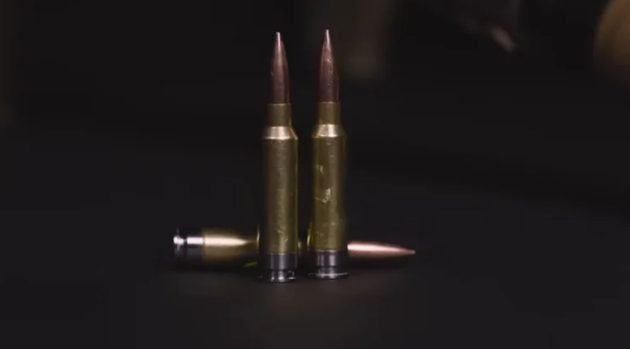
The SIG Sauer M7 and M250 were not chosen in isolation. They were selected to work together from the ammo up. The Army selected them as a matched set, built around a single idea: one cartridge that can feed both the rifleman and the gunner without forcing either role to accept the kind of performance mismatch that comes from mixed-caliber solutions. That cartridge is the Army’s 6.8 Common Cartridge family of ammunition, commonly referred to as 6.8×51mm.
The US Army awarded SIG Sauer a 10-year production contract on April 19, 2022, for what were then known as the XM5 rifle and XM250 automatic rifle, along with the associated ammunition family. The weapons were later designated as the M7 and M250. On paper, that decision looks like a simple caliber change. In practice, it is a squad-level design choice.
The Cartridge Is the System
The 6.8×51mm concept is tied to pressure and packaging as much as bullet diameter. The commercial counterpart to the Army’s cartridge family is .277 SIG FURY, which the Sporting Arms and Ammunition Manufacturers’ Institute recognizes with a maximum average pressure of 80,000 psi. That pressure ceiling is a key enabler of higher performance from a relatively compact package.
This helps explain why the Army treated ammunition and weapons as a single acquisition issue under the Next Generation Squad Weapon program. Rather than selecting a cartridge and forcing platforms to adapt, the Army pursued a system intended to deliver increased range, accuracy, and retained energy against modern threats.
The ammunition plan reflects that systems approach. The Army has publicly identified multiple 6.8 mm loads intended for both operational use and training. These include the XM1186 General Purpose round and the XM1188 Reduced Range training round, which is designed to allow use on more training ranges by reducing surface danger zones. The goal is not a single high-performance round, but a family of ammunition that supports real-world employment and sustainment.
Commonality at the Squad Level
When the rifle and the automatic rifle operate within a closely aligned ballistic performance envelope, the squad gains options that are difficult to achieve with mixed calibers.
Resupply becomes less fragile. When a weapon runs dry, leaders are not forced into a caliber management problem under pressure. Rifle magazines and machine-gun belts remain distinct, but the underlying ammunition supply chain can be simplified, making planning more resilient.
Effects also become more predictable. In legacy configurations, the rifleman and the gunner often occupied different ballistic neighborhoods. The automatic weapon could dominate through volume, while the individual rifleman could be limited at distance or through intermediate barriers. A common 6.8 mm family gives leaders the opportunity to align rifle and automatic rifle effects more closely than mixed-caliber squads have allowed in the past.
Signature management is another area where commonality matters. The Next Generation Squad Weapon program was built with suppressor integration as a baseline requirement, not an afterthought. Reporting on the program has described continued refinement of suppressor designs to address issues such as weight, length, and shooter exposure to gases. Suppression is treated as part of the system, not an optional accessory.
High Energy
The paired-system approach does not eliminate tradeoffs. It shifts where they live.
A higher-energy cartridge can bring increased recoil impulse and greater heat management demands. It also places a premium on shooter fundamentals and training discipline. At the same time, it changes how the squad’s automatic rifle can be employed. The M250 is not only a volume-of-fire tool. It is intended to be a reach and control asset.
The Army’s stated objectives for the M250 include improved accuracy, extended range, enhanced signature management, and increased lethality compared to legacy systems. If those gains hold under sustained use, the squad’s base-of-fire option gains more reach and more authority over terrain, allowing leaders to fix threats, protect movement, and shape the fight with greater consistency.
A squad does not win firefights with specifications alone. It wins with timing, control, and pressure applied at the right place. A common cartridge across rifleman and gunner helps those fundamentals work with fewer seams.
Bottom Line
“One cartridge, two roles” is not marketing language. It reflects an attempt to make the squad’s two primary small-arms roles speak the same ballistic language. The SIG M7 and M250 are the hardware. The 6.8 Common Cartridge family is the connective tissue. If the concept holds up under hard use, the payoff is a simpler sustainment picture and a more consistent set of effects across the squad when it matters most.








COMMENTS