Maduro Captured in U.S. SOF Operation
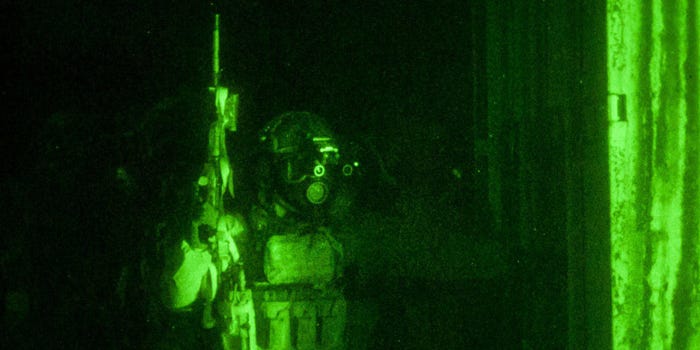
SOFREP has confirmed through multiple sources, including reporting by CBS News and senior officials speaking on background, that Delta Force, with maritime support from DEVGRU (SEAL Team Six), and 160th SOAR conducted the pre-dawn special operations raid that captured Venezuelan leader Nicolás Maduro and his wife Cilia Flores early January 3.
According to U.S. and SOFREP sources, the operation took place around 2 a.m. local time at the couple’s residence inside the Fort Tiuna military installation in Caracas. The pair were seized without confirmed U.S. casualties and rapidly exfiltrated by air, then transferred to the U.S. Navy amphibious assault ship USS Iwo Jima, currently operating in the Caribbean.
President Donald Trump publicly confirmed the capture, stating that Maduro and Flores are “headed to New York” to face prosecution. The Associated Press reports that U.S. Attorney General Pam Bondi said the pair would “soon face the full wrath of American justice,” referencing long-standing U.S. indictments tied to narcotics trafficking and narco-terrorism that date back to 2020 and were reaffirmed under the current administration.
President Trump also stated that the United States would “run the country for a while” as Venezuela transitions away from Maduro’s rule, framing the move as a temporary stabilization effort rather than a permanent occupation. No formal transitional authority has yet been announced.
Inside Venezuela, multiple outlets and social media footage show public celebrations erupting in parts of Caracas and opposition strongholds following news of the capture.
Videos show crowds chanting anti-Maduro slogans, fireworks, and regime symbols being torn down. At the same time, senior regime figures have issued inconsistent statements, and Venezuelan authorities have not released proof of life for Maduro.
These developments align with earlier confirmed events, including overnight explosions, low-flying aircraft over Caracas, and a nationwide state of emergency declared by Maduro’s government in the immediate aftermath of the raid.
The Pentagon has not publicly confirmed unit-level involvement, referring questions to the White House. As of this writing, no formal Department of War or Department of Justice charging documents have been released.
This remains a fast-moving situation. Additional confirmation, legal filings, and international reaction are expected.
Stay with SOFREP for verified updates as this story continues to unfold.
Already have an account? Sign In
Two ways to continue to read this article.
Subscribe
$1.99
every 4 weeks
- Unlimited access to all articles
- Support independent journalism
- Ad-free reading experience
Subscribe Now
Recurring Monthly. Cancel Anytime.
The Coast Guard launched an HC-130J toward waters near the Mexico-Guatemala border in response to the Dec. 30 strike. U.S. Marine Corps photo by Cpl. Jade K. Venegas.
U.S. Airstrikes Sink Narco-Trafficking Boats as Coast Guard Search Ends With No Survivors Found
U.S. military airstrikes against suspected narco-trafficking vessels in international waters continue to escalate, with new details emerging from late December operations that left multiple boats destroyed and dozens dead across the broader campaign.
According to U.S. Southern Command, Joint Task Force Southern Spear conducted coordinated airstrikes on December 30 against a convoy of three vessels operating along known narcotics trafficking routes in the Eastern Pacific. Intelligence indicated the boats were actively transferring drugs between them when the strike was authorized.
Three individuals were killed in the initial strike. Survivors from two of the boats reportedly jumped into the water and attempted to distance themselves before those vessels were deliberately sunk. U.S. officials notified the Coast Guard immediately following the strike, triggering a large-scale search and rescue effort.
The Coast Guard later confirmed it was alerted to people in the water roughly 400 nautical miles southwest of the Mexico-Guatemala border. That location alone underscores the reality of the situation. This was not a coastal mishap. It was deep-ocean recovery under extreme conditions.
Coast Guard aircraft and vessels searched for more than 65 hours, covering approximately 1,090 nautical miles. Assets included an HC-130J aircraft out of Sacramento and multiple commercial vessels participating in the Automated Mutual-Assistance Vessel Rescue system.
Crews battled nine-foot seas and winds reaching 50 miles per hour.
No survivors were found. No debris was recovered. The search was suspended between January 2 and 3.
Capt. Patrick Dill, commander of Coast Guard Sector San Diego, stated bluntly that survival odds were extremely low given the elapsed time, environmental conditions, and available resources for anyone in the water.
That assessment was clinical, not political.
The December 30 strike was followed by two additional airstrikes on December 31 targeting other suspected drug-smuggling boats. SOUTHCOM confirmed five more people were killed in those follow-on attacks but did not disclose their locations.
Taken together, these strikes are part of a broader campaign that has intensified sharply since September. U.S. forces have conducted more than 30 strikes on alleged narco-trafficking vessels during that period, with at least 115 people killed.
These operations fall under Operation Southern Spear, an effort directed by Secretary of War Pete Hegseth to disrupt maritime drug trafficking networks now formally designated as terrorist organizations. U.S. officials frame the campaign as targeting logistics, revenue streams, and operational mobility rather than individual smugglers.
From a military standpoint, the strikes reflect a shift from interdiction and seizure to denial and destruction. Once boats are confirmed as hostile trafficking platforms, they are treated as expendable nodes, not law enforcement problems.
The Coast Guard’s role remains clear and unchanged. When people enter the water, search and rescue is initiated, regardless of circumstances.
Second off-duty NYPD cop saves baby during holiday season. Image Credit: Yahoo News
Off-Duty NYPD Officer Saves Choking Infant in Long Island Home
An off-duty New York City police officer saved the life of a one-year-old girl earlier this month after she began choking inside her family’s home in Elmont, Long Island, according to reporting by PIX11 and confirmed by multiple outlets.
Officer Freddy Cerpa, assigned to the NYPD’s 43rd Precinct in the Bronx, was fresh out of the police academy, just seven months on the job, when the incident occurred on December 7. Cerpa was at home when neighbors, longtime family friends, began pounding on his door in a panic. Their one-year-old daughter was not breathing.
The child had been sick with a cold and began choking on mucus, a high-risk situation for infants who lack the strength and coordination to clear their own airways. Cerpa immediately took control using first aid techniques taught during academy training.
For infants under one year old, choking response differs significantly from adult procedures. The Heimlich maneuver is not used. Instead, Cerpa positioned the child face-down along his forearm, supporting her head and neck, and delivered firm back blows between the shoulder blades. The intent is controlled force, using gravity and percussion to dislodge the obstruction without causing injury.
After several back blows, the child’s chest rose and airflow returned.
By the time EMS arrived, the infant was breathing on her own. She was transported to a hospital for evaluation and later made a full recovery, according to her parents.
Cerpa reached the child faster than a 911 call could be processed. There was no uniform, no radio, and no backup. Just proximity, training, and the ability to act under pressure.
“This is what we train for,” Cerpa later said in remarks shared by the NYPD. “Preserving life is the job.”
The rescue was not isolated. About two weeks earlier, NYPD Detective First Grade Michael Greaney saved the life of an eight-month-old baby along the Bronx River Parkway using the same back-blow technique. That rescue was captured on video and widely shared on social media.
The NYPD later amplified Cerpa’s rescue on its official platforms, emphasizing that officers are never truly off duty and urging the public to pursue CPR and first aid training through organizations like the Red Cross and FDNY.
Cerpa echoed that message. Training works. When seconds count, professional help is usually minutes away.