

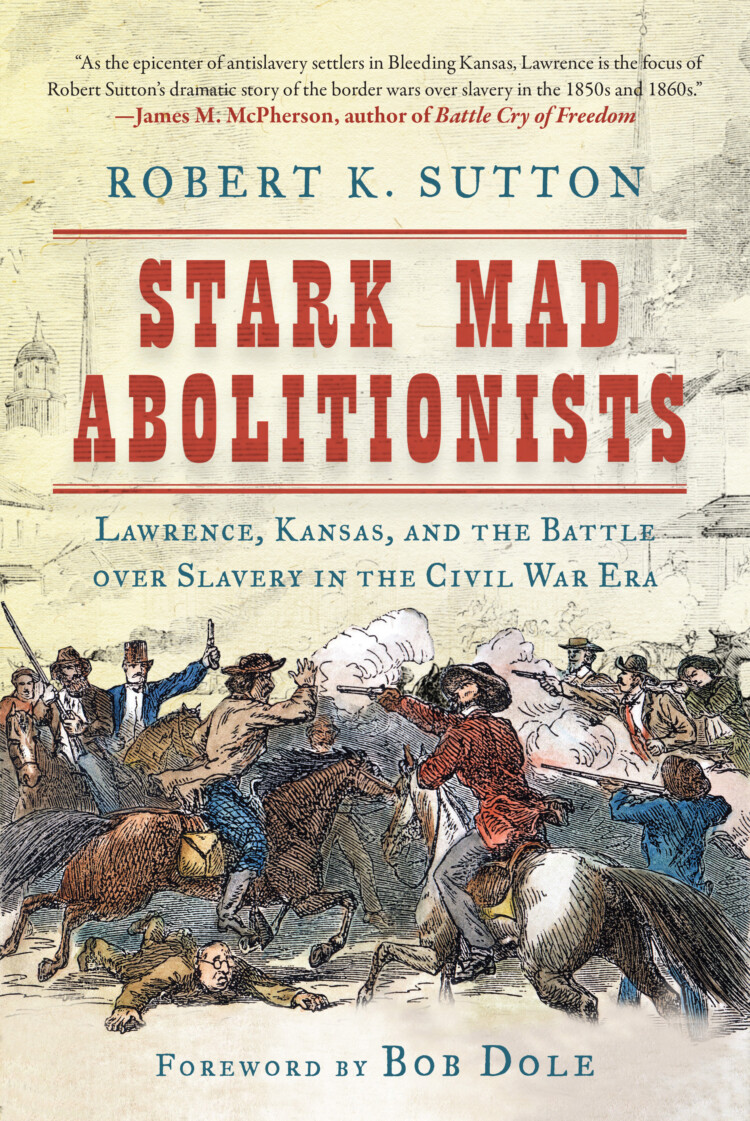
In May, 1854, Massachusetts was in an uproar. A judge, bound by the Fugitive Slave Law of 1850, had just ordered a young African American man who had escaped from slavery in Virginia and settled in Boston to be returned to bondage in the South. An estimated fifty thousand citizens rioted in protest. Observing the scene was Amos Adams Lawrence, a wealthy Bostonian, who “waked up a stark mad Abolitionist.” As quickly as Lawrence waked up, he combined his fortune and his energy with others to create the New England Emigrant Aid Company to encourage abolitionists to emigrate to Kansas to ensure that it would be a free state.
The town that came to bear Lawrence’s name became the battleground for the soul of America, with abolitionists battling pro-slavery Missourians who were determined to make Kansas a slave state. The onset of the Civil War only escalated the violence, leading to the infamous raid of William Clarke Quantrill when he led a band of vicious Confederates (including Frank James, whose brother Jesse would soon join them) into town and killed two hundred men and boys.
Stark Mad Abolitionists shows how John Brown, Reverend Henry Ward Beecher, Sam Houston, and Abraham Lincoln all figure into the story of Lawrence and “Bleeding Kansas.” The story of Amos Lawrence’s eponymous town is part of a bigger story of people who were willing to risk their lives and their fortunes in the ongoing struggle for freedom and equality.
Stark Mad Abolitionists
AI Overview
Summary is AI-generated, newsroom-reviewed.
A town at the center of the United States becomes the site of an ongoing struggle for freedom and equality.In May, 1854, Massachusetts was in an uproar. A judge, bound by the Fugitive Slave Law of 1850, had just ordered a young African American man who had escaped from slavery in Virginia and settle
Read the full article for more on:
- Important insights and detailed analysis
- Expert commentary on current events
- Breaking developments and updates
A town at the center of the United States becomes the site of an ongoing struggle for freedom and equality.In May, 1854, Massachusetts was in an uproar. A judge, bound by the Fugitive Slave Law of 1850, had just ordered a young African American man who had escaped from slavery in Virginia and settled in […]
What readers are saying
Generating a quick summary of the conversation...
This summary is AI-generated. AI can make mistakes and this summary is not a replacement for reading the comments.








COMMENTS