


John Wukovits
St. Martin’s Press
On October 25, 1944, the Samuel B. Roberts, along with the other twelve vessels co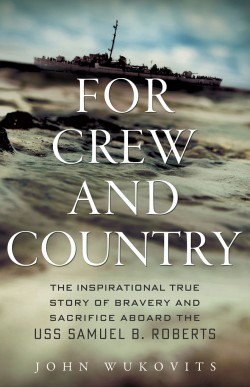 mprising its unit, stood between Japan’s largest battleship force ever sent to sea and MacArthur’s transports inside Leyte Gulf. Faced with the surprise appearance of more than twenty Japanese battleships, cruisers, and destroyers, including the Yamato, at 70,000 tons the most potent battlewagon in the world, the 1,200-ton Samuel B. Roberts turned immediately into action with six other ships. Captain Copeland marked the occasion with one of the most poignant addresses ever given to men on the edge of battle: “Men,” he said over the intercom, “we are about to go into a fight against overwhelming odds from which survival cannot be expected.”
***
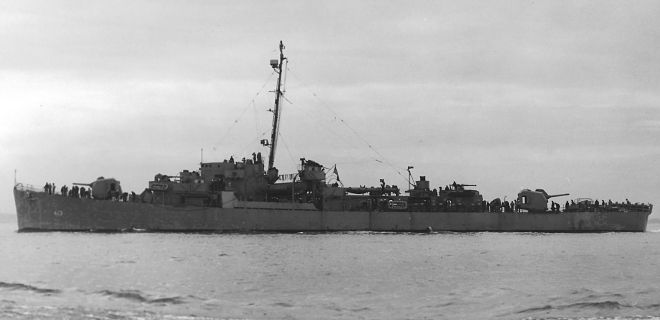
Rarely has a hotel hospitality room held such a collection of unassuming sea warriors as the one that gathered in San Pedro, California, in August 1982. They had come from Utah and Virginia, Michigan and Arizona, and more than ten states in between. They set aside garage tools and law books, left schoolrooms, farms, factories, and police stations, and made room in packed schedules, because of their shared bond. As shipmates of the World War II destroyer escort USS Samuel B. Roberts (DE-413), they came to honor their skipper, Robert W. Copeland. His command of the feisty destroyer escort thirty-eight years earlier had catapulted him to the ranks of admiral and earned him the rare honor the United States Navy was bestowing that August 7, 1982: naming a warship of the fleet after him. The frigate, USS Copeland (FFG-25), would that day be commissioned.
The aging men, most in their fifties and sixties, had shared the same dangers-some were, in fact, at his very side-in 1944 when Copeland turned his diminutive vessel toward those Japanese battleships and cruisers intent on annihilating his ship. Despite being badly outgunned, Copeland charged the foe in a David-and-Goliath feat that prodded one deputy chief of naval operations to call the vessel “the destroyer escort that fought like a battleship.” They wanted to be with the Copeland family today, their skipper’s second moment of triumph.
They came out of respect and love, for their commander and for each other. Red Harrington, labeled “the bearded and tattooed Boatswain” by the ship’s newsletter in September 1944, was one of those venerable chiefs that helped every skipper run a ship. He was all navy, and his gruff ways and piercing glare had unnerved more than a few seamen, some of whom thought his flowing red beard gave him the visage of a buccaneer of yore rather than a navy chief.
***
In For Crew and Country, John Wukovits tells of the most dramatic naval battle of the Pacific War and the incredible sacrifice of the USS Samuel B. Roberts.








COMMENTS