

The scout elements returned and informed the company commander that this appeared to be the best place. They also noted that within 500 meters, the ground was a spider web of trails, some quite recently used.
The company, reacting to silent signals from the NCO’s, began to disperse to best positions alongside reasonably substantial trees and avenues of observation. The squad leaders placed the LMG positions to best advantage and tapped personnel for the night OP mission to their front. There would be less than an hour of useable daylight.
No smoking. Chow now. Rucks to the front and weapons out. Claymores, trips and flares to the front. The personnel selected for the Night OP tasks were removed to the rear-one two-man OP per platoon. They quietly moved out while the SL insured everyone knew of the location and placed the Claymores so as to avoid back blast injuries. The OP itself, took three Claymores as well as some trip flares.
The SL moved out with the OP and selected the best position as well as the placement of the Claymores and trips. Insofar as possible, he tried to find a large tree or rock outcropping that he could place the OP in front of. This would protect the OP from outgoing friendly fire should the NVA ignite a flare or fire into the position. The OP was to remain in place regardless of circumstances. Experience had shown that attempting to re-join the perimeter in the midst of a firefight was a very bad idea.
For the moment, once disposed, the troops began a very low murmur of conversation as they quietly ate what C rats they wished and arranged their gear for the night. The SL’s went amongst them establishing the sleep schedule and radio watch. It was the period between establishment of the perimeter and dark that the greatest amount of smokeless tobacco was consumed. By morning, empty snuff cans marked the troop locations.
The company commander quietly read his map while the artillery FO set his Defensive Concentrations (DEFCONs). They would be set but not fired. The unit had so far avoided contact during the day and wanted to stay that way.
The CP arranged itself for the night in a tested configuration. The radios were stacked back-to-back in the center. Each man, Co commander, Arty FO and the two RTO’s and the Secure set asst RTO, all arranged themselves in a circle, head next to the radio stack. They would rotate radio watch on a hourly basis. This insured that each man in the CP would get around five hours of uninterrupted sleep. The CO always took the first and last watch.
“Musty Races. Musty Races. This is Dragon Control. If you Roger this transmission, break squelch twice. Over.”
“Squeak, Beep. Beep.Beep. Beep. Beep.”
“Dragon Control. Roger. Out.” And so it went.
Night quickly descended with its velvet black shroud over the company, wrapping each individual in his own mental and physical cocoon. Here, both the human sensors and the sinews of the mind took hold.
The jungle, hitherto silent, began to dominate. The millions of insects, grubs and other members of the primordial, constantly recycling population, began their movements in search of food and mates. Small phosphor trails began to make their presence known. Green dancing lines suddenly appeared then disappeared. Small flashing green and blue dots danced in the air. Small indecipherable rustles, snaps and buzzes rendered the silence moot. High pitched wing beats assailed the men in search of the liquid of the eyes, the inner recesses of the ear and other orifices.
Deeper, a tiger might roar or pigs and deer begin their nightly rooting and mating calls. To the soldiers, now hunkered behind their rucks, watched and listened, attempting to discern threat from acceptable companions.
The deep silence was occasionally broken by the intermittent noises of a nation at war. The deep rumble of a B52 arclight, the high squeal of a Puff with its red spiraling message and the rhythmic thunder of artillery rolled through the perimeter. For those in the position to see through the canopy, the green spiraling flares of a distant action would mark the dark blanket of the night.
On the OP’s, the NCO’s had paired vets with Cherries to insure maturity and appropriate response in an isolated position. New units in country were easily identifiable by a nighttime filled with shots at shadows, imagined infiltrations and simply the plain fear of firing to somehow assuage the utter loneliness associated with the unknown. This would not happen with this company. Their independent survival depended upon stealth and secrecy. An inadvertent Claymore blast or a shot at shadows could compromise the entire unit in a deeply resourced NVA enclave. The phosphors would have to show a rubber soled foot or a pith helmet to warrant response.
On the OP, the sense of isolation and fear was pronounced. Separated from the main body by a good distance, the two occupants were truly in No Man’s Land and on their own until dawn. No retreat to the perimeter would be allowed-for their own safety.
The Claymores, arranged as booby traps along the avenues of approach as earlier dictated by the SL, further increased the likelihood of contact, heightening tension. Sleep would be impossible with the accumulating adrenalin.
The two on OP found a small space, ideally with some form of rock or log protection and a decent amount of viewing distance in front. They arranged two aligned sticks to indicate each Claymore and Trip Flare location. It could suddenly be very busy and the sticks would recall what the nervous and reactionary soldier might forget.
Each soldier would soon be lost in his own thoughts as the darkness and its denizens achieved sensory dominance. “What’s out there? What’s that? Do I hear footsteps? And so the night passed. If a quiet night. How many more to go?
The morning light creeps through the Deep Green as cat paws in a corn field. Subtle, indiscernible and suddenly on top. When the light was visible enough to see an entire platoon line, the NCO’s moved along waking their men and directing the usual SOP work.
Wipe the weapons with an oily rag. Regain the Claymores and Trips after alerting the perimeter. Pack the jungle ponchos and rain gear. Fix the straps on the ruck. Eat what you can and do it NOW.
Heat tabs would emerge with individual and paired C ration stoves. The perimeter immediately groaned, exhaled and cursed as “bad tabs” wafted half burned gasses across their immediate companions. Coffee was quickly heated with the more adventuresome employing a small ball of C4 vice the heat tab.
The company commander had tolerated this and had always ordered a number of C4 blocks on log day for general distribution to remove the temptation of taking C4 from the back of the claymores. This gained him immediate credit points in the mind of his troops. In his mind, C4 was far less discernible in the bush than heat tabs. No point in tempting fate at Stand To.
In the CP, the CO, on last watch, quietly woke his crew. They stirred and began their routines. Key was the setting of the day’s secure code gun for the secure radio. This was a black, divisible aluminum encased device with an entrenching tool type handle that would plunge the carefully arranged contents into the secure radio allowing connection with the battalion. Open, it revealed a large quantity of small chrome rods arranged in rows below a series of letters. Each day, the arrangement changed, requiring the RTO to engage or disengage the appropriate three letter pod.
Upon Log Day, the company would receive seven days of codes. In that Log Day was scheduled for every fourth day, this was an insurance policy for delays, which were fairly common, especially during the Monsoon.
The “Sun Gun” as it was called, was complicated to arrange, especially for large fingers and distracted minds. Accordingly, it usually took two or three tries by different members of the CP before the welcome “Buzz. Bounce. Squelch” was heard from Dragon TOC.
As this was going on, the Internal operator made a coffee can of instant coffee and Swiss Miss. This allowed all members of the CP to have a half canteen cup of the mixture. He carried the can tied to his ruck presenting the picture of a wandering hobo.
The CO had selected him for the job due to his keen attention to detail and innate intelligence. Managing the internal administration, logistics requests and actual exact numbers on “Lift Day,” required all the capability that the Birmingham, Alabama segregated public school system could provide. Between he and the Arty FO, they knew they would run the company in combat if the CO was out of action. For these reasons, he and the CO were close and spoke to each other on a near equal basis. He had a preternatural understanding of what the CO wanted and almost always pre-empted a prompt. If there was such a thing as a Deputy commander, it was him-despite his SP4 rank.
For a brief moment, the unit was resting before the day’s endeavors and intuitively honored this pause. Coffee was drunk, gear was cleaned and packed and some just did nothing.
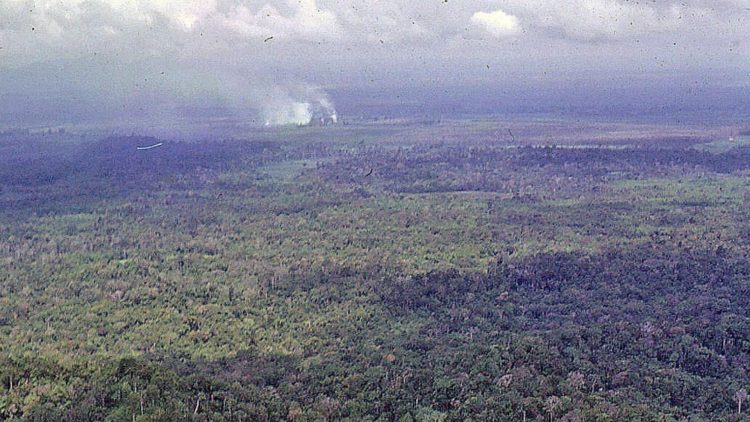
The Captain sank into an introspective mode. He could see the hills well beyond him. The steaming green was releasing visible vapor as a breathing giant. He knew the Green was a huge living organic machine absorbing liquid, digesting nutrients and expelling the detritus of its exertions. It was into this living corpus that he and his men trespassed. If they did not exert their available resources, they too would be recycled within the giant and expelled on some isolated mountain slope, invisible to the onlooker but appreciated by the processes under the fetid canopy.
This reverie took less than five minutes when the CO alerted to the day and signaled to prepare to move out. Slowly, the long winding centipede of soldiers raised themselves from the ground, slung their rucks over tired shoulders and with the help of others arranged the heaviest of rucks to a reasonably portable position on the back.
They stood as one and awaited the signal to move out to the day’s events. It had been a welcome uneventful night. There would be many more nights, some much more eventful. It was the Tour.








COMMENTS