CSS Virginia crushed wooden Union ships at Hampton Roads, proving ironclads would dominate naval warfare and reshape global sea power forever
Read the full article for more on:
Important insights and detailed analysis
Expert commentary on current events
Breaking developments and updates
Updating summary...
On This Day March 8: Hampton Roads Battle Ends Wooden Navy Era Forever
Guy D. McCardle
Speed
1x
Listen
COMMENTS
CSS Virginia crushed wooden Union ships at Hampton Roads, proving ironclads would dominate naval warfare and reshape global sea power forever
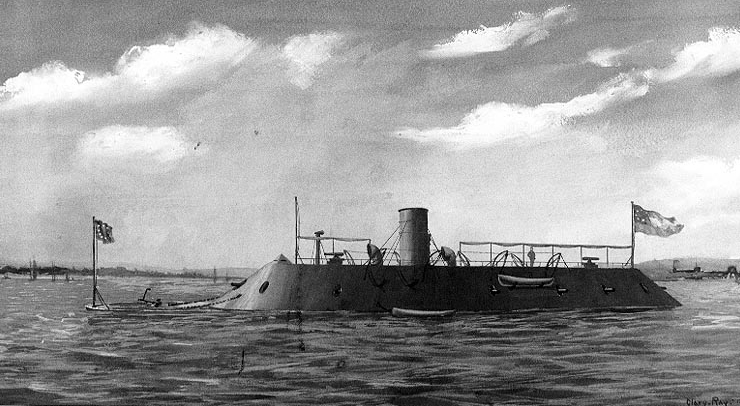
An artwork depicting the CSS Virginia. Image Credit: Wikimedia Commons
On March 8, 1862, Hampton Roads, Virginia, became the stage for a naval clash that would change warfare at sea forever. The Confederate ironclad CSS Virginia (rebuilt from the captured Union scuttled steam frigate USS Merrimack) launched a devastating assault on the wooden Union warship. By ramming the USS Cumberland and setting the USS Congress ablaze, Virginia revealed the vulnerability of traditional wooden fleets and heralded the age of armored naval power.
Advertisement
Scuttled Frigate to Iron Monster
Virginia’s story began at the Norfolk Navy Yard, abandoned by Union forces in April 1861 during Virginia’s secession. The Union had scuttled the powerful 40-gun screw frigate Merrimack before fleeing. Confederate engineers, led by John L. Porter and backed by Secretary Stephen Mallory, saw potential in the wreck. They removed its burned upper works and encased the hull in two layers of iron (four inches thick overall), angled at 45 degrees to deflect incoming fire.
Commissioned on February 5, 1862, Virginia weighed 4,000 tons, carried ten guns (including six 9-inch Dahlgrens and two 7-inch Brooke rifles), and reached six knots under steam and sail. During trials, Union cannonballs bounced harmlessly off her iron plating.
Lieutenant John Taylor Wood called her “a floating fortress, impervious to the old navy.” Drawing inspiration from European experiments like France’s Gloire, Virginia became the first ironclad to wield such power in combat.
Advertisement
March 8: Virginia’s Rampage
At dawn, Flag Officer Franklin Buchanan led Virginia into Hampton Roads from the Elizabeth River. Union blockaders including USS Cumberland (24 guns) and USS Congress (50 guns) stood guard near Norfolk and Fort Monroe. Buchanan first targeted the Cumberland, the strongest ship off Newport News.
Virginia closed to point-blank range and unleashed broadsides. Cumberland’s shots bounced off; Virginia’s tore through oak hulls. When cannon fire wasn’t enough, Buchanan ordered a ramming attack at seven knots. Virginia’s reinforced prow pierced Cumberland’s starboard side, opening fatal gashes. By 9:30 a.m., Cumberland sank stern-first, claiming 121 crewmen, including Lt. George Morris, who stayed at his post.
Advertisement
Chromolithograph depicting the Battle of Hampton Roads. Image source: Wikimedia Commons
Next, Virginia pounded the aground USS Congress, which surrendered after being set ablaze. Buchanan was wounded and relieved by Lieutenant Catesby ap Roger Jones, but Virginia withdrew at dusk with only light damage, having crippled the Union squadron and lifted Southern morale.
The Federals Strike Back: Monitor Arrives
The drama continued March 9, when the USS Monitor, the Union’s revolutionary “cheesebox on a raft,” arrived from New York. Designed by Swedish inventor John Ericsson, the low-freeboard ironclad featured a revolving turret with two 11-inch Dahlgrens and drew just 10 feet of water.
For four hours, the ironclads traded fire at 10–20 yards, neither able to pierce the other’s armor.
Advertisement
Monitor saved the Union fleet, though poor sea conditions prevented a follow-up attack. Virginia retired to Norfolk and was scuttled weeks later as Confederates evacuated.
The battle ended as a tactical draw but a strategic win for the Union, preserving its blockade.
Hampton Roads made wooden navies obsolete overnight. Britain and France accelerated their ironclad programs, and by war’s end, over 50 Union monitors patrolled rivers. The battle influenced dreadnought designs into the 20th century and foreshadowed steel giants like HMS Warrior.
The clash showcased Civil War ingenuity: Confederates innovated defensively, Union offensively. Casualties totaled 280, mostly from Cumberland.
Today, relics like Cumberland’sbell survive in museums, and annual reenactments at the Mariners’ Museum honor the moment when sail and oak gave way to steam and steel that reshaped naval warfare for generations.
Advertisement
What readers are saying
Generating a quick summary of the conversation...
This summary is AI-generated. AI can make mistakes and this summary is not a replacement for reading the comments.












COMMENTS