

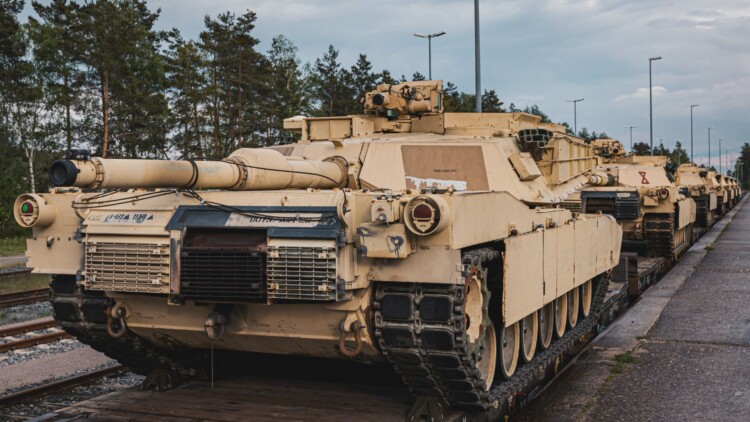
Strategic Deployment and Secrecy
However, it’s important to note that the deployment of these Abrams tanks to the battlefield may not occur immediately.
Ukrainian forces reportedly prioritize establishing necessary support elements and carefully planning to maximize their effectiveness. As a result, the specific locations of the tanks are expected to remain undisclosed for obvious security reasons to prevent them from becoming vulnerable to precision strikes before being fully engaged in battle.
Western Support Falls Short of Target
The arrival of the Abrams tanks is a significant achievement by Western allies, driven by persistent appeals from Ukraine.
The US military personnel initiated training for Ukrainian forces in late spring – spanning 12 weeks – to ensure proficiency in operating these advanced armored vehicles. The training took place at American military facilities in Germany, providing Ukrainian troops with in-depth instruction.
Despite the delivery of the Abrams tanks, Ukraine’s current inventory still falls significantly short of its goal.
According to Colonel Markus Reisner of Austria, who closely monitors the conflict, Ukraine had articulated a need for a minimum of 300 Western tanks to bolster its counter-offensive capabilities.
In contrast, Russia maintains a robust tank production capability, with an annual output of around 200 tanks. This glaring gap underscores Ukraine’s requirement for additional Western tanks to address the disparity in armored capabilities.
The Formidable M1 Abrams Tank
The M1 Abrams tank, known for its battlefield prowess, boasts advanced features such as the M256 120mm smoothbore gun, capable of firing armor-piercing projectiles. During Desert Storm, it demonstrated remarkable effectiveness against Soviet-made Т-72 tanks, with minimal losses. The tank has undergone multiple modernizations since then.
However, the limited number of Abrams tanks delivered is unlikely to substantially impact Ukraine’s counter-offensive efforts. Instead, the US decision to supply these tanks is viewed as a diplomatic gesture, influencing other countries like Germany to authorize the provision of additional heavy weapons and platforms to Ukraine.
Evolving Battlefield Dynamics: Drones and Vulnerabilities
Meanwhile, questions have arisen about the effectiveness of the Abrams tanks in Ukraine’s conflict, particularly in the absence of air superiority.
Concerns have been raised about their vulnerability to precision strikes from drones, which have become increasingly prevalent on the battlefield.
Gustav Gressel, a military expert at the European Council on Foreign Relations, highlighted to reporters the evolving threat landscape and the need for adaptive strategies and defenses. He emphasized that the rapid proliferation of drones has made Abrams tanks more susceptible to attacks, diminishing their potential impact on the ground.
Gressel noted that Ukraine could have gained a strategic advantage in 2022 with access to Western battle tanks, considering Russia’s limited UAV capabilities at the time. However, this advantage has waned as drone technology has advanced.
Challenges in Handling and Support
Retired Russian Colonel Sergey Suvorov, on the other hand, pointed out that the effectiveness of Western-made tanks provided to Ukraine was often compromised due to inadequate handling and support. Ukrainian forces frequently dispatched these tanks without essential precautions, leaving them vulnerable to Russian weaponry.
Suvorov explained, as reported by state media, that the Ukrainian command often dispatched Western equipment without adequate support, neglecting essential precautions like safe passage through minefields or conducting thorough reconnaissance. As a result, these tanks often found themselves vulnerable and exposed, making them easy prey for various Russian weaponry.
These are the indicative estimates of Russia’s combat losses as of Oct. 4, according to the Armed Forces of Ukraine. pic.twitter.com/4sLr3RbzUm
— The Kyiv Independent (@KyivIndependent) October 4, 2023
~
The early arrival of American-made Abrams tanks represents a significant development in Ukraine’s ongoing counter-offensive efforts against Russian forces. While these tanks are a valuable addition to Ukraine’s armored capabilities, they may face challenges in an evolving battlefield marked by the proliferation of drones. Nonetheless, this delivery underscores the continued support of Ukraine by its Western allies and their commitment to bolster its defense against Russian aggression.








COMMENTS