

No one knows who actually fired “the shot heard ‘round the world,” but the fighting had commenced. The British easily swept aside the militia but were decimated in Concord by the increasingly swelling numbers of colonial militia and civilians armed with their muskets.
The militia didn’t fight as European armies did: in a line and in tight formation. They fought unconventionally, as they had against the French and Indians, as irregulars, behind trees and stone walls. But they still operated under a centralized command.
The colonists sniped and nipped at the British all the way back through Lexington. They were exhausted and nearly out of ammunition. But then a British brigade under the command of Earl Hugh Percy, with 1,000 fresh troops met them at 1430 hrs.
The fighting at Arlington and Cambridge was probably the bloodiest of the entire day. At times the fighting was house-to-house and the British soldiers, frustrated at the tactics of the militia, killed several innocent civilians. Percy, having fought the Indians and French, understood the militia’s use of frontier tactics:
“During the whole affair the Rebels attacked us in a very scattered, irregular manner, but with perseverance & resolution, nor did they ever dare to form into any regular body. Indeed, they knew too well what was proper, to do so. Whoever looks upon them as an irregular mob, will find himself much mistaken. They have men amongst them who know very well what they are about, having been employed as Rangers against the Indians & Canadians, & this country being much covered with wood, and hilly, is very advantageous for their method of fighting.”
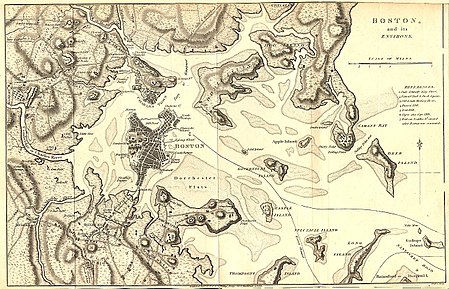
The British troops limped back into Boston late on the night of the 19th. However, by the morning of April 20, Boston was surrounded by over 15,000 militia who had received the call and responded. Militia units from New Hampshire, Rhode Island, and Connecticut also arrived. General Gage and the British were surrounded on three sides and their worst nightmare had come true. The rebellion had turned to open warfare.
Gage was shocked at how quickly and expertly the militia responded and dug in around the city, leaving the sea as the only open avenue to the British:
“The rebels are not the despicable rabble too many have supposed them to be… In all their wars against the French they never showed such conduct, attention, and perseverance as they do now.”
No one knew what would happen next. Gage immediately decided to strengthen his defenses and placed cannons at the likely avenues of approach. But he decided to withdraw his troops from Charlestown to fortify the approaches and thus left Dorchester Heights undefended. That would later prove to be a pivotable moment.
The Royal Navy ruled the seas. So their ships were able to enter and leave Boston Harbor without any issues. However, colonial privateers harassed British supply ships and that would take a toll on the British food supply as the garrison and the city suffered a food shortage and went on short-rations.
In May, a combined force under the command of Benedict Arnold and Ethan Allen took the lightly-defended British position in Vermont, Fort Ticonderoga. In doing so, they captured the fort’s 180 cannons that would prove pivotal in the coming months.
Gage received reinforcements throughout May and his troops now numbered 6,000. He wanted to break out of the siege and retake Charlestown and Dorchester Heights. Once again, Washington’s spies learned of the plans and gave him plenty of time to react.
On the night of June 16, Colonel William Prescott occupied the heights of Breed’s Hill and Bunker Hill and began fortifying them. On June 17, General Howe attacked, and although he captured the heights during the Battle of Bunker Hill (Breeds), his troops suffered appalling casualties with over 1,000 soldiers dead and wounded and 92 British officers killed in the engagement. The two sides would hunker down into a stalemate.
While both sides conducted harassing raids into each other’s territory, a stalemate appeared to have been created. Washington dispatched Arnold and 1,000 men to invade Quebec. He also formulated plans for attacking Boston, but his staff argued that they should wait until winter when the harbor would be frozen over.
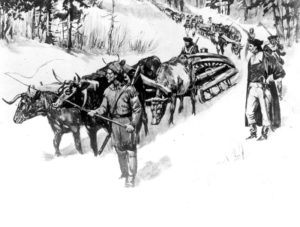
In November, Washington dispatched Colonel Henry Knox and a team of engineers to Fort Ticonderoga to recover the fort’s cannons and reinforce the now-Continental Army. Knox returned with 60 tons of cannons on January 24 — he had used sledges to transport them through the snowy country.
The Continental Army then reoccupied Dorchester Heights on March 4, 1776. The heights overlooked the city and thus the cannons could bring devastating fire, while the British cannons couldn’t reach the heights. Washington also moved thousands of reinforcements to Dorchester.
Because the ground was frozen and the men couldn’t dig in, a colonial millwright, Rufus Putnam, had the men build fortifications made of heavy timbers and fascines out of sight of the British and then move them into position during the night. General Howe, who replaced Gage in October, said:
“My God, these fellows have done more work in one night than I could make my army do in three months.”
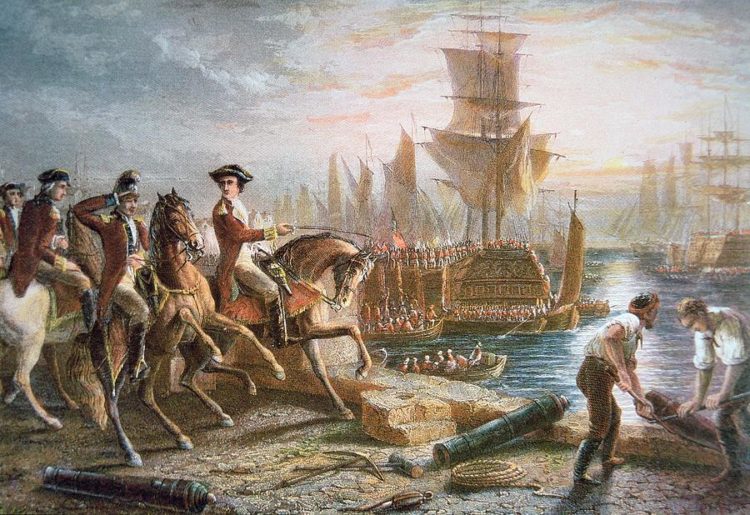
Howe wanted to drive the Continental Army off of Dorchester Heights. He planned an attack, but bad weather forced him to cancel it — probably for the better as the Continental army had fortified the position well. Seeing his avenues of action being increasingly limited, Howe decided to withdraw. On March 17, after several weather delays, the British departed Boston with 11,000 British soldiers and Loyalist civilians loaded into 120 ships.
The British promised to not harm any Bostonian building as long as they received no incoming fire. However, their orders were to torch the city if fired upon. No shot was fired.
Three days later, the Continental Army entered Boston. General Washington would then move the army south to New York and New Jersey. This effectively ended major combat operations in New England for the remainder of the Revolutionary War. After the hotheads of Massachusetts lit the fire that became the Revolution, it quickly spread away from them.
Several National Guard units hold lineage with the Continental Army units that fought in Boston. They include the 101st Eng Bn, 125th MP Co, 181st Inf, 182nd Inf, 197th FA, and the 201st FA.








COMMENTS