When Anduril’s YFQ-44A cleared the runway it did more than prove a prototype; it announced an era in which affordable, software-first wingmen will rewrite the rules of air combat.
Read the full article for more on:
Important insights and detailed analysis
Expert commentary on current events
Breaking developments and updates
Updating summary...
Anduril’s YFQ-44A Makes First Flight, Kicks Collaborative Combat Aircraft Effort Into High Gear
Guy D. McCardle
Speed
1x
Listen
COMMENTS
When Anduril’s YFQ-44A cleared the runway it did more than prove a prototype; it announced an era in which affordable, software-first wingmen will rewrite the rules of air combat.
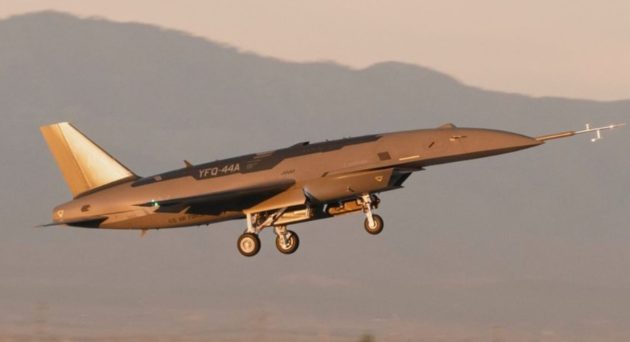
Anduril’s YFQ-44A lifts off on its maiden flight in California, marking a major milestone in the U.S. Air Force’s race to field autonomous combat wingmen. Image Credit: Anduril Industries
Why this matters
The U.S. Air Force’s Collaborative Combat Aircraft (CCA) effort is finally in the air with both industry prototypes now flying. Anduril’s jet-powered YFQ-44A logged its maiden flight on October 31, 2025, a milestone that puts real data behind the promise of lower-cost, autonomous wingmen for front-line fighters. The flight follows the August 27 debut of General Atomics’ YFQ-42A, which was the first CCA to fly. The service still targets a competitive production decision in fiscal 2026.
Advertisement
The company behind the jet
Anduril Industries was founded to push software-led defense systems at Silicon Valley speed, and it shows in the portfolio. Lattice, the company’s AI-enabled operating system, fuses disparate sensors and controls unmanned systems across domains.The catalog now spans Ghost reconnaissance drones, the Altius family acquired through Area I, Roadrunner interceptors, and the Fury air vehicle that matured into the YFQ-44A. The firm has also moved into mixed reality soldier systems work and has taken over the Army’s IVAS headset path from Microsoft.
YFQ-44A took flight today. Anduril has launched a new age of airpower with the push of a button.
Anduril and the Air Force conducted a semi-autonomous first flight in California. That detail matters. Company officials said they were determined to avoid a remote pilot “stick and throttle” profile from the start, and the Air Force framed the event as the beginning of competitive flight testing that will feed requirements and reduce risk. In plain English, the aircraft taxied, took off, flew, and recovered with onboard autonomy in the loop, which is exactly the behavior the service wants to scale.
Speed of development
From clean sheet to wheels up in 556 days.
Anduril and the Air Force are making that number a calling card because it signals a faster cycle than traditional fighter programs. The airframe is built around a modular digital backbone to push rapid autonomy updates, mission apps, and payload changes, which is the kind of software cadence the CCA concept depends on.
Advertisement
What is the YFQ-44A, exactly
The YFQ-44A grew from the Fury project that Anduril gained with its 2023 acquisition of Blue Force Technologies. It is a high subsonic, fighter-likeunmanned jet that aims for high altitude, high-G maneuvering, and weapons carriage. Open sources indicate a single Williams FJ44-4M turbofan and a gross weight in the low thousands of pounds, which aligns with the Air Force goal of affordable mass rather than exquisite, one-off jets. Think of it as a compact sparring partner that can punch above its weight when teamed with F-22, F-35, and the next generation manned fighter.
General Atomics’ YFQ-42A was the trailblazer, flying on August 27, 2025, with the company later announcing a second aircraft in early November. The Air Force set up this head-to-head sprint in April 2024 when it selected Anduril and General Atomics for Increment 1, eliminating three major primes from funded competition but keeping the door open for future increments.
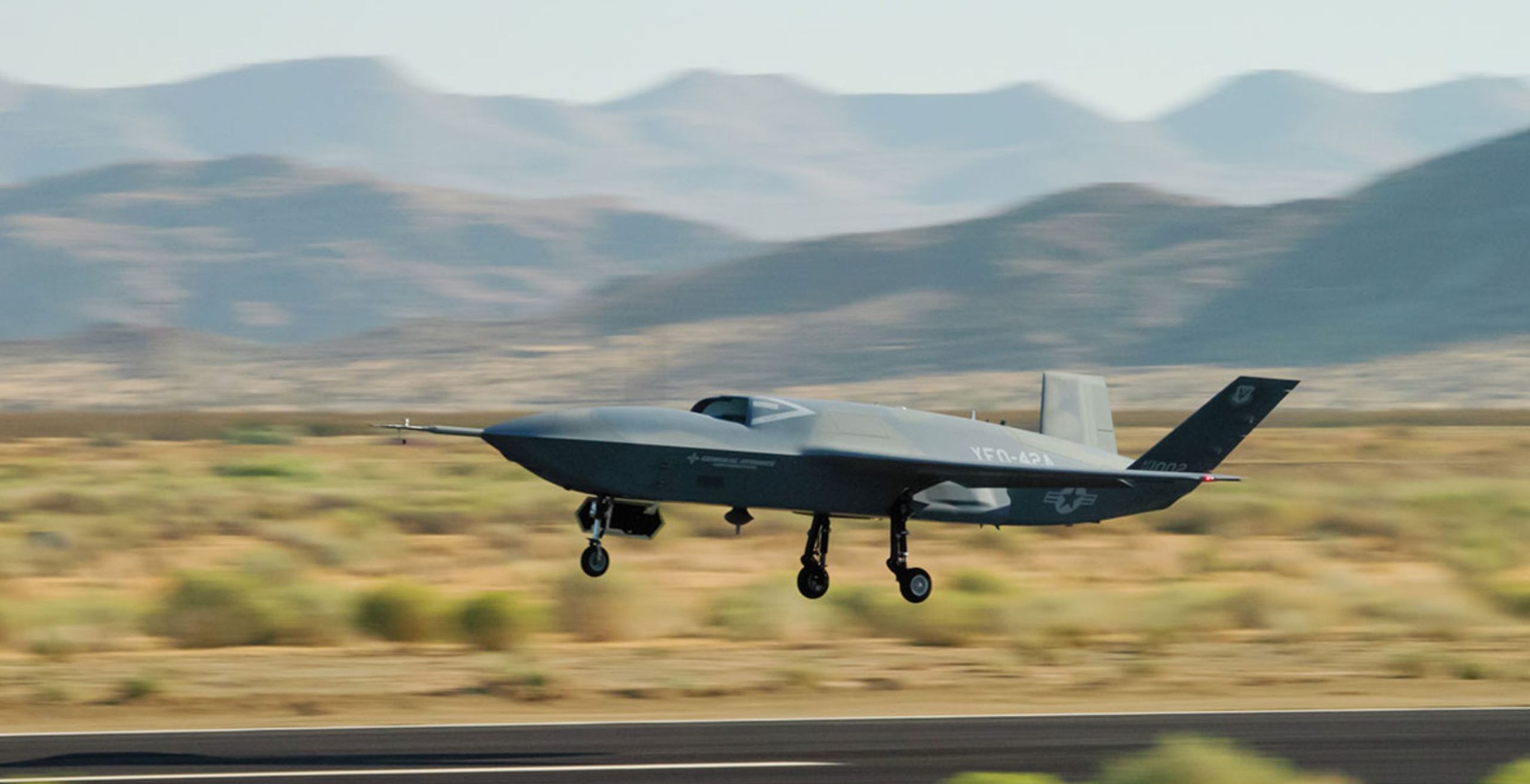
General Atomics YFQ-42A takes flight. Image Credit: General Atomics
Technical and operational aims
The wingman prototype is built to do several jobs. First, act as a sensor and shooter teammate, sharing targeting and electronic warfare duties with crewed fighters through Lattice-enabled autonomy. Second, soak up risk. The point is to field multiple jets that can press into contested airspace, confuse an adversary’s decision cycle, and trade at a cost that preserves manned fleets. Third, spiral fast. The software-centric architecture is meant to absorb new behaviors as quickly as you can swap apps on a phone, which is where Anduril stakes its edge.A good formation is like a jazz quartet, each player listening, adjusting, and giving space for the solo, and CCA wants to make that style of manned-unmanned teamwork routine.
What the test campaign has proved so far
The semi-autonomous profile on day one validated the control laws, basic flight envelope, and the autonomy stack’s integration with the vehicle management system.Air Force leadership called out the value of getting “hard data” early to shape final requirements, which suggests upcoming sorties will stretch endurance, envelope, sensor fusion, and, eventually, weapons integration.
What comes next
Near term, both industry teams will continue flight envelope expansion at government and vendor ranges, including test centers such as Edwards and Nellis.The Air Force plans to choose a production path in fiscal 2026, and Anduril says it is preparing to scale manufacturing in Ohio to meet demand if selected. Expect autonomy updates, teaming trials with frontline fighters, and progressive payload tests to dominate the next blocks of work.
Bottom line
The Air Force asked for speed, competition, and software first thinking. With YFQ-44A airborne, Anduril has put its marker down. The next rounds will decide who can turn early flight data into a reliable, scalable wingman that shows up in numbers.
The smart money rides on the team that treats code like a weapon system and learning as its fuel.
Advertisement
What readers are saying
Generating a quick summary of the conversation...
This summary is AI-generated. AI can make mistakes and this summary is not a replacement for reading the comments.










COMMENTS