
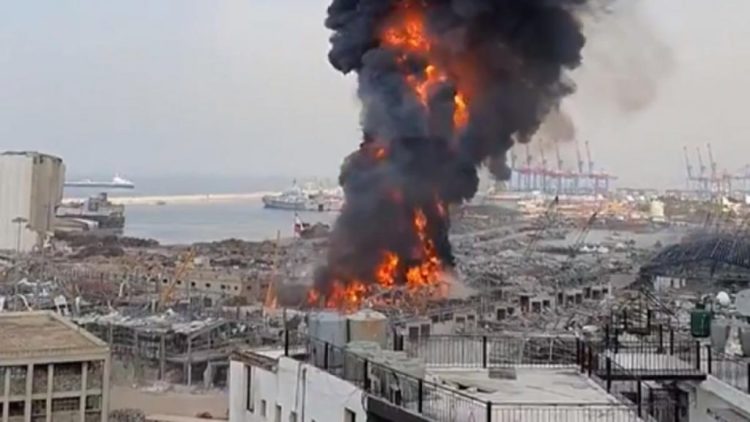
Another video on social media showed panicked port employees running in fear of the fire. The scary scene resembled the same scenario that occurred in the same place just a month prior.
Lebanese troops closed the major road near the port, rerouting traffic to other areas.
The Lebanese civilians, who are still recovering after the August 4 blast, are at their wit’s end. Having already forced most of the government to resign, battling the coronavirus pandemic as well as the country’s worst economic crisis in decades, this is the last thing the country needs.
Sensing the peoples’ outrage, the television station ran by Hezbollah, switched from fire coverage to a story on how Hezbollah ministers are doing a great job in looking after the people of Lebanon.
The blast that leveled Beirut in August was caused by 2,750 tons of ammonium nitrate (NO2). The ammonium nitrate had been brought to the port from a Moldovan-flagged cargo ship, the MV Rhosus. The ship had docked in Beirut in 2013 after suffering “technical problems” while sailing from Georgia to Mozambique.
The Rhosus was inspected, banned from leaving port, and abandoned in short order by its owners, according to Shiparrested.com. The cargo of ammonium nitrate was reportedly transferred to the port’s Warehouse 12 following a court order. It should have been disposed of properly or resold, but it never was.
The blast was the equivalent of 1,500 tons of TNT and one of the largest non-nuclear explosions in history. It created a crater about 500 feet across which filled with seawater. More than 200 people were killed in the blast, over 5,000 injured, and hundreds of thousands were displaced.
The blast blew out windows at Beirut’s International Airport over five miles away; it was heard in Cyprus, over 200 km away across the Mediterranean Sea.
To make matters worse, the Lebanese army said it discovered at least for more tons of ammonium nitrate in four containers. The containers were stored near the port and were “dealt with,” according to military officials.
Now questions are being asked whether the second batch of ammonium nitrate was linked to the August explosion and where it came from. Adding to the confusion and questions concerning the port was the discovery of 20 containers of dangerous chemicals by French and Italian chemical experts working in the port facilities. The army later said that these containers were also moved and stored safely away from the port.








COMMENTS