

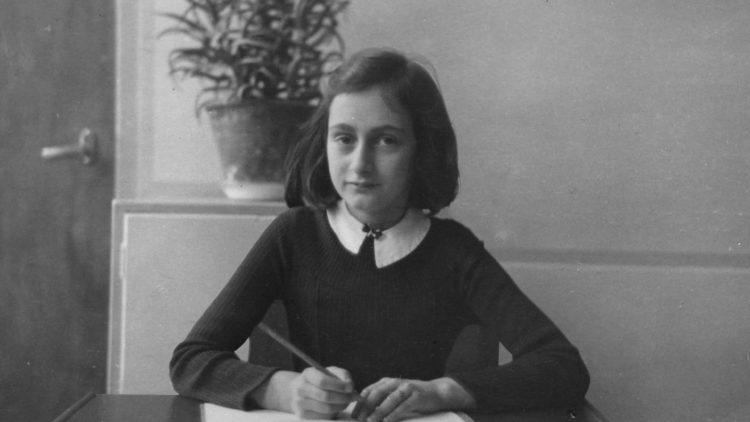
The Dutch minister of education, in exile in England, had encouraged all Dutch civilians to keep war diaries. Anne began rewriting her diary into one running story titled “Het Achterhuis” (The Secret Annex).

But after 25 months in hiding the people in the annex were betrayed and discovered. On August 4, 1944, Austrian Nazi SS Oberscharführer of the Gestapo Karl Silberbauer, followed by the members of the Nazi-allied Dutch NSB (Dutch national socialists) Gezinus Gringhuis, Willem Grootendorst, and Maarten Kuiper burst in and arrested all of the eight people hiding in the annex.
Who exactly betrayed them? It has been a matter of great debate and controversy since the war ended. No one truly knows. But as Gies herself later said, the longer the hiding went on, the more careless they became:
“The hiders became less careful. Curtains were opened beyond just a crack, rooftop windows inadvertently stayed open, accidental noises became more frequent, and so on. All in all, the visible evidence mounted for the world outside that there were people in the building after office hours. People in the outside world may quite innocently have mentioned this in conversation, which could have been overheard by the wrong persons. In this scenario, the name of the night watchman, Martin Sleegers, plays a prominent role. Following the report of a burglary on the premises in April 1944, he and a police officer went to investigate. They actually fumbled with the bookcase that hid the entrance to the Secret Annex. Anne describes this burglary in her diary entry of April 11, 1944. There is no concrete evidence that Sleegers betrayed the hiders. While it is a fact Sleegers knew the NSB member Gringhuis (who was present at the arrest), this in itself does not constitute proof.”
After being arrested, the eight Jews were taken from the Sicherheitsdienst’s (the security service of the SS) prison in Amsterdam and then to the Westerbork transit camp. They were then put on a transport to the Auschwitz-Birkenau concentration and extermination camp.
The train trip took three days, during which they and over a thousand others were packed closely together in cattle wagons. There was little food and water and only a barrel for a toilet. Upon arrival at Auschwitz, Nazi officers checked to see who was able to do heavy forced labor. Around 350 people from the train were immediately taken to the gas chambers and murdered. Anne, Margot, and their mother were sent to the labor camp for women. Otto ended up in a camp for men.
In November 1944, Anne was transferred to the Bergen-Belsen concentration camp with Margot. Their parents remained in Auschwitz. The conditions in Bergen-Belsen were awful. There was a lack of food, it was cold, wet, and contagious diseases were widespread. Both of the Frank sisters contracted typhus at Bergen-Belsen. In February 1945 Margo died followed by Anne shortly afterward.
The fate of the others was similar. According to History.com:
“Edith Frank died of starvation at Auschwitz in January 1945. Hermann van Pels died in the gas chambers at Auschwitz soon after his arrival there in 1944; his wife is believed to have likely died at the Theresienstadt concentration camp, in what is now the Czech Republic, in the spring of 1945. Peter van Pels died at the Mauthausen concentration camp in Austria in May 1945. Fritz Pfeffer died from illness in late December 1944 at the Neuengamme concentration camp in Germany.”
Otto was the only one of the eight people from the annex to survive the war. He was liberated from Auschwitz by the Russians. During his long trip back to Amsterdam he learned that his entire family was dead.
After his return from Auschwitz, Gies gave Otto all of the papers that they had left behind in the annex, which the Nazis had neglected because they were of no use to them. Gies gathered several notebooks, Anne’s diary, and over 300 loose papers of Anne’s writing that she had hid in her desk. Margot also kept a diary but that was lost.
Otto put together all of Anne’s writings into a manuscript. He had it published in Dutch in 1947 under the title “Rear Annex.” In 1952, U.S. publishers released it as “Diary of a Young Girl,” and it sold tens of millions of copies. It was required reading in schools in the United States.
One of Anne Frank’s quotes rings very true today:
“What is done cannot be undone, but one can prevent it happening again.”
Otto Frank died in 1980. He remained closely involved with the Anne Frank House and museum: His hope was that readers of the diary would become aware of the dangers of discrimination, racism, and the antisemitism that fueled the Holocaust.








COMMENTS