

Our friends at Barrett Firearms have rolled out a new Precision Grenadier System line built around a 30×42 mm, semi-automatic, magazine-fed “grenade rifle” that can crack defilade cover and knock down low-flying drones. It’s the same disruptive idea that just won the U.S. Army’s xTech Soldier Lethality competition alongside partner MARS, Inc., and Barrett recently took it to the Association of the United States Army (AUSA) exhibition floor in Washington. The AUSA Annual Meeting took place from October 13 to 15, 2025, and the SSRS — Squad Support Rifle System — was on display, generating buzz.
Barrett’s pedigree with the U.S. military
Barrett’s imprint on modern U.S. arms is long and well known. The M82 that became the M107 anti-materiel rifle is still a staple across the force, with a fresh Army contract awarded in late 2024 to keep guns, parts, and training flowing through 2029. The company’s MRAD family matured into the multi-caliber MK22 program as the Army’s Precision Sniper Rifle. That track record matters because the Army keeps betting on firms that deliver and keep training, spares, and upgrades on schedule.
What the PGS needs to do
The Army’s Precision Grenadier System requirement is plain: a soldier-portable, shoulder-fired, semi-automatic, magazine-fed, integrated weapon plus ammunition and fire control that can put precise air-burst effects on personnel in defilade and slap down small unmanned aerial systems. In short, fast effects with smart fuzing and enough range to matter at the squad level.
How Barrett and MARS won xTech
The Barrett–MARS team moved quickly. They designed, built, tested, and live-fired a shoulder-fired 30 mm system that met the Army’s brief, beating out the other finalist. On May 22, 2025, the Army announced the team as the xTech Soldier Lethality winner for PGS; Army xTech followed up with a public note that MARS’s solution took top honors, with Barrett as the weapon-system partner. Barrett’s release lists AMTEC as the 30 mm ammunition developer and Precision Targeting on fire control.
Two short quotes capture the tone. Barrett CEO Bryan James: “With our focus now on the U.S. Army’s PGS initiative, we are committed to delivering… programmable air-bursting counter-defilade and Counter-UAS capabilities.” Barrett VP Ryan Krantz called the award proof of “the power of partnership, agility, and a shared mission.”
The hardware: SSRS core, PGS family
The center of gravity is the SSRS, a recoil-operated, semi-automatic 30×42 mm launcher with a five-round magazine. Army Recognition’s AUSA coverage and MARS’s spec sheet point to long-recoil internals with an ambidextrous control layout, shoulder-fire ergonomics, and integration with a programmable fire-control optic. Think rapid follow-up shots and timed air-bursts on call. Barrett and MARS showed that package at AUSA and previously to international audiences at DSEI (Defense and Security Equipment International) in September.
About those Mods
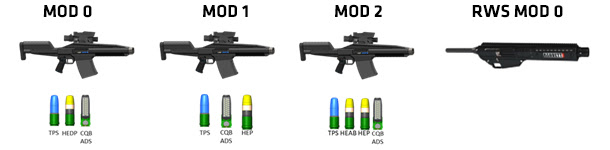
Think of the PGS family as a ladder, not a single gun. Barrett is planning a staged rollout that takes a soldier from a baseline, combat-ready launcher to a fully integrated squad-level munition system.
Mod 0, due in 2026, is the baseline the rest will climb from. It pairs a five-round, semi-automatic firing mechanism with an advanced, disturbed reticle fire control system, a recoil-dampening package, and support for four ammunition types. In practice, that means a grenadier gets quick follow-up shots, reduced shooter fatigue, and a single fire control and ammo family that can be tailored to targets on demand.
Mod 1, slated for 2027, builds on Mod 0 and is optimized for counter-unmanned aerial systems. It adds an upgraded fire control system and proximity-fused ammunition to raise the probability of kill against small drones. Where Mod 0 is the versatile foundation, Mod 1 is the specialized hammer for aerial threats.
Mod 2 is the maturation into a program of record capability. It will include Mod 0 and Mod 1 features while pushing the fire control forward to improve lethality, target engagement, and handoff, and high-explosive air burst performance. The aim is a true squad-level counter-defilade munition that ties weapon, ammo, and fire control into a single, repeatable effect.
All dates and feature sets are described as planned and remain subject to engineering schedules, testing, and Army requirements.
What’s next and why it matters
AUSA is where the Army looks for near-ready weapons, not science projects. By putting a live-fired, competition-winning package on the booth, Barrett is positioning PGS as a squad-level effect that the Army can scale. The payoff is tactical: single grenadier, programmable air-burst over trench lines, windows, and alley mouths; proximity fuzes for quadcopters that menace patrols; and a rate of fire that outpaces legacy single-shot launchers. That is the kind of problem-solver squads have asked for since the old XM25 effort died.
Bottom line
Barrett’s PGS push blends a mature industrial base with a scrappy partner and a clear Army requirement. The company has earned trust with the M107 and MK22; now it’s chasing the same with a smart-grenade rifle that can punch where rifles and machine guns struggle. The prize is a family of configurations that gives commanders options from a grenadier’s shoulder to a truck-mounted remote station, all running the same effects chain.








COMMENTS