U.S. President Donald Trump proposed sending Tomahawk missiles to Ukraine, but the country has developed its own advanced missile, the FP-5 Flamingo, which boasts superior capabilities. The Flamingo, produced by Fire Point, is a game-changer for Ukraine, allowing it to strike Russian targets independently.
Key points from this article:
The FP-5 Flamingo missile, weighing 13,000 pounds and with a range of 1,865 miles, is significantly larger and more powerful than the Tomahawk missile.
How the Flamingo's production by Fire Point, led by CTO Iryna Terekh, allows Ukraine to strike Russian military targets without relying on Western missiles or facing restrictions.
Why the Flamingo's capabilities, including a massive warhead and low production costs, position it as Ukraine's most advanced long-range missile, enhancing its military strategy against Russia.
Updating summary...
Better Than Tomahawks: Ukraine’s New, FP-5 Flamingo Missiles
Warren Gray
Speed
1x
Listen
COMMENTS
Forged under fire by engineers who refused to wait for permission, Ukraine’s FP-5 Flamingo shows how a nation can build its own long-reach answer to Russian aggression—and hit harder than anyone expected.
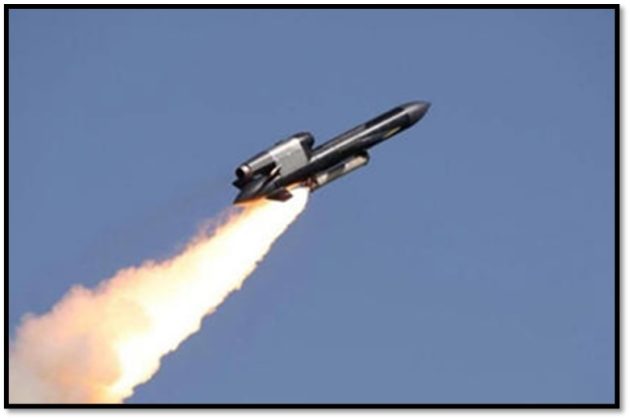
Fire Point FP-5 Flamingo cruise missile, with rocket booster firing. Photo credit: RBC Ukraine.
“When you have a gun being pointed toward your head, you don’t think about standards, you think that ‘this should be working.’ We didn’t care that we met NATO standards. We only cared that our weapons would be effective on the front line…We could, as a result, make a very effective weapon.”
— Iryna Terekh, Chief Technology Officer for Fire Point.
On October 13, 2025, U.S. President Donald J. Trump boldly suggested the possibility of sending BGM-109C Tomahawk Land-Attack Missiles (TLAM-Cs) to Ukraine, and the Pentagon subsequently approved the offer. The Tomahawk is an American-made, GPS-guided, 2,900-pound cruise missile with a 992-pound warhead, a range of 1,000 miles, and a very low flight altitude of about 100 to 160 feet, traveling at a speed of 570 miles per hour, or Mach .74. It’s a truly formidable weapon system.
Advertisement
However, in order to avoid the Russian perception of escalation of the war, any future discussions about Tomahawk missiles for Ukraine have been downplayed. As it turns out, Ukraine already has a much better, long-range, cruise missile system, the Fire Point FP-5 Flamingo, weighing in at a hefty 13,000 pounds (3.5 times larger than a Tomahawk), with a 2,540-pound, high-explosive warhead (2.5 times larger than a Tomahawk’s), and a range of 1,865 miles (almost twice as far as a Tomahawk.)
The Flamingo was first revealed to the public on August 17, 2025, and three days later, Ukrainian President Volodymyr Zelenskyy called it “the most successful missile we have,” declaring that it was in full production. On August 30, 2025, the Flamingo saw its first combat action, striking a Russian Federal Security Service (FSB) facility in occupied Crimea with at least three new missiles.
Fire Point is a defense production organization, founded in 2022, and currently producing three FP-5 Flamingos per day, without any Western funding, licenses, or restrictions, relying solely on the initiative of Ukrainian engineers. They plan to increase production to seven missiles per day by the end of 2025.
Advertisement
Their Chief Technology Officer (CTO) and spokesperson is Iryna Terekh, age 33, an experienced entrepreneur with a significant background in design, architecture, and the production of concrete structures. She’s also a mother to two children, juggling multiple corporate positions full-time.
Iryna Terekh, Chief Technical Officer for Fire Point. Photo credits: WordPress and LinkedIn.com.
The “Flamingo” name allegedly came from early versions of the missile being painted pink, a supposed factory error that the company denies. Another source stated that the initial pink coloration was a temporary tribute to Ukrainian women, like Terekh, who have recently stepped into leadership positions in the Ukrainian industry, as a result of most of the men being away at war.
Advertisement
For another example, in August 2023, I wrote about Blade Brothers Knives, of Kharkiv, Ukraine, an excellent company in which their female office manager oversaw daily operations, while the owner, Oleksander Vorobey, was frequently away at the front lines, defending the Kharkiv region from Russian invaders.
Interestingly, the FP-5 missile is powered by a surplus Ivchenko AI-25TL turbofan engine, previously used in the Czech-designed Aero L-39 Albatros jet trainer aircraft, with thousands of such engines recently extracted from landfills in Ukraine. Many of these turbofans had only about 10 service hours left before overhaul was required, but since the one-way, flight time of a Flamingo missile is no more than about 3.5 hours, none of that really matters, and it keeps the production costs down to an estimated $500,000 to $1 million per copy, considerably cheaper than the much smaller and shorter-range, Tomahawk missile.
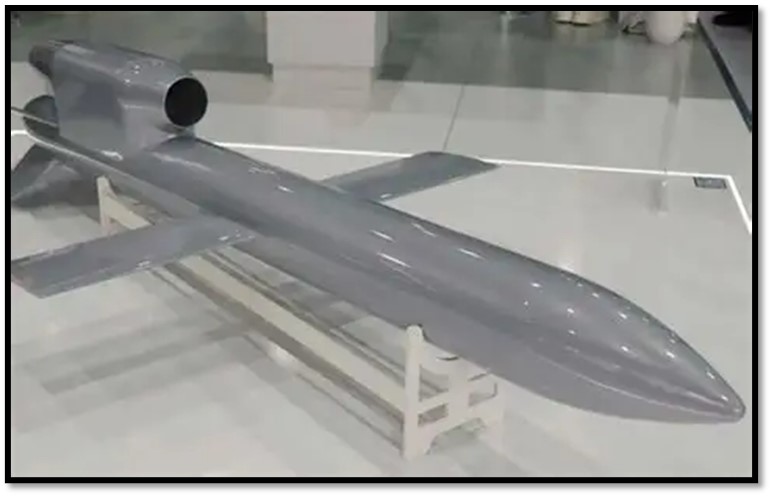
Fire Point FP-5 Flamingo missile. Photo credit: RBC Ukraine.
Although the Flamingo’s guidance system is not as complex, sophisticated, or as costly as a Tomahawk’s, the FP-5 still impacts within 46 feet of its assigned target, and its massive, 1.27-ton, explosive warhead ensures catastrophic damage to the target. Its carbon-fiber/fiberglass body can be manufactured in just six hours, with the engine mounted on top, and Fire Point has begun producing its ownbrand-new engines, as well. This design gives it a general resemblance to the German V-1 “Buzz Bomb” from World War II, although the Flamingo is far more advanced.
The FP-5 flies just as fast and just as low as a Tomahawk missile, and it has already been employed at least nine times in real combat operations. It is consideredto be Ukraine’s very best and most advancedlong-range missile.The Independent, a British publication, recently wrote that, “Kyiv can fire the Flamingo at any target it wants. It is not restricted by what Ukraine’s ‘allies’ say it can and cannot do when fighting Russia’s invading forces.”
Flamingo missile launch. Photo by Fire Point.
The new Flamingo missile is a real game-changer, enabling Ukraine to finally strike Russian military targets, air bases, oil refineries, ammunition depots, and critical infrastructure without relying upon other Western missiles or being constrained by rules of engagement imposed by allied nations. One military expert accurately described the FP-5 Flamingo as “the first truly strategic weapon of Ukrainian origin.”
Iryna Terekh summed it up quite bluntly on November 9, 2025, stating that, “They say flamingos are pink because they eat shrimp. Our Flamingo will be black because we ‘eat’ Russian oil refineries…We are preparing for a bigger, much scarier war.”
Advertisement
What readers are saying
Generating a quick summary of the conversation...
This summary is AI-generated. AI can make mistakes and this summary is not a replacement for reading the comments.
VETERAN-FRIENDLY COMPANIES
HYWELL
Hywell is a premium gear brand specializing in heavy-duty Merino wool boot socks for blue-collar professionals and outdoorsmen. Backed by an ironclad 10-Year Warranty.













COMMENTS