

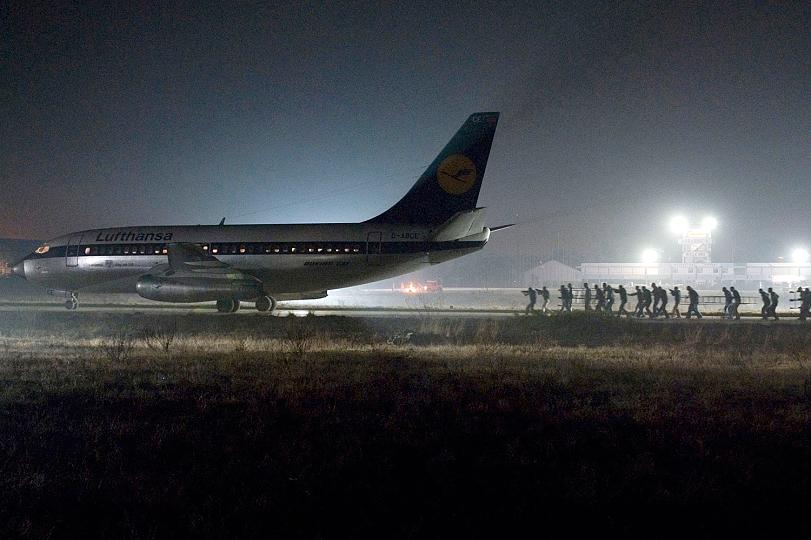
The PFLP-SC was behind the hijacking of “an Air France A-300B Airbus by a transnational terrorist force that included two West Germans, one Iranian, and a Palestinian” (Livingstone, 127) who then flew the plane to Entebbe, Uganda, and turned it over to the Ugandan military in a pre-arranged agreement. The hostages were eventually freed by Israeli commandos in July of 1976, a catalytic event that forced the United States to start taking terrorism seriously.
When Haddad died in East Germany in 1978 (some say he was poisoned by Mossad), his organization split into three factions that continued to conduct terrorist attacks around the world. After the fall of the Berlin Wall and the opening of archives belonging to the Soviet Union, it was revealed the Haddad was a highly valued KGB asset.
Abu Nidal
Abu Nidal was another notorious terrorist of this era who, like Haddad, split off from Arafat’s Fateh to found the Abu Nidal Organization (ANO). Nidal and his terrorist group were responsible for dozens of terrorist attacks from Rome to Vienna, Pakistan, Kuwait, and beyond. Another thing he had in common with Haddad was flirting with Libyan dictator Omar Qaddafi, and like Haddad, he placed his headquarters in Saddam Hussein’s Iraq at one point. In an interview with Der Spiegal, Nidal proved himself to be no stranger to theatrics, stating that he was “the evil spirit of the secret services. I am the evil spirit which moves around only at night, causing them nightmares” (Livingston, 137).
Nidal was also known to have close ties to Warsaw Pact intelligence services. Through Polish and East German cutouts, ANO trafficked in weapons and cash, banking with the notorious Bank of Credit and Commerce International (BCCI). “The Soviets don’t run him or control him,” former CIA director Bill Casey said. “But they use him and his group for their own purposes” (Livingstone, 243).
“These national liberation fronts are classic communist organizations. They create big tent for the disenfranchised who are controlled by the communist party. The control features are secretly communist, but they present themselves as national liberation groups,” Roger said. “After the revolution is over, they do what they do. They start knocking off the other liberation fronts and you get nothing but Bolsheviks, Castros, and Gaddafis.”
Even if they did not have ideological bonds, groups as diverse as the Bandaar Meinoff gang, the IRA, and the Red Brigades had to repay the Palestinians for the training they had received at their camps, and they did this by staging surrogate terrorist attacks. East German Stasi and the Bulgarians were also used as proxies. At the time, the USSR spread a propaganda narrative that America was an imperial power and Israel was simply its puppet.
Blue Light now found itself on the front lines of a proxy war being staged by the Soviet Union to destabilize the West.
The development of Delta’s counterterrorism capabilities
Meanwhile, Charlie Beckwith was attempting to get his own counterterrorism unit off the ground. The first three people in Delta were Beckwith; his secretary, Marion; and Sergeant Major William “Country” Grimes. After working out of an office on Smoke Bomb Hill at the corner of Reilly and Gruber Road, Delta then moved to what had been Fort Bragg’s stockade, Building A-3275 off of Butner Road. Beckwith ran back-to-back selection courses in Uwharrie national forest, and then put the candidates into the Operator Training Course (OTC) seven days a week, 15 hours a day, for a total of 776 hours of instruction.
Although Delta Force had been funded, Charlie knew how to scrounge as well—perhaps a product of his own Special Forces background. He procured .45 caliber M3 “Grease Guns” the sights of which he had sawed off. “We were to learn to shoot instinctively…Beckwith wanted us to shoot 3×5″ cards,” Sergeant Major Michael Vining said. “I think he hated 3×5″ cards.” Sergeant Major Vining served as an explosive ordnance technician with the 99th Ordnance Detachment in Phuoc Vinh, Vietnam. After a break in service, he returned to the Army, and was accepted into Delta Force in 1978, graduating from the Operator Training Course (OTC) at the top of his class. As a Delta operator, he participated in numerous operations, such as Eagle Claw and Urgent Fury.
It was not uncommon to spend half a day shooting in Delta. The unit armorer, Terry Hall, invented the idea of using rubber from an inner tube, cut and fitted to the bolt of the M3, to deaden the sound of the open-bolt submachine gun when it was fired.
In the mornings, Beckwith would start the men off with brick PT, in which all events were done with a brick in each hand. NCO bricks had holes in them and officer bricks were solid. A former college football player, Beckwith would then stomp around with a whistle, being a coach, while the men played football.
“Our unclassified mission was POW rescue. We wanted to have a standing force that could do a Son Tay-type mission. During Son Tay, they put together the people, training, rehearsals, and conducted the mission. We hoped to eliminate the first two steps,” Vining told SOFREP. “We did not know what the next threat would be to our nation’s security.”
Beckwith’s Delta Force model was based off of the British SAS, and so were their tactics. In this regard, they were a little bit ahead of where Blue Light was. The SAS had already been dealing with terrorism in urban environments such as in northern Ireland. Techniques taken for granted today, such as drawing and shooting from the holster, were unusual for the time, but commonplace in the SAS.
“In the beginning, we had a guy from 22 SAS, Ginger Flynn, who helped us with our shooting program,” Vining recalled. Flynn taught the operators shooting techniques like the double tap. However, in OTC class #1, the operators essentially trained themselves. They would sit down together and figure out what they wanted to train on, then weapons men would train them on weapons and EOD guys would train on improvised explosive devices. They would practice vehicle ambushes and aircraft takedowns, figuring out what worked and what didn’t.
“At the time, the things everyone was concerned with were hijacked airplanes and barricaded hostage situations,” Roger said, reflecting on Blue Light’s training. These were tubular targets, which include buses—the type that the National Command Authorities (POTUS and SECDEF) were the most concerned about. “Because we were so focused in Blue Light on the most likely primary threat, tubular targets and hostage barricade, we didn’t get into the other mission profiles.”
“We view aircraft takedowns as nothing more than a linear target on wheels,” Vining said. “We went to experts and they taught us about aircraft systems. We learned the various airport jobs: baggage handling, refueling, emptying the toilets, restocking the aircraft, and so on so we could pass as workers.” Delta snipers also learned how to shoot through the glass windows of an airplane cockpit. Simultaneously, Blue Light was developing some of these same capabilities with their assault/intelligence team, including Katie.
One of Blue Light’s team sergeants, Jake Jakovenko, recalls when he flew into “Tampa Airport and met the engineers” of various aircraft, “and learned the easiest way to penetrate them.”
Roger elaborated on Blue Light’s perspective: “We didn’t have the advantage to be exposed to the SAS. They had transitioned long before that because of what they were doing in northern Ireland, which was one of several urban terrorist scenarios they had dealt with, including Kenya, Aden, and Malaysia. They had been dealing with this for a long, long time. The SAS knew they had to rapidly extract a semi-automatic pistol from a holster or concealed carry. It was the SAS that used the double tap and the Modified Isosceles shooting stance. The Unit had been introduced to those other mission profiles early on, but not Blue Light, aside from one team that had a pre-assault collection mission in which team members might be dressed to look like ground crew members or airport staff.”
“The overwhelming focuses from the National Command Authorities were embassies and domestic facilities, overseas bases, or the hijacking of a U.S.-flagged aircraft,” Roger continued. Both Delta and Blue Light trained for permissive and non-permissive environments, but realistically, the only permissive environment that either unit might have operated in would be within the United States—if the president signed a waiver on posse comitatus. Even if terrorists took hostages on an overseas U.S. military base, it would have been surrounded by military police, and then host-nation counterterrorism units would have executed the mission as stipulated in the Status of Forces Agreement (SOFA).








COMMENTS