


After the Americans entered the war, her cover as a journalist for the NY Post was not going to last much longer. After the United States invaded North Africa, the Germans overran the rest of Vichy France. She had to get out. Klaus Barbie, the infamous “Butcher of Lyon,” had found out her identity and the Gestapo was hot on her trail. “She is the most dangerous of all Allied spies. We must find and destroy her,” the Gestapo said about her.
To escape, she had to cross the Pyrenees Mountains into Spain on foot, something that for a woman with an artificial leg was especially difficult. During the crossing, her artificial leg, Cuthbert, was giving her problems. She jokingly radioed as such to her superiors in London. The reply from an unknowing staff officer was: “If Cuthbert is giving you difficulty, have him eliminated.”
Upon returning to London, the British SOE didn’t want her returning to France. It was then that Hall learned about OSS, the fledgling American intelligence service. She joined instantly and asked for an immediate reassignment to France.
She went back to France on the night of March 21, 1944. She didn’t parachute in as was the norm for espionage agents: but because of her prosthetic limb she was dropped off by a British PT boat. She dyed her gray, covered up her limp with the doddering gate of someone 40 years older and disguised herself as an old French farmer woman.
Operating under the cover name of “Diane” she immediately went to work. The Germans and Barbie believed that Hall, who was codenamed “Artemis” by the Nazis, was a Canadian. “I’d give anything to lay my hands on that Canadian bitch,” Barbie had said. It was not to be. The famous “Limping Lady” always kept one step ahead of the Gestapo.
Hall mapped out drop zones for the resistance and conducted 15 supply drops of arms, ammunition, demolitions and medical supplies without a hitch. Hall helped train three battalions of Resistance forces (800 fighters) to wage guerrilla warfare against the Germans. In the buildup to and in the immediate aftermath of D-Day, Hall’s resistance group destroyed four bridges, derailed several freight trains, severed a key rail line in multiple places and downed many telephone lines. They were also credited with killing some 150 Germans and capturing 500 more.
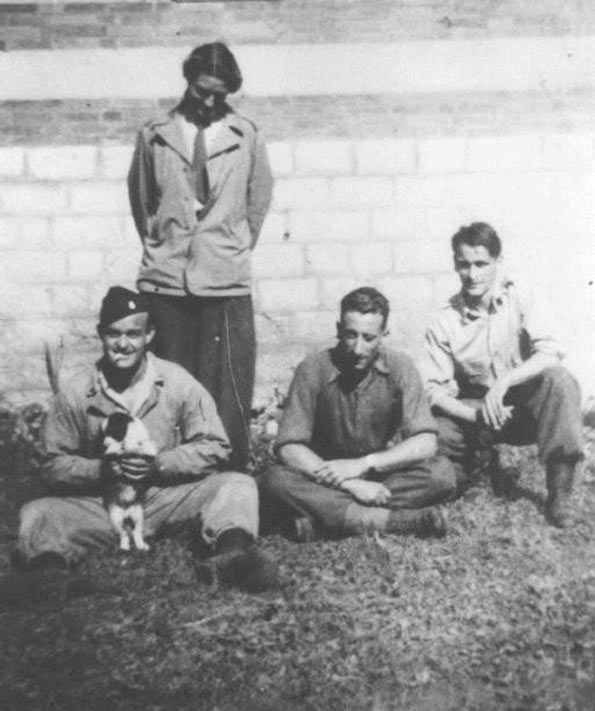
As the Americans began to push the Germans out of France, OSS parachuted more agents in the country. One of them was named Paul Goillot. He was eight years her junior, six inches shorter but had a cheerfulness and energy that struck with Hall. She became smitten with him. They would spend the next 38 years by each other’s side.
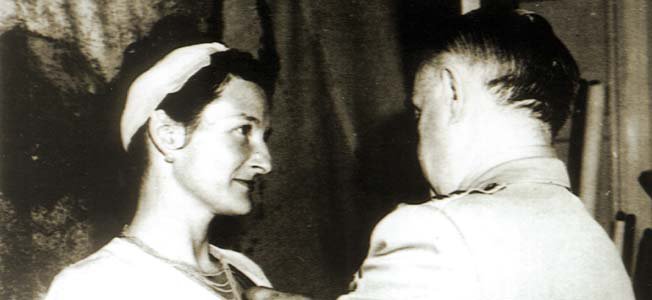
Upon hearing of her exploits, President Harry S. Truman wanted to award Hall the Distinguished Service Cross — the only time in World War II that the medal would be awarded to a civilian and a first for a woman as well. But Hall asked that General William “Wild Bill” Donovan, the wartime head of the OSS present it to her.
Donovan presented the medal to Hall in a small private ceremony in his office, attended only — at her request — by her mother. Hall personified the “Quiet Professional” mantra before it was even a thought: Hall was reluctant to capitalize on any fame or notoriety regarding her time in France as the cost in human lives during the operations weighed heavily on her. She simply said, “It was just six years of my life.”
She later joined the CIA as an analyst, before retiring from the Agency in 1966. She passed away in 1982 at age 76.
The Agency only long after her death fully recognized her accomplishments, naming in 2016 a training center for agents in her honor.
It was announced a while ago that there is to be a feature film made of Hall’s life and that she’d be portrayed by Daisy Ridley who played Rey in the latest Star Wars films. No doubt, the “force” will be strong with this production. The producers have reportedly hired Purnell to be the writer of the screenplay.
Purnell’s book can’t be recommended highly enough. If you enjoy reading spy thrillers about SOE and OSS, then this book is for you. If you’re a fan of James Bond, then reading about a true-life “Jane Bond” makes this book a must-read.









COMMENTS