

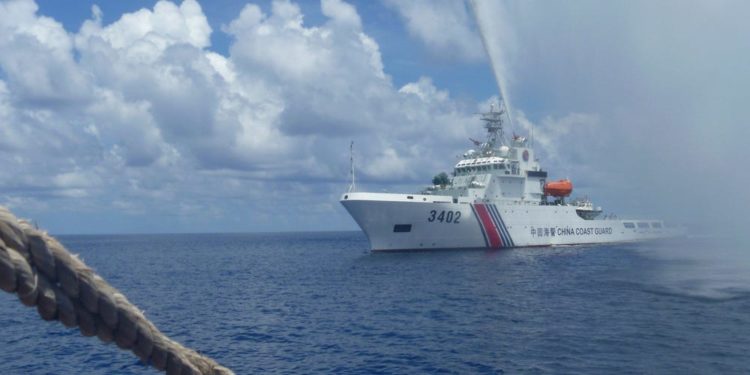
“This shows the Coast Guard is becoming more professional. It is clarifying to its own people and to the world the conditions under which the CCG regard as appropriate for them to consider all these actions,” Heath added.
The World’s Largest Coast Guard
But the risk of escalation is still very real, especially since the CCG will implement the new law in disputed territory. The clarifications and new guidelines may actually embolden Chinese ship captains.
The older, more vague rules prompted some restraint because Chinese officials “weren’t totally sure what the conditions were that would be appropriate for them to use force or take any of these actions,” Heath said.
“Now with that clarity provided through these regulations, these commanders on the water … may feel that, in their judgement, they have a right to respond to incidents much more rapidly and with much greater force than the past,” Heath told Insider.
The CCG certainly has the hardware to be bold. It has over 130 large patrol ships (each displacing more than 1,000 tons), making it “by far the largest coast guard force in the world” according to a 2020 Pentagon report.
CCG ships are also among the largest and the best armed of any coast guard. The CCG’s two Zhaotou-class cutters alone displace over 10,000 tons — more than a US Navy Ticonderoga-class guided missile cruiser.
Many carry guns up to 76 mm, which are usually only seen on naval vessels. Most CCG patrol vessels can also carry helicopters.
Japan’s Coast Guard (JCG) is much smaller, with only 63 vessels displacing more than 1,000 tons, and its ability to use deadly force is heavily restricted, which means it sometimes has to call the Japanese Maritime and Air Self-Defense Forces (JMSDF/JASDF) for assistance.
Japan has made known its displeasure with the new law. Prime Minister Yoshihide Suga warned it could “intensify tensions,” and Japan’s defense minister called it “absolutely unacceptable.”
The greatest fear is an escalating encounter with China’s three maritime forces: Hundreds of vessels from China’s Maritime Militia could flood the Senkakus and be intercepted by the JCG. In response, the CCG could be called on and open fire. This would force the JMSDF and JASDF to respond, potentially leading to the Chinese Navy and Air Force showing up, risking war.
Japan works to prevent such a scenario. The JCG maintains a constant presence and responds very quickly to incursions around the Senkakus. They also shadow CCG vessels instead of aggressively confronting them and sometimes call JASDF jets to conduct flyovers.
A Military Buildup and a Strong Alliance
Japan has been slowly building up its military’s capabilities in response to the Chinese threat. The JCG plans to acquire 12 more large patrol vessels by 2023, bringing its fleet to 75.
The JMSDF also plans to acquire new, advanced ships that are smaller, cheaper, and easier to build. This includes the 30FFM-class frigate, the first of which, Kumano, was launched last November and is expected to be commissioned in 2022. The JMSDF hopes to have 22 of the frigates by 2032.
The JMSDF itself is expanding, and is converting its two Izumo-class helicopter carriers to be able to carry F-35B fighters.
Japan is also modernizing its infantry arsenal, building up bases in its southwest, and increasing its F-35 fighter arsenal with plans for an indigenous stealth fighter as well. It has also created an amphibious unit designed for island warfare and modeled on the US Marine Corps.
But Japan will never win a numbers game with China, which has more resources and industrial capacity. In addition to the largest coast guard in the world, China also has the largest navy.
“The big problem for the Japanese is that they’re simply outnumbered and outgunned,” Heath said.
Increasing Chinese maritime and aerial incursions are straining Japan’s ships, sailors, aircraft, and pilots.
“The problem they have is that the steady-state operational tempo is going up.” Cooper said of the Japanese. “Therefore, it’s going to be harder and harder for them to play man-on-man defense.”
But Tokyo is not alone. The US has a treaty obligation to come to Japan’s defense, and President Joe Biden, Defense Secretary Lloyd Austin, and Secretary of State Antony Blinken have all said the treaty applies to the Senkakus.
“We hold with the international community about the … sovereignty of the Senkakus, and we support Japan obviously in that sovereignty,” Pentagon spokesman John Kirby said February 23. “We would urge the Chinese to avoid actions using their Coast Guard vessels that could lead to miscalculation and potential physical and material harm.”
The US, which has also criticized the new Chinese law, has sent its own Coast Guard to keep an eye on China and to train with Japan’s Coast Guard. US Marine Corps F-35Bs also may operate from the Izumos after they are converted.
China’s new coast guard law certainly adds a new level of complexity to tensions in the East China Sea, but Japan’s efforts and the US-Japan alliance present challenges to China.
“It doesn’t really matter how much presence Japan has or China has at any given time” around the Senkakus, Cooper said. “The alliance will still apply, and the US has been very clear in standing behind Japan on this.”
This report was written by Benjamin Brimelow and originally published on Insider.








COMMENTS