

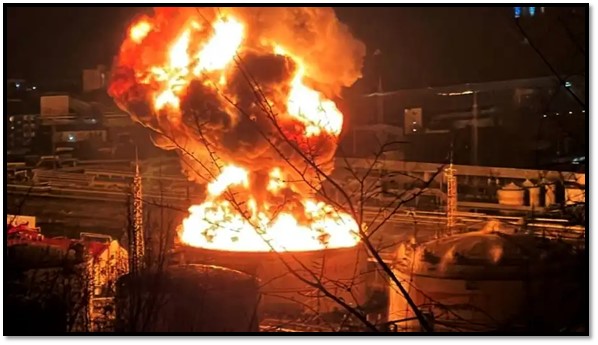
“Seventy strikes on Russian territory have targeted fuel and lubricant production, explosives, and other elements of the Russian military-industrial complex…The DeepStrike program is part of a broader effort to disrupt Russia’s war machine and critical, industrial infrastructure, to weaken the aggressor’s operational capabilities.” — The New Voice of Ukraine, October 10, 2025.
On Monday, October 6, 2025, the Ukrainian General Staff confirmed that facilities of the JSC Marine Oil Terminal in Russian-occupied Feodosia, on the southeastern coast of Crimea, had been attacked by 40 Ukrainian kamikaze drones, igniting a huge fire at Crimea’s largest oil storage and transshipment hub. The following day, the blaze intensified and spread to additional storage tanks, and black smoke was still rising from the stricken oil terminal three days later.
The Kyiv Post subsequently reported that, “The Feodosia strike was part of a larger wave of drone attacks conducted by Ukrainian forces against Russia overnight October 6-7th, involving an estimated 250 to 300 Ukrainian aircraft launched toward 14 Russian regions, along with Russian-occupied Crimea. It was the second-most massive, one-night, Ukrainian drone assault of the entire war, following a May 2025 wave of raids numbering a reported 524 aircraft.”
Previously, at 2:40 AM on Saturday morning, October 4, 2025, the Kirishi oil refinery, which opened in 2017, one of the largest refineries in the Russian Federation, only 50 miles southeast of Saint Petersburg, was struck by a Ukrainian drone attack and blazing fire, a full 500 miles from the Ukrainian border, shutting down Crude Distilling Unit 6 (CDU-6), its most-productive unit, with a capacity of 160,000 barrels per day, which is 40 percent of the plant’s overall processing capability.
The refinery’s recovery is expected to take about one month, during which time the plant will operate at about 70 percent of its capacity, while other units at the plant will be ramped up to exceed their normal capacities. This one refinery alone is responsible for 6.6 percent of Russia’s oil refining output per year. It was attacked at least three other times in the past, in September and March 2025, and March 2024.
One day prior, on Friday, October 3, 2025, Ukrainian drones blasted a chemical plant in Russia’s remote, Perm Krai region, nearly 1,000 miles from Ukraine, briefly disrupting production at one of the country’s largest nitrogen fertilizer producers, which also supplies chemicals used in military explosives.
That same day, Ukraine successfully targeted the Orsknefteorgsintez oil refinery in the Orenburg region of Russia, the only refinery there, some 940 miles from Ukrainian-held territory in their own country, with the massive plant engulfed in black smoke as video showed a drone ramming into the facility, creating a huge explosion.
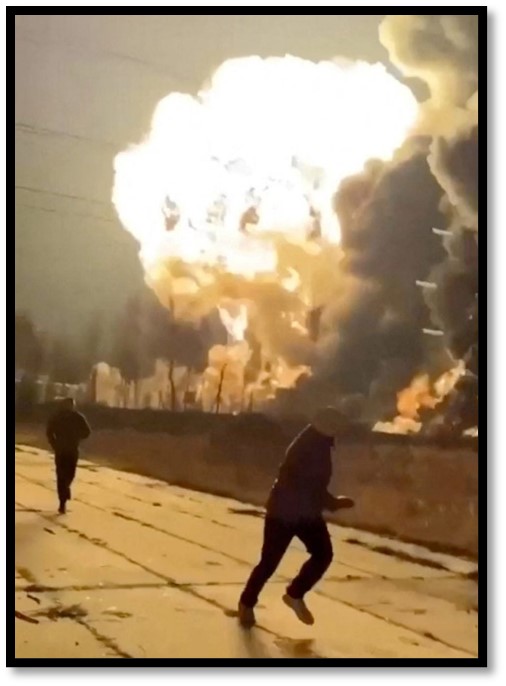
The Ukrainian government announced that, “SBU (Security Service of Ukraine) continues to cause significant harm to the Russian economy by targeting facilities in the Russian oil and gas industry. The reduction in oil dollar revenues to the budget directly affects the aggressor’s ability to continue the war against Ukraine. Nearly 40 percent of Russia’s oil refining capacity is currently out of operation.” Over the past two months alone, Ukraine has targeted at least 16 of Russia’s 38 oil refineries (42 percent), dropping Russian diesel exports to their very lowest levels in the past five years.
These most-recent, drone raids come on the heels of a drone strike on the Ryazan oil refinery, 106 miles southeast of Moscow, being attacked on August 26, 2025, a Russian ammunition depot in Bilokurakyne, eastern Ukraine, hit on August 18th, and the Lukhovitsy Aviation Plant, at the southeastern edge of Moscow, struck by Ukrainian drones at dawn on July 11th, the aerospace factory producing Russia’s advanced, MiG-29 Fulcrum-C and MiG-31 Foxhound-B jet fighters, and upgrading their Geran/Shahed drones.
Also, on Sunday, June 1st, 2025, Ukraine’s SBU agency destroyed 41 Tu-95MS16 Bear-H and Tu-22M3 Backfire-C bombers at five bases thousands of miles from Ukraine, with 117 long-range, Osa (“Wasp”) $2,000, quadcopter drones launched from trucks well inside Russia, under the covert Operation Spider’s Web, which was not coordinated with the U.S. government in advance.
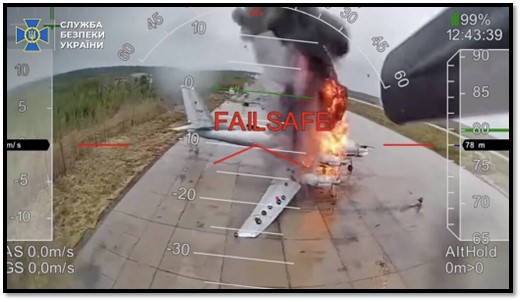
In addition, the Russian railroad network near the Ukrainian border was decimated by several strikes, and even Russian bases in the Arctic region were hit. Airfields in five regions were confirmed to have been attacked: Murmansk, Irkutsk, Ivanovo, Ryazan, and Amur. This destroyed 34 percent of Russia’s long-range bombers, in what the Russian media called a “terrorist attack.”
These long-range, deep-strike, drone attacks are carried out by the Ukrainian SBU and the Main Directorate of Intelligence (GUR, or HUR), which I previously described at length in my SOFREP article on “Defending Putin’s Lake Valdai Retreat,” published on August 18, 2025.
These very special units have had to improvise and become exceptionally innovative, adaptive, and creative, outnumbered by as much as 10 to one on the ground, so they’ve transitioned from direct, frontal attacks to hybrid warfare, which has been defined as, “the emerging, simultaneous use of multiple types of warfare by flexible and sophisticated adversaries…designed to fit the goals at the time.” These methods include conventional warfare, irregular warfare, political and economic warfare, propaganda, cyberwarfare, fake news, and other techniques.
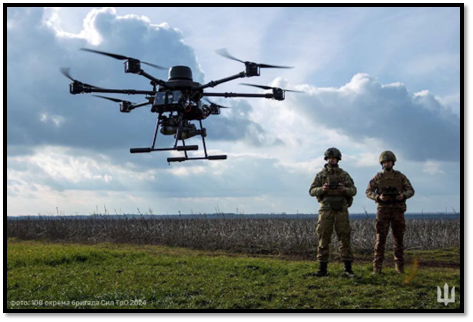
Ukraine, in particular, has had to rapidly adapt to the modern use of drone warfare because conventional warfare alone has proven insufficient in the current brutal war. Before the conflict began in February 2022, Russia occupied 15 percent of the total landmass of Ukraine, including all of Crimea, in the south, and most of the Donetsk and Luhansk regions in the east.
Now, after more than three and a half years of fierce battles, and losing more than 1.3 million men, killed (350,000), wounded (up to 810,000), or missing, they currently occupy only 18 percent of Ukrainian territory. At this rate, it will take them the next 95 years to conquer all of Ukraine, and Russian President Vladimir Putin will be long dead by then, so total victory seems utterly impossible.
The front lines of warfare have degenerated into static, frozen, entrenched positions, replicating World War One conditions more than anything else, which is not advantageous for either side, but especially for the greatly outnumbered Ukrainians. So, as Winston Churchill once observed in World War Two, “If you cannot beat the enemy at his own game, it is nearly always better to adopt some striking variant.”
Ukraine’s “striking variant” is drone warfare, at which they have rapidly become the absolute masters and experts, so much so that the Ukrainian government has reached a major, $50-billion, “Drone Deal” with the United States government, which would involve producing up to 10 million drones annually, but not until the war with Russia ends.
These combat-proven, armed drones and their associated technology are required, in order to update the U.S. Armed Forces on the very latest battlefield technology, at which no one currently excels more than the Ukrainians. This latest drone warfare against refineries and other infrastructure accomplishes several critical objectives at once:
Interdiction missions: These attack vital infrastructure and logistical supply lines deep within enemy territory, striking distant targets such as factories, bridges, railroads, pipelines, supply routes, ammunition depots, and, of course, oil refineries.
Economic warfare: Russia depends very heavily upon its exports of oil, gasoline, and liquid natural gas (LNG) to support their struggling economy, and is already suffering from major gasoline shortages as a result of poor management and previous attacks against petroleum-based facilities. Targeting oil refineries cripples the Russian economy behind the scenes, cuts their supply lines, and reduces the flow of vital oil and gasoline to power their tanks and other armored vehicles on the front lines.
However, the NATO member nations of Hungary, Slovakia, and Turkey continue to purchase inexpensive oil directly from Russia, despite the European Union attempting to shift supplies over to oil from Azerbaijan and even the United States, so NATO itself remains divided on how to reduce energy dependence from Russian oil.
Psychological warfare: While the majority of Russians still support the war effort, despite their own, staggering losses, which are not discussed in the Russian news media, cutting off the supply of gasoline to average Russian at home will certainly have an impact on public morale, support for the regime, and other factors. When ordinary citizens far from the frontlines of battle find themselves personally and negatively affected by the regime’s belligerent policies, widespread dissent, and even open revolt, become more likely with the passing of time, even within authoritarian Russia.
Furthermore, because the Russian Federation is a nuclear power, even if it were possible for the Ukrainians to defeat them on the battlefield by conventional means, which it certainly is not, they would feel forced into a corner, perceiving an existential threat to the nation, and would likely resort to nuclear warfare. This can be avoided through the use of hybrid warfare, disrupting their vital infrastructure and supply lines from within.
U.S. President Donald J. Trump may not have personal, military experience, but he is a world-class businessman and economist, who clearly understands the power of the dollar. He fully realizes that it is neither necessary nor desirable to defeat Russia on the battlefield, when it’s far more advantageous to attack their greatest, economic weakness, an overdependence upon oil exports, worth 20 percent of their gross domestic product (GDP.)
In the past, the mighty Soviet Union collapsed in 1991 due to three major factors: First, President Ronald Reagan deployed 108 MGM-31B Pershing II hypersonic (Mach 10), super-accurate (within 100 feet), nuclear (.5 to 80 kiloton variable yield) missile launchers into West Germany from 1983 to 1985, at the height of the Cold War, which the Soviet authorities correctly assessed to be virtually unstoppable, and it terrified them.
Unfortunately, all Pershing IIs were dismantled and destroyed by the U.S. Army by May 1991, following ratification of the Intermediate-Range Nuclear Forces (INF) Treaty on May 27, 1988, so these superb missiles are no longer available for the nuclear deterrence mission.
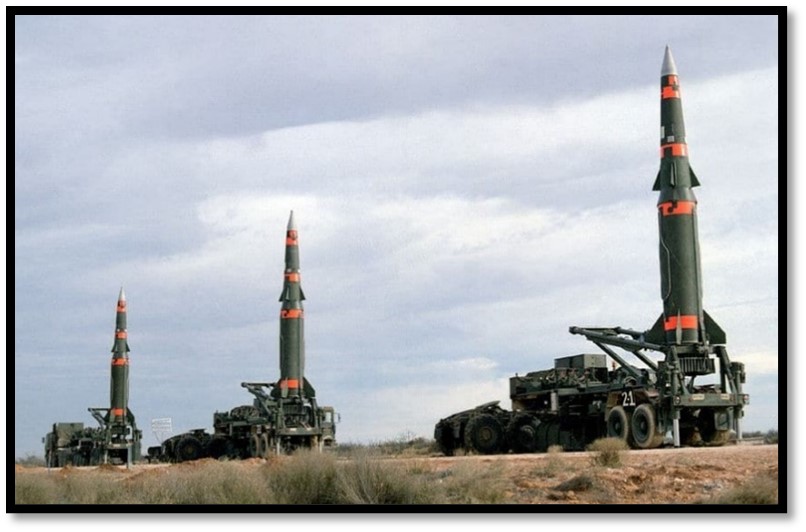
Secondly, Reagan produced such a powerful, booming economy (called “Reaganomics” at the time) that the oppressive Soviet Union couldn’t possibly match that level of economic growth and prosperity as a competing superpower.
And third, the Soviets were hopelessly bogged down in the unpopular and seemingly-endless, 10-year-long, Soviet-Afghan War, from which they ultimately withdrew in defeat on February 15, 1989, after suffering comparatively light casualties of 15,000 men killed, 54,000 wounded, and 416,000 hospitalized due to disease.
Today, Russian President Vladimir Putin faces a very similar set of circumstances, having failed to learn from the crucial lessons of Cold War history. The United States will soon be supplying Ukraine with the very latest in conventional weapons through NATO intermediaries and lifting all restrictions upon their use for long-range attacks, deep into Russian territory.
In addition, a very strong U.S. economy counterbalances Russia’s struggling economy, with the Russian ruble still lagging against the U.S. dollar (81 rubles per dollar), after a previous low of 107 rubles per dollar in November 2024.
And finally, the Russian Federation is once again sinking into the quagmire of another bloody and endless war, and rapidly losing popular support for the war effort as more young men come home in body bags, and more Russian parents find themselves in deep despair as a result.
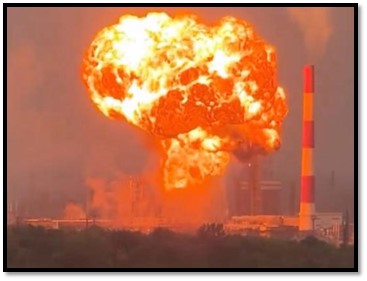
Accordingly, the Ukrainian government has recently adopted the brilliant, combat strategy of asymmetric, drone warfare to seriously cripple the Russian economy from within, while simultaneously negating any battlefield provocation that might lead to nuclear annihilation. Putin is unwittingly falling into the same trap that destroyed the Soviet Union, under very nearly the same circumstances, but he is so blindly fixated upon conquering Ukraine, a virtually impossible task, that the Russian Federation is beginning to economically crumble all around him.
According to The New Voice of Ukraine on October 10, 2025, “Seventy strikes on Russian territory have targeted fuel and lubricant production, explosives, and other elements of the Russian, military-industrial complex…The DeepStrike program (campaign) is part of a broader effort to disrupt Russia’s war machine and critical industrial infrastructure, to weaken the aggressor’s operational capabilities.”
Ukrainian President Volodymyr Zelenskyy recently stated that, “Long-range sanctions (meaning drone strikes) against Russia…(are) achieving truly significant results…The fuel shortage in Russia is already approaching 20 percent. This specifically concerns their gasoline…They’ve now begun tapping into diesel reserves, which they’ve been saving for a rainy day.” He added that 40 percent of Ukraine’s combat weapons are Ukrainian-made, and that will increase to 50 percent by the end of the year.
It remains to be seen if these latest, DeepStrike, drone missions will turn the tide of war in Ukraine’s favor, but the results so far are quite impressive, shutting down 40 percent of Russia’s oil-production capacity, and the United States is certainly learning this important lesson by coordinating with Ukraine for future drone production and advanced, drone technology.
Volodymyr Zelenskyy is literally the only world leader facing down the mighty, Russia bear in mortal combat within his own homeland, and his strength, courage, willpower, determination, and resolve should never be underestimated by anyone.
Vladimir Putin recklessly unleashed the savage fury of unrestricted, total warfare against peaceful Ukraine three and a half years ago. As Galatians 6:7 in the Bible clearly states, “Whatever a man soweth, that shall he also reap.” Hosea 8:7 takes this proverb a step further: “They have sown the wind, and will reap the whirlwind.”
That latter passage was often cited by British Air Chief Marshal Harris (Sir Arthur Harris, known as “Bomber Harris”) of the RAF (Royal Air Force) Bomber Command, as justification for the massive, bombing campaign against German industrial targets and cities, and especially the bombing of Hitler’s Obersalzberg complex, the vaunted “Alpine Redoubt,” high in the German Alps, near the end of World War Two. Today, the DeepStrike drone campaign ensures that Vladimir Putin is clearly reaping the proverbial whirlwind for his unprovoked invasion of Ukraine.








COMMENTS