At Camp Atterbury, the Pentagon is teaching a new kind of air combat—where pilots wear goggles instead of helmets, the aircraft cost a few thousand bucks, and victory depends on who can outfly chaos with a swarm of expendable machines.
Read the full article for more on:
Important insights and detailed analysis
Expert commentary on current events
Breaking developments and updates
Updating summary...
Discover the Pentagon’s New “Top Gun” for Drones
Guy D. McCardle
Speed
1x
Listen
COMMENTS
At Camp Atterbury, the Pentagon is teaching a new kind of air combat—where pilots wear goggles instead of helmets, the aircraft cost a few thousand bucks, and victory depends on who can outfly chaos with a swarm of expendable machines.
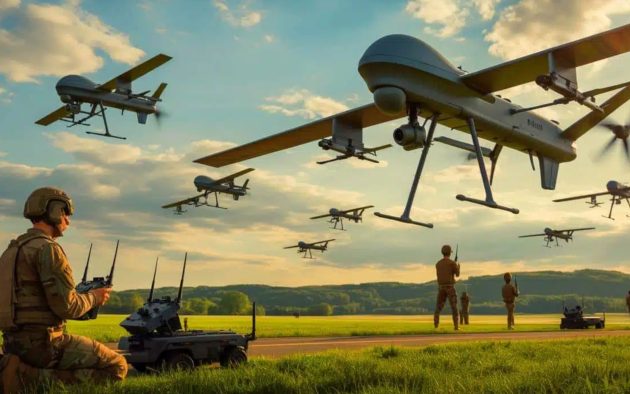
On a dusk-stained runway, waves of inexpensive, kamikaze drones lift like engineered locusts—flown by goggle-clad operators and guided by hard, frontline pragmatism, they’re set to rewrite how America fights at the small-unit level. Image Credit: Visegrad Post
Move over, Maverick.
Advertisement
The Pentagon has quietly ripped a page from Hollywood and Ukraine’s battlefield playbook and set up a “Top Gun”-style school for drone operators ,except the jets are replaced by first-person-view (FPV) kamikaze drones and the dogfights happen a few feet above a dusty training range. The event was staged as part of the Department of Defense’s Technology Readiness Experimentation (T-REX) series at Camp Atterbury, Indiana, where service teams and industry prototypes faced off in threat-representative environments.
What is it — and when did it happen?
The course debuted during the T-REX experimentation window held in August 2025 (reports and on-the-ground coverage place demonstrations around mid- to late-August), and quickly grew into more than a show-and-tell. Organizers billed a competitive “Top Drone” school inside T-REX where red-vs-blue matches, constrained urban scenarios, and live demonstrations put both pilots and counter-drone systems through their paces. Follow-on events have continued, and the program’s architects say this is no one-off — they want a recurring, scalable schoolhouse model for close-in unmanned-aircraft combat.
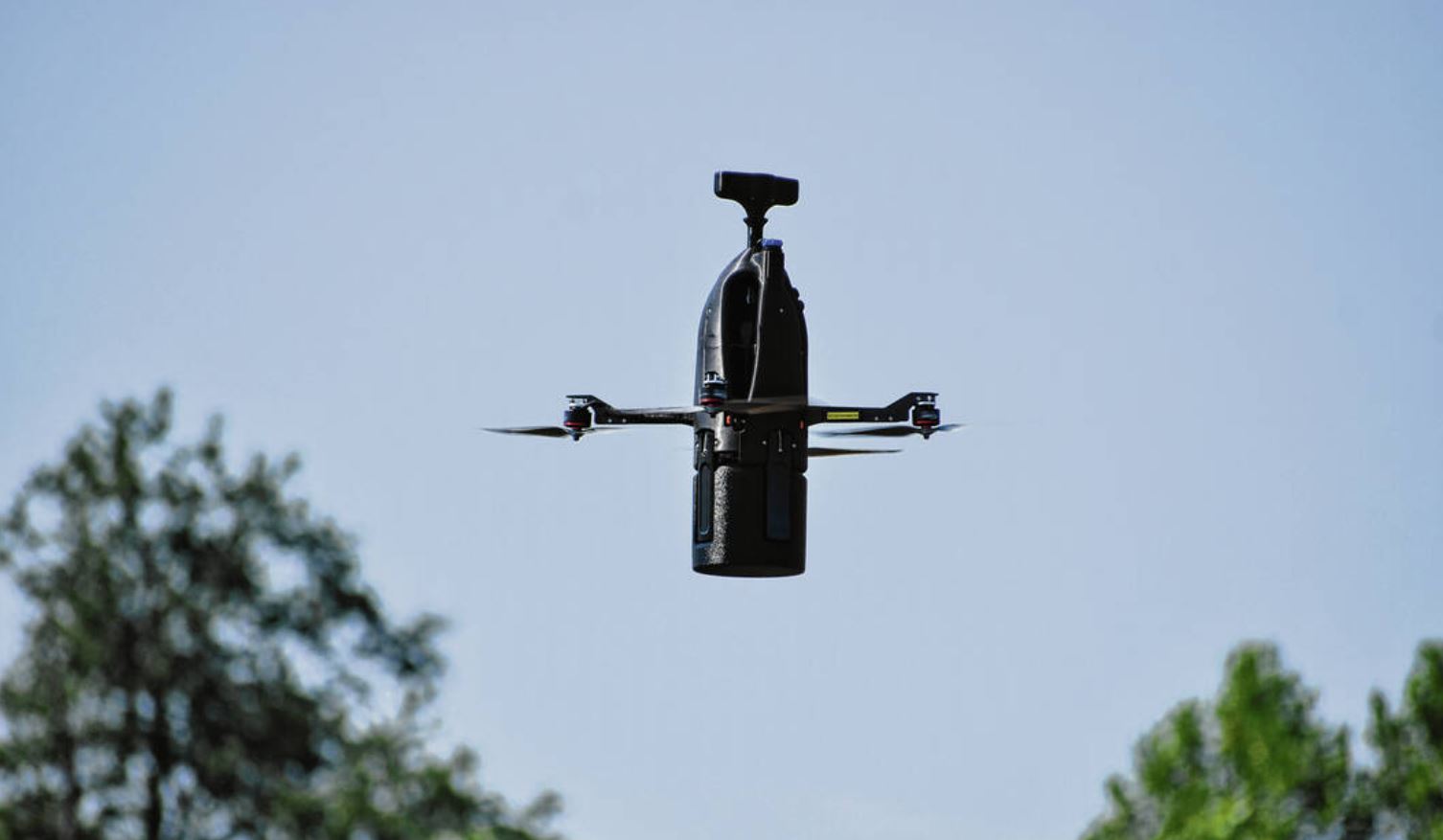
Here we have a WASP/HIVE drone taking to the skies over Camp Atterbury. It is manufactured by IDA Corp. Not all drones look alike. Some look like flying vacuum cleaners. Image Credit: Noah Crenshaw / Daily Journal
Who’s it for?
This isn’t just for the Air Force’s drone nerds. Teams from the Army, Navy, Marines, and the National Guard showed up — operators, tactics developers, prototypers and hardened test officers.The goal: teach crews how to fly, fight, and integrate attritable swarms and FPV strike systems into company- and battalion-level operations, and to give acquisition types real user feedback under pressure. Ukrainian advisors were even present to share hard lessons from the front lines, because if the system hasn’t survived contact with the real thing, it isn’t battle-ready.
Advertisement
What goes on there? What will they test?
Think of it like a combat flight school crossed with an R&D stress test. Exercises included close-quarters FPV runs, target identification under jamming and GPS-denied conditions, live-fire demonstrations of loitering munitions, and red-team attempts to spoof or seize control of platforms. Organizers layered in electronic warfare, counter-UAS measures, mesh communications, and mission command resilience, and a menu of adversarial conditions so developers can see failure modes in real time. The objective is practical: make drones usable in the chaotic, degraded environments they’ll actually face.
Which drones showed up?
The roster ranged from tiny FPV strike rigs to mid-sized tactical systems. Industry and service platforms cited at T-REX and the Top Drone iterations included FPV recon and attack setups demonstrated by companies like Draganfly (Commander 3XL and Flex FPV) and familiar Replicator buys like AeroVironment’s Switchblade family — alongside larger experimental and attritable aircraft such as Kratos’ XQ-58 and swarm/loitering concepts like WASP/HIVE. In short: everything from hobbyist-turned-weapon FPVs to purpose-built tactical loitering munitions and expendable drones.
Advertisement
Did You Know Neuralink’s Director of Operations Shivon Zilis is the newest board member of ShieldAI. You are looking at the Valkyrie XQ-58, an uncrewed AI integrated and piloted jet for the US DoD. The AI is developed by ShieldAI and Kratos 👀 pic.twitter.com/SH3tgeLbbG
T-REX’s “Top Drone” thread deliberately tests the ecosystem, including counter-UAS sensors and shooters, resilient communications and mesh networks, autonomy stacks, launcher and logistics concepts, and human-machine interfaces for tight operator control. They run EW envelopes, test mission planning tools, and push doctrine — because a million cheap drones are worthless unless you also have doctrine, supply chains, and operators who can integrate them into combined arms.
Introducing Vadris, an RF-seeking payload for FPV drones that locates the operator, the source of the threat. In active testing and development with the U.S. military.
It detects and characterizes control signals in real time and overlays a live line-of-bearing onto the pilot’s… pic.twitter.com/gh46EWZSFY
The school is another plank in a public campaign to make drones central to U.S. force design. The Pentagon’s Replicator initiative and follow-on buys have aimed to field thousands of low-cost, attritable systems, and service leaders have signaled plans for massive procurement ramps — from Replicator tranches to reported Army targets measured in the hundreds of thousands and, as recent reporting shows, even plans referencing acquisition of at least a million expendable drones over the next few years. The Top Drone school (that’s what I’m calling it now) is about human capital and tactics: mass manufacture is only half the job; you still need pilots, tactics, and a playbook to turn cheap flying robots into credible combat power.
Pentagon’s ‘Replicator Initiative’ Is About to Pump Out Millions of Flying Killer Robots
If Ukraine taught the world anything about modern war, it’s that ingenuity and thousands of dollars’ worth of electronics can now change the calculus of force projection.
The Pentagon’s “Top Gun” for drones is the U.S. answer: build the factories, then build the pilots, the doctrine, and the countermeasures. It’s messy, experimental, and indispensable — a lab for the ugly, intimate future of attritable air combat.
For anyone who still imagines modern warfare as only big, shiny platforms, Camp Atterbury’s dust will be a rude awakening.
The future belongs to the small and the many, working as one.
Unique footage of the drone ambush technique.
Russians on foot are targeted by Ukrainian drones waiting in the grass. Although we don’t know the time distance between each cut, the Russians continue to use the same route. It appears to all be just one, heavily trafficked spot. pic.twitter.com/Gj9yY7aMpc










COMMENTS