

September 11, 2001 allowed for the first direct action missions for the TCS program as I was assigned to ST-3E with the help and support of Brandon Webb. TCS proved that it could function in the field. Additional world-wide combat deployments to Afghanistan, Iraq, Bosnia, etc. continued to show the promise and potential and even some of the harshest critics from both ends of the spectrum began to understand the potential for increased mission success, new target creation/development and increased safety for all operators involved.
When I was assigned to a new platoon, I would give a simple brief: “Anyone who watches the NFL knows that the coaches communicate to the field by radio transmissions. I play offense and defense, can intercept and translate the messages and best of all I have their playbook.” Don would have been accepting of TCS and there was not one mission that I conducted where I thought that I had an additional responsibility to perform, just as if I was working with him.
Ironically, my last combat deployment before retiring was with SEAL Team 4. Prior to that final deployment to Iraq, I would often walk by the plaque of Don in the hallway where his Navy Cross Citation is displayed. The following is the summary of action:
For extraordinary heroism in action while serving as Platoon Chief Petty Officer of SEAL Team Four Golf Platoon at Paitilla Airfield, Republic of Panama during Operation Just Cause, 19-21 December 1989. Golf Platoon was an element of Naval Special Warfare Task Unit Papa, a force consisting of three SEAL Platoons, special purpose U.S. Army and Air Force Operations Aircraft and U.S. Navy Patrol Boats. Task Unit PAPA’s mission was: to deny the use of Paitilla Airfield to General Noriega and key Panamanian Defense Force (PDF) personnel; to disable General Noriega’s personal jet aircraft and other selected aircraft; and to hold the airfield until relieved by conventional forces at H + five hours. This mission was crucial to the success of Operation Just Cause because it blocked a principal means of escape for General Noriega and his associates.”
As nightfall settled over Panama on 19 Dec., ENC McFaul and his platoon launched their combat rubber raiding craft (CRRC) from a beach near Howard AFB, rendezvoused with a waiting U.S. Navy patrol boat off the coast, and began a clandestine transit to a loitering point 3000 yds. off the southern approach to Paitilla Airfield.
At 2315 the SEAL elements began their infiltration to a beach at the southern end of the airfield. As the force clandestinely moved ashore, sounds of artillery fire began to fill the air from the battles unfolding in and around Panama City. Concerned that the force would soon be compromised, his platoon was directed to move quickly to its objective.
As the platoon patrolled up the airfield, an intelligence report was received indicating that General Noriega was possibly flying into Paitilla in four minutes aboard an unknown aircraft. The platoon continued with all possible speed to the PDF hangar on the northwestern side of the 4,300 ft. runway to ensure that General Noriega would not be able to use his jet aircraft.
As the first squad of Golf Platoon closed to within fifty yards of the hangar housing General Noriega’s aircraft, they became engaged in a fierce firefight with well positioned Panamanian Defense Forces in and between the hangars. As the engagement continued, ENC McFaul and the second squad fought fiercely, attempting to suppress the enemy fire. The platoon’s first squad had sustained heavy casualties in the initial volley — eight of the nine men had been wounded. ENC McFaul came to realize that the men from first squad were not responding to orders and were, in fact, all lying wounded in their exposed positions. Most were barely able to operate their weapons. He immediately responded to help the numerous wounded, since his was the closest element — approximately 25 yards south of the first squad during the initial firefight.
ENC McFaul, realizing that the first squad was in extreme danger, instructed his men to continue their suppressing fire directed at the PDF hangar while he and a corpsman moved forward to rescue his stricken teammates. As he progressed toward the beaten zone, ENC McFaul encountered LTJG Casey dragging a wounded teammate from the firefight. In the absence of effective cover fire and with disregard for his personal safety, ENC McFaul entered the kill zone with the single focus of saving his teammates’ lives. Moving quickly, he located Petty Officer Moreno, who had suffered a severe head wound, and courageously began to drag him from the deadly enemy fire. As he desperately pulled Petty Office Moreno to safety, ENC McFaul was savagely raked by enemy automatic weapons fire, and upon succumbing to his mortal wounds, he laid himself across his teammate, protecting him from enemy fire.
ENC McFaul demonstrated the highest possible level of personal sacrifice and valor. His extraordinary heroic actions, in total disregard for his personal safety, saved the life of Petty Office Moreno and inspired other heroic acts that unquestionably saved more lives. He set the highest possible standard for the leadership by example in combat. His selfless and extraordinary heroism clearly warranted the special recognition of the Navy Cross.
The Arleigh Burke-class Frigate DDG-74 bears the name USS McFaul. The Chiefs’ Mess at Little Creek Amphibious Base also carries his name and I have sat in the McFaul room on many occasions, yet his unrecognized legacy is the TCS program which hopefully still strives to achieve the same level of professionalism, honor, and courage that Chief McFaul displayed.
On this day, I wish the McFaul family a wonderful Memorial Day weekend knowing that Don’s legacy continues.
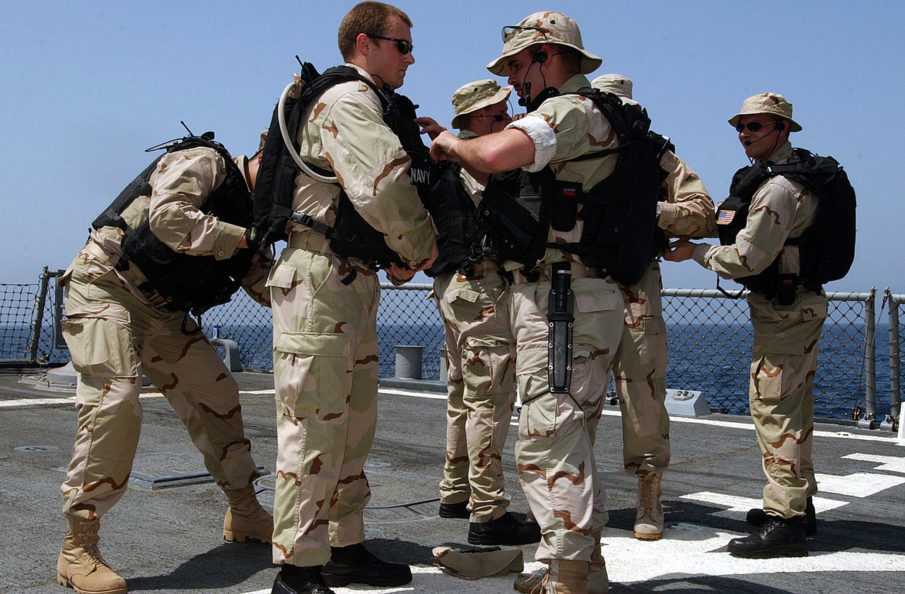
Featured image: Gulf of Oman (Apr. 1, 2004) – Members assigned to the Visit Board Search and Seizure (VBSS) team aboard the guided missile destroyer USS McFaul (DDG 74) — named for U.S. Navy SEAL Chief Petty Officer Donald L. McFaul — don their equipment after getting orders to conduct a search of a fishing dhow. McFaul is on a regularly scheduled deployment in support of the Global War on Terrorism. U.S. Navy photo by Photographer’s Mate 1st Class Alan D. Monyelle. (RELEASED)








COMMENTS