$200 Billion and No Clock on the Wall
The War Department is preparing to walk into Congress with its hand out again, this time for roughly $200 billion, and doing it with a straight face while admitting there’s no timeline for how long this thing runs. Not a rough estimate. Not a guarded projection. Nothing. Just a blank space where the end of the war should be, paired neatly with a price tag that looks like it was pulled from a casino ledger at three in the morning. And this isn’t starting from zero. It stacks on top of roughly $150 billion already pushed through last year, with the meter reportedly running at about a billion dollars a day since the shooting started.
On paper, the justification is clean enough. Munitions are burning fast, stockpiles are thinning, and the industrial base needs to spin up. Bombs don’t replace themselves, and when you’re dropping them by the thousand, somebody has to keep the conveyor belt moving. That part tracks. War has always been expensive, and this one is no exception.
The ask also reflects a simple reality: the deeper you go, the more it costs to stay there.
But here’s where it gets strange. The same officials asking for a mountain of money are also telling you, without hesitation, that they don’t know how long the fight lasts or what the final shape of victory even looks like. The campaign is expanding, targets piling up, operations digging deeper into Iranian territory, and yet the end state remains as slippery as a timeline written in dry-erase marker. Earlier talk of a short, defined timeline has quietly dissolved into something far more open-ended.
Congress, predictably, is starting to twitch. There are murmurs about blank checks, questions about authorization, and the kind of uneasy shifting in chairs that happens when the numbers get too big to ignore. Some want clearer objectives. Others just want to know how long the meter is going to keep running.
Nobody likes the feeling of funding a war that doesn’t come with a map.
And that’s the real tension sitting underneath all of this. Not the bombs, not the targets, not even the politics. It’s the combination of scale and uncertainty. Big money, no timeline, and a war that still hasn’t found its ceiling. That’s the kind of equation that has a habit of writing its own ending, whether anyone in Washington is ready for it or not.
Drones Over the Nation’s Front Yard
Somewhere in Washington, D.C., a handful of unidentified drones drifted over Fort McNair like they owned the place, and the illusion of control slipped away just enough for everyone to notice. Not a base out in the desert. Not some forgotten installation in the middle of nowhere. This is two miles from the White House, home to the National Defense University and, more importantly, where senior officials like Secretary of State Marco Rubio and Defense Secretary Pete Hegseth have been staying in recent days.
The details are thin, which is exactly what makes it interesting. Multiple drones have been spotted in a single night within the past ten days. No known origin. No ownership. No explanation. Just enough presence to trigger security meetings at the White House and quiet discussions about whether to move top officials somewhere safer, which, for now, they have not. Officials say there’s no credible threat. That’s the official line. But when something unidentified floats over restricted airspace in the capital during an active war, that phrase starts to sound less like reassurance and more like a placating placeholder.
The timing is what turns this from a curiosity into a signal. The United States is already on a heightened alert posture as operations against Iran expand, and bases from MacDill to McGuire-Dix-Lakehurst have moved to higher force protection levels. At the same time, the State Department has ordered global security reviews for diplomatic posts, citing the risk of spillover. Put all of that together, and the drones stop looking like a random nuisance and start looking like a probe.
And that’s the part nobody wants to say out loud. Experts will tell you the range of possibilities runs from harmless hobbyist to surveillance platforms to something designed to carry a payload. Each option carries its own kind of problem, and none of them come with easy answers when the airspace in question sits at the center of American power.
Already have an account? Sign In
Two ways to continue to read this article.
Subscribe
$1.99
every 4 weeks
- Unlimited access to all articles
- Support independent journalism
- Ad-free reading experience
Subscribe Now
Recurring Monthly. Cancel Anytime.
Maybe it was nothing. Maybe it was everything. But the fact remains, something unidentified made it into restricted airspace over one of the most sensitive pieces of real estate in the country and stayed there long enough to be noticed.
In a war defined by long distances and proxy strikes, this one felt uncomfortably close to home.
Dark Eagle Nears the Launch Rail
For years, the Army’s hypersonic program had the aura of a Pentagon fever dream, all glossy renderings, delayed tests, and conference-panel optimism. Now it is suddenly, uncomfortably real.
Army officials say the first Dark Eagle battery is only weeks away from being fully equipped, which would put the service on the verge of fielding its first operational hypersonic weapon after years of slips, stumbles, and enough missed deadlines to make a congressional staffer reach for the bourbon at lunch.
The Army had once aimed to field the system in 2023. That did not happen. Then came more delays, more fixes, and the sort of careful public language officials use when a machine this expensive keeps refusing to behave on schedule. This week, though, the tone changed. “Within a few weeks” is not the language of theory. It is the language of a capability that’s about to start changing assumptions.
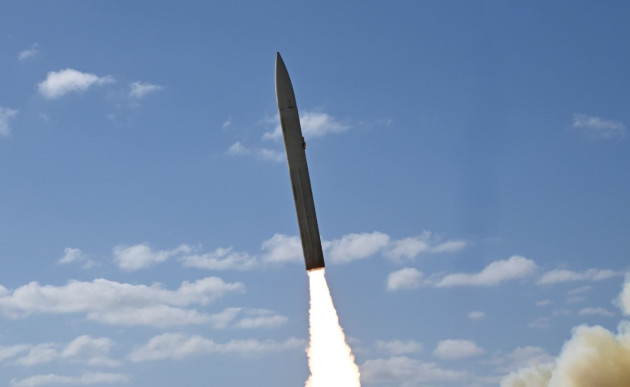
Dark Eagle, formally known as the Long-Range Hypersonic Weapon, is built to do a simple but unnerving thing: hit hard, hit fast, and hit places the other guy thought were safe.
The system uses a truck-launched booster to sling a Common Hypersonic Glide Body downrange at speeds above Mach 5, with a reported range of more than 1,700 miles.
One battery includes a battery operations center, four transporter-erector-launchers, and up to eight missiles. This is the Army’s long-awaited answer to the problem of striking deep into defended territory without waiting on airpower or legacy cruise missiles.
The first battery standing up at Joint Base Lewis-McChord is not just a technical milestone; it’s a geographic signal. This is a Pacific-facing weapon, built for a fight where distance and denial define the battlefield.
But the champagne should stay corked for a moment.
Even as the Army talks like a man jingling car keys outside the casino, Pentagon test officials are warning that Dark Eagle still lacks enough data to judge its operational effectiveness, suitability, survivability, and cyber resilience, with sufficient test data not expected until 2027, a timeline that itself reflects the long tail of delays that have dogged the program since its original 2023 target.
That is the tension wrapped around this whole effort.
The Army wants a weapon that can finally put the United States on the board in the hypersonic race.
The test community wants proof that the thing can survive contact with reality. Both are right. And that is why Dark Eagle is important.
It is not just another missile. It is the Army trying to shove itself into the future at Mach 5 and hoping the bolts hold.










COMMENTS