

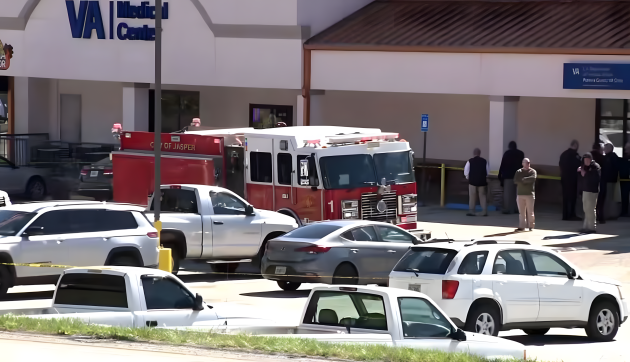
The wounded employee was airlifted to a hospital. As of Wednesday, their name and condition have not been released. VA Press Secretary Pete Kasperowicz confirmed the victim was a clinic employee and said the facility would remain closed for the rest of the week while the investigation continues.
No motive has been established. Dawkins told reporters: “We don’t know what led up to it.” The suspect has been identified only as a local Jasper-area man. His name has not been released, and a Pickens County Sheriff’s Office spokesman said he did not know whether the man had any military background. Authorities are still determining what connection, if any, he had to the VA system.
The investigation now involves the FBI, the Georgia Bureau of Investigation, and the VA’s Office of Inspector General. VA Secretary Doug Collins posted on X that the department was sending a team from headquarters to Georgia to support clinic staff. The VA said it was rescheduling appointments and making counseling and chaplain services available.
A witness inside the neighboring Goodwill told CNN affiliate WXIA that police chased the suspect around the side of the building, and that a bullet pierced the store wall near where he had been standing moments earlier.
Jasper is a town of roughly 5,000 people at the foot of the Blue Ridge Mountains, about 60 miles north of Atlanta. The clinic, which opened in 2020, provides primary care, mental health services, laboratory work, and telehealth to area veterans.
Violence at VA facilities is uncommon but not without precedent. These clinics serve a population that carries more than its share of invisible weight, and the people staffing them absorb more of that pressure than most realize. When the investigation produces answers, they may explain who this man was and why he did what he did. They won’t resolve the tension that lives in these buildings every day, between a system doing its best and a population that has already given more than enough.
Another Head Rolls in Tehran: The Slow Collapse of Iran’s Intelligence Machine
Somewhere in Tehran, sometime before dawn, a man who once knew everyone else’s secrets ran out of time.
Iran’s intelligence minister, Esmaeil Khatib, was killed overnight Tuesday into Wednesday in what Israeli officials describe as a precision airstrike inside the capital. This time, there’s no ambiguity about the outcome. Iranian President Masoud Pezeshkian publicly confirmed Khatib’s death, calling it an assassination, even as details about the exact strike location and method remain tightly controlled.
This wasn’t a battlefield kill. This was a targeted strike in one of the most heavily defended cities in the region, against a man who should have been surrounded by layers of protection. Tehran is not supposed to be porous. And yet, over the past several weeks, it has started to look exactly that way.
Khatib’s death did not happen in isolation. He was the third senior figure eliminated in roughly 48 hours, following Ali Larijani, secretary of Iran’s Supreme National Security Council, and Gholamreza Soleimani, commander of the Basij militia. The Iranian leadership itself has acknowledged a broader wave of losses, including cabinet-level officials and senior commanders. That’s a solid pattern of kills. And it’s starting to look like a campaign.
The strikes appear to follow a consistent approach. Identify the target, confirm the location, and deliver a precise hit intended to remove leadership rather than flatten entire blocks, though not totally without collateral loss. Iranian officials have acknowledged that some family members and aides were also killed in recent strikes.
Even controlled violence carries consequences.
What stands out is the reach. These operations are happening deep inside Iranian territory, suggesting either significant intelligence penetration or highly effective surveillance, or both. Some reporting has pointed to coordination between Israel and the United States at the intelligence level, a detail that, if accurate, would explain the consistency and tempo of these hits.
Because every successful strike like this raises the same question: how are these targets being found?
It’s also unclear whether Tehran can replace leadership at the pace these losses are occurring. Khatib was not a mid-level figure. He was a trusted insider with deep ties to Iran’s intelligence services and the ruling structure itself. Losing people like that doesn’t just create vacancies. It creates hesitation, fractures decision-making, and forces responsibility onto those who may not be ready to carry it.
So what does this mean tonight?
It means Iran is still in the fight, but it is operating with a leadership structure that is being steadily eroded.
It means senior officials are now working under the assumption that their location is not secure. And it means each strike is doing more than removing a name; it is slowly and methodically chipping away at the system holding everything together.
This is what a decapitation campaign looks like when it’s working.
Not loud. Not chaotic.
Just one more office light going dark in a city that’s starting to feel a little less secure than it did yesterday.








COMMENTS