Six Airmen Killed in KC-135 Tanker Crash Over Iraq
War in the air rarely pauses long enough to notice the aircraft that make the rest of the fight possible. On Thursday, one of those quiet workhorses never made it home.
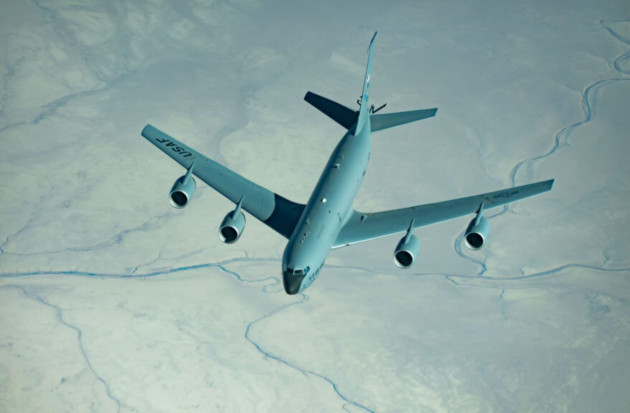
A U.S. Air Force KC-135 Stratotanker crashed in western Iraq on March 12 while flying a combat support mission for Operation Epic Fury, the ongoing U.S.-led campaign against Iran. All six airmen aboard were killed, according to U.S. Central Command.
Early reports suggested fewer casualties while search and rescue teams worked the crash site. By Friday morning, the military confirmed the worst. The identities of the crew have not yet been released pending next-of-kin notification.
CENTCOM said the loss followed an “incident” involving two U.S. military aircraft operating in friendly airspace. One aircraft went down in western Iraq. The other landed safely after declaring an emergency.
Later reporting from defense outlets indicated the second aircraft was also a KC-135. Images after the landing showed it missing a large section of its vertical stabilizer, pointing to the possibility of a midair collision or some other severe contact. Investigators have not yet released a definitive cause.
U.S. officials have ruled out both hostile fire and friendly fire. An Iranian-backed militia group, Islamic Resistance in Iraq, quickly claimed responsibility for shooting down the tanker, but CENTCOM’s statement directly undercuts that assertion.
CBS News, citing Iraqi intelligence sources, reported the aircraft crashed near Turaibil along the Iraqi-Jordanian border, an isolated stretch of desert often used as an air corridor for coalition aircraft operating across the region.
The loss adds to the mounting cost of Operation Epic Fury. With these six deaths, the number of U.S. service members killed since the campaign began in late February has reached 13. It also marks the fourth loss of a manned American aircraft since operations intensified.
The KC-135 Stratotanker has been the backbone of American aerial refueling since entering service in 1957. These aircraft extend the reach of fighters, bombers, and surveillance platforms, keeping them on station far longer than they could manage alone.
Most KC-135 missions fly with a crew of three: pilot, co-pilot, and boom operator. The presence of six airmen aboard this aircraft suggests additional personnel were traveling on the mission.
Tanker work is routine until it isn’t. It demands precision in crowded airspace, sometimes at night, always under pressure, and with very little room for error.
Already have an account? Sign In
Two ways to continue to read this article.
Subscribe
$1.99
every 4 weeks
- Unlimited access to all articles
- Support independent journalism
- Ad-free reading experience
Subscribe Now
Recurring Monthly. Cancel Anytime.
Most nights, the choreography holds.
On March 12, over the desert of western Iraq, it didn’t.
Marines Moving: USS Tripoli and the 31st MEU Head Toward the Middle East
The United States is sending in the Marines.
As the war with Iran enters its third week, the War Department has approved the deployment of a Marine Expeditionary Unit to the Middle East, giving U.S. Central Command another option if the conflict spreads beyond the current air campaign.
At the center of the move is the amphibious assault ship USS Tripoli, forward-deployed from Sasebo, Japan, carrying elements of the 31st Marine Expeditionary Unit, based primarily in Okinawa. The unit numbers about 2,200 Marines and sailors,organized as a Marine Air-Ground Task Force built for rapid crisis response.
The ground combat element is Battalion Landing Team 3rd Battalion, 1st Marine Regiment, supported by aviation and logistics components that allow the force to operate directly from amphibious ships.
Tripoli brings significant aviation power. America-class ships are designed around air operations and can deploy F-35B Lightning II short-takeoff stealth fighters, along with MV-22 Osprey tilt-rotor aircraft and attack helicopters. Unlike earlier amphibious ships, Tripoli does not have a well deck for landing craft, a design trade that prioritizes aviation capacity.
It remains unclear whether the full amphibious ready group that normally sails with Tripoli—including transport dock ships capable of launching landing craft—is deploying with it. Ship-tracking data earlier this week placed the assault ship south of Taiwan, moving through the Luzon Strait.
Pentagon officials have described the deployment as a contingency move requested by Central Command to expand operational options as tensions across the region rise. The force could support maritime security operations, embassy evacuations, raids against hostile targets, or reinforcement of U.S. positions if required.
So far, the conflict has largely been fought from the air. Operation Epic Fury, launched in late February, has centered on sustained strikes against Iranian missile infrastructure, air defenses, and military facilities.
The arrival of a Marine amphibious force adds another dimension.
A Marine Expeditionary Unit operating offshore can shift rapidly along a coastline and respond to crises without relying on land bases.
For now, Tripoli and the Marines of the 31st MEU are still heading west, adding a mobile force to an already volatile theater.
Havana Confirms Direct Talks with Washington
Cuba’s leadership has confirmed something diplomats have been hinting at for weeks: Havana and Washington are talking again.
Cuban President Miguel Díaz-Canel acknowledged the discussions publicly after a meeting Thursday with senior Communist Party leadership, with the remarks released Friday and followed by questions from state reporters. He said the talks are aimed at addressing bilateral disputes and exploring possible areas of cooperation between the two countries.
More notable is who is leading them. Díaz-Canel said the Cuban side is being directed by former president Raúl Castro, the 94-year-old revolutionary figure who remains one of the most influential power brokers inside the Cuban system.
The American side appears equally high-level. U.S. officials say Secretary of State Marco Rubio and senior aides met in late February with Raúl Guillermo Rodríguez Castro, Raúl Castro’s grandson, on the sidelines of a regional meeting in the Caribbean.
The timing of the dialogue is not accidental.
Cuba is facing a severe energy and economic crisis triggered by Washington’s pressure campaign against the island. After U.S. forces captured Venezuelan leader Nicolás Maduro earlier this year, Venezuelan oil shipments to Cuba were effectively cut off. Washington also imposed tariffs and sanctions aimed at discouraging other countries from supplying fuel to the island.
The loss of those shipments has left Cuba with critically low fuel reserves, forcing widespread blackouts, transportation shutdowns, and disruptions to hospitals and industry. In some areas, electricity outages now stretch more than half the day.
Against that backdrop, Havana recently announced the release of 51 prisoners, a move Cuban officials said was connected to diplomatic engagement with the Vatican, which has historically served as a quiet mediator in U.S.–Cuba relations.
None of this guarantees a breakthrough. Relations between the two countries have swung between confrontation and cautious engagement for decades, with negotiations often collapsing as quickly as they begin.
But the structure of these talks suggests something more serious than routine diplomatic signaling.
With Raúl Castro guiding the Cuban side and senior U.S. officials directly involved, both governments appear willing to explore whether the current crisis can produce a negotiated opening.
For now, the discussions remain largely behind closed doors.
What matters is that they are happening at all.










COMMENTS