The Strait of Hormuz Turns Into a Battlefield
The Strait of Hormuz has always been one of the most dangerous pieces of water on Earth. It is narrow, crowded with tankers, and sits within range of Iranian missiles, drones, naval mines, and swarms of fast-attack boats. In peacetime, that makes it tense. In wartime, it turns the passage into a loaded gun pointed at the global economy.
Now that gun is going off.
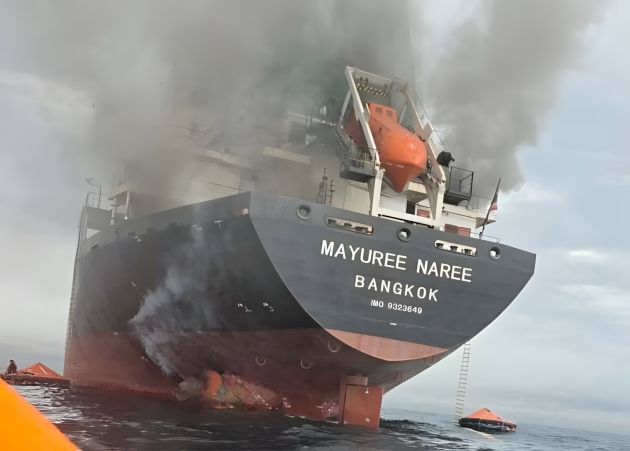
Over the past twenty-four hours, three commercial vessels have been struck by projectiles in and around the Persian Gulf, according to maritime security alerts. The most serious incident involved the Thai-flagged cargo ship Mayuree Naree, which was hit by two projectiles that sparked a fire spreading from the stern into the engine room. Twenty crew members abandoned ship in a lifeboat before the blaze intensified. The Royal Navy of Oman later rescued them and brought them ashore at Khasab. Three crew members remain missing.
Two other ships were also hit in separate incidents. The Japan-flagged container vessel ONE Majesty was struck while anchored in the Gulf, roughly 25 nautical miles northwest of Ras Al Khaimah in the United Arab Emirates. The Marshall Islands-flagged bulk carrier Star Gwyneth was hit about 50 nautical miles northwest of Dubai. Both vessels reported damage but remained operational after the attacks.
Taken together, the strikes signal that the maritime dimension of the war is widening.
The Strait of Hormuz is not just another shipping lane. Roughly one-fifth of the world’s oil and a similar share of global liquefied natural gas exports normally pass through the narrow channel connecting the Persian Gulf to the open ocean. When traffic through that corridor stops, the shock travels far beyond the Gulf.
Shipping through the strait has effectively ground to a halt since the conflict erupted at the end of February. More than 150 vessels have been stranded or forced to wait outside the Gulf while companies and insurers reassess the risk of running the gauntlet.
The United States has already begun using force to keep the sea lane from closing entirely. U.S. Central Command reported destroying 16 Iranian vessels believed to be involved in laying naval mines near the strait. Intelligence assessments indicate that Iranian forces had already begun deploying a limited number of mines before the strikes.
For naval planners, the problem is brutally simple. Securing a maritime chokepoint the size of Hormuz requires enormous resources. Disrupting it requires only a few cheap weapons and a willingness to use them.
Iran knows this.
From the Iranian coastline, anti-ship missiles, drones, mines, and fast attack craft can threaten nearly every vessel moving through the passage. The strategic leverage is obvious: if the war continues, the economic consequences will not remain confined to the battlefield.
Already have an account? Sign In
Two ways to continue to read this article.
Subscribe
$1.99
every 4 weeks
- Unlimited access to all articles
- Support independent journalism
- Ad-free reading experience
Subscribe Now
Recurring Monthly. Cancel Anytime.
The VA’s GI Bill Fight Is Leaving Millions of Dollars on the Table
The federal government has a talent for building bureaucratic mazes so intricate that even the people who designed them eventually get lost inside. The latest example sits inside the Department of Veterans Affairs, where a fight over GI Bill rules has turned into a legal brawl that could affect roughly 1.2 million veterans.
At issue is education money that many veterans earned the hard way. The dispute centers on the relationship between two programs: the Montgomery GI Bill and the Post-9/11 GI Bill. Under federal law, veterans who qualify under both programs may be able to use up to 48 months of combined education benefits, rather than being capped at 36 months under a single program.
On April 16, 2024, the Supreme Court weighed in. In Rudisill v. McDonough, the Court rejected the VA’s interpretation of the law and ruled that veterans who separately earned eligibility for both GI Bill programs can access the second set of benefits, up to the statutory 48-month cap.
That decision should have resolved the question. Instead, it triggered a second fight over how the VA applies the ruling in practice.
Veterans’ attorneys argue that the agency continued using policies that effectively limited access to the full benefit in certain cases. The most controversial issue involved how the VA treated “breaks in service.” Under the department’s interpretation, veterans with multiple service periods could qualify for both GI Bills, while veterans who served one long continuous stretch could be restricted from receiving the full 48 months.
The scope of the problem is substantial. Plaintiffs in the litigation say the VA itself estimates that about 1.2 million veterans could be affected by the break-in-service rule. Separately, the department has announced it will automatically review the records of 1.04 million veterans whose education benefits eligibility may need to be reassessed.
Legal pressure increased again in May 2025, when the U.S. Court of Appeals for Veterans Claims issued its decision in Perkins v. Collins. The court held that a veteran whose single continuous period of service is long enough to qualify under both GI Bill programs can receive benefits from both, as long as the same service time is not counted twice.
Following that ruling, the VA chose not to pursue an appeal. The department has since begun updating its systems and says it will automatically review potentially affected veterans’ files and issue formal decisions on their eligibility.
The broader legal fight, however, is not finished. Attorneys representing veterans have filed a separate rulemaking challenge in the U.S. Court of Appeals for the Federal Circuit, arguing that conflicting language in VA regulations still undermines the Supreme Court’s ruling. Questions also remain about whether veterans who paid education costs out of pocket while the dispute dragged on could be reimbursed.
The stakes are simple. For hundreds of thousands of veterans, the outcome could determine whether years in uniform translate into the education benefits they were promised when they signed the contract.
Thirty-Two Nations Open Strategic Oil Reserves
The oil market heard the rumble from the Persian Gulf and did what governments built emergency reserves for in the first place. It reached for the vault.
As attacks around the Strait of Hormuz continue to rattle shipping and energy markets, the International Energy Agency convened an emergency meeting of its 32 member governments and agreed to release 400 million barrels of oil from strategic reserves. The drawdown is the largest coordinated stock release in the organization’s history, more than double the previous record set in 2022 after Russia’s invasion of Ukraine.
The move is meant to steady markets while one of the world’s most important energy chokepoints sits under direct threat.
The Strait of Hormuz is not just another shipping lane on a map. On an average day, roughly 20 million barrels of crude oil and petroleum products move through the strait, along with enormous volumes of liquefied natural gas bound for global markets. That flow represents about 25 percent of the world’s seaborne oil trade, which means any sustained disruption immediately ripples through energy prices, shipping schedules, and national economies.
Right now, the flow has slowed to a crawl.
Multiple reports describe shipping through the region as near standstill conditions following the latest attacks on commercial vessels. Tankers that would normally move through the waterway are hesitating or waiting outside the Gulf while companies, insurers, and governments reassess the risk of sending ships through an active conflict zone.
That is where the emergency stockpiles come into play.
IEA member states are required to maintain strategic petroleum reserves specifically for moments like this. The coordinated release now underway will inject crude from those reserves into global markets in order to offset the shock of disrupted Gulf exports.
Several governments have already signaled their participation. Germany has said it will contribute oil from its reserves if the IEA plan proceeds. Japan has also announced it will begin releasing crude from its emergency stockpiles starting March 16, drawing from both government and privately held reserves as part of the coordinated response.
Energy markets reacted immediately to the announcement. Oil futures initially dipped on the news before rebounding, climbing back into the high $80-per-barrel range as traders weighed whether reserve barrels can compensate for a shipping corridor under sustained threat.
Strategic reserves can buy time. They can cushion the shock and keep refineries supplied while governments work to stabilize the situation.
What they cannot do is replace the steady flow of tankers through the Strait of Hormuz. For now, thirty-two countries have opened the vault in an attempt to prevent a regional war from turning into a global energy crisis.










COMMENTS