The Force Protection Condition (FPCON) system is crucial for safeguarding U.S. military personnel and installations against terrorist threats, operating on a five-tier scale that adjusts security measures based on real-time intelligence. As of March 2026, all American military bases are on heightened alert at FPCON Bravo due to increased threats, emphasizing the system's adaptability and importance in maintaining operational readiness.
Key points from this article:
The FPCON system operates on a five-tier scale from Normal to Delta, with each level implementing progressively stricter security measures based on threat assessments.
How the recent elevation to FPCON Bravo reflects an increased and more predictable threat, prompting heightened security measures across all U.S. military bases worldwide.
Why understanding FPCON levels is essential for military personnel and civilians, as it helps them recognize security cues and follow protocols that ensure safety during heightened alert periods.
Updating summary...
Force Protection Condition Explained: How the US Military Protects Its Forces Against Threats
Guy D. McCardle
Speed
1x
Listen
COMMENTS
US bases operate under hidden alert levels called FPCON. Each shift changes security, readiness, and how personnel respond to threats.
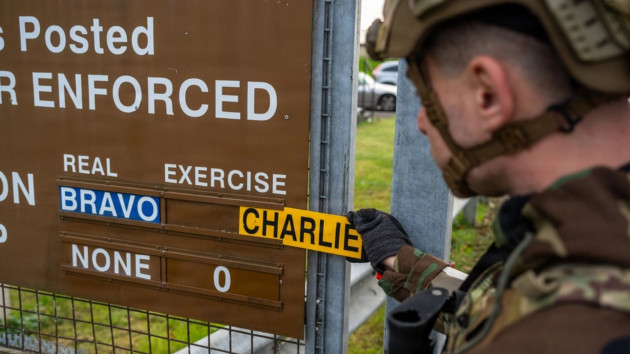
An Airman changes a FPCON sign during Pathfinder Sentinel 25-05 at RAF Fairford, England, November 20, 2025. (Image Credit: DVIDS)
Force Protection Condition, or FPCON, is the silent shield that guards US military personnel, installations, and resources against terrorist threats worldwide. Unlike DEFCON (Defense Readiness Condition), which measures broad military readiness for war, FPCON operates on the ground level. It focuses on antiterrorism measures to secure bases, embassies, and critical Department of Defense (DoD) assets.
Advertisement
For commanders, FPCON is more than a checklist. It is a dynamic framework that empowers leaders to deter, detect, delay, deny, and defend against threats. The system balances intelligence-driven risk assessment with operational realities, giving units the tools to respond before an incident occurs. Major combatant commands, such as US Northern Command (NORTHCOM) or US Forces Korea, set baseline levels across their areas of responsibility, while local commanders have authority to adjust them based on immediate threats. This ensures that security measures are both proactive and tailored to real-time conditions.
Understanding the FPCON Levels
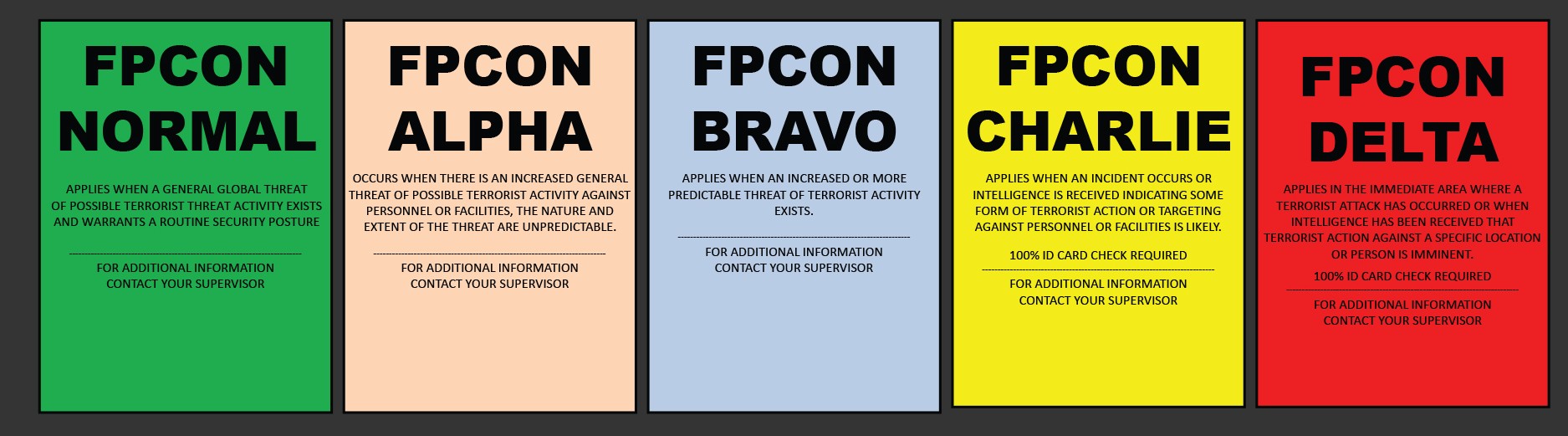
FPCON operates on a five-tier scale, ranging from Normal to Delta, with each level triggering progressively stricter protective measures. These levels are often displayed at installation entry points, signaling to personnel and visitors the current security posture.
The five Force Protection Condition (FPCON) levels. (Image Credit: DVIDS)
FPCON Normal reflects routine conditions in a global environment where terrorism remains possible but unspecified. Standard measures apply, such as ID checks at gates and basic access control. It sets a baseline without disrupting day-to-day operations, allowing forces to operate efficiently while maintaining awareness.
Advertisement
FPCON Alpha addresses an increased, unpredictable threat. It prompts heightened vigilance, including random patrols, briefings for personnel and families, and minor procedural adjustments. These actions remind everyone that risk exists and that attention to detail can prevent incidents before they occur.
FPCON Bravo signals a heightened, non-specific threat. Commanders implement more visible measures: physical barriers, 100 percent vehicle inspections, restricted parking, and increased law enforcement presence. At this level, security is serious, but operations continue with controlled access.
Advertisement
FPCON Charlie indicates a probable incident or a specific threat. Non-mission-essential activities may be curtailed, access to bases may be restricted, and facilities can close if necessary. Patrols and surveillance intensify. At this level, commanders aim to disrupt potential adversary actions before they materialize while protecting vital mission capabilities.
FPCON Delta represents imminent attacks or confirmed incidents. Only mission-essential personnel operate. Thorough screenings, road closures, flight groundings, and chemical, biological, radiological, and nuclear monitoring may be implemented. Delta is often localized to affected areas, reflecting both urgency and precision.
Since 2001, US installations have rarely operated below Bravo, reflecting persistent global risks. The reality of modern threats ensures that bases, embassies, and forward-deployed forces remain on constant alert.
Advertisement
FPCON in Action
The effectiveness of FPCON lies in its adaptability. Commanders evaluate intelligence from multiple sources, weighing threat levels against operational demands. In the continental United States, NORTHCOM sets base-wide levels, while individual directors, such as those at the Defense Logistics Agency, can raise conditions when credible threats arise. Overseas, commands like US Forces Korea provide real-time status updates, ensuring units can respond swiftly to evolving risks.
FPCON applies beyond the wire of military installations. It extends to events, embassies, and even airports when joint force coordination is required. Personnel receive briefings on identifying and reporting suspicious activity. Security measures evolve with the threat environment. For example, intelligence alerts might elevate a base from Bravo to Charlie, tightening access and curtailing non-essential movement. Signage and public notices inform the community without disclosing sensitive operational details.
Practical implementation often involves visible changes at gates, along perimeters, and inside facilities. Vehicle checks, visitor screening, and patrol patterns adjust dynamically to reflect the current level.
Coast Guard members conduct security checks of another member and their vehicle upon approaching the front gate. (Image Credit: DVIDS)
For troops, understanding these levels is second nature. A Bravo alert triggers bag inspections and vehicle scrutiny. A Delta alert signals mission-essential personnel only and immediate lockdown protocols. This shared awareness ensures that both military and civilian personnel contribute to deterrence through vigilance.
Why FPCON Matters in 2026
In an era defined by asymmetric threats, FPCON remains a cornerstone of DoD force protection. It provides commanders with a flexible, intelligence-driven response framework, safeguarding lives while maintaining mission effectiveness.
The system recognizes that threats rarely present themselves uniformly; instead, they emerge in specific areas and at unpredictable times. By assigning levels, commanders translate abstract intelligence into actionable protective measures.
Recent examples underscore the relevance of FPCON today. Bases like Nellis Air Force Base and Marine Corps installations have temporarily elevated conditions amid regional tensions, demonstrating how the system adapts to real-world crises. Elevating FPCON allows commanders to respond rapidly without resorting to excessive force or unnecessarily restricting operations. It strikes a balance between preparedness and practicality.
For military communities, understanding FPCON is more than memorizing definitions. It is about recognizing the cues, appreciating the risks, and following protocols that keep everyone safe.
A high FPCON level does not mean panic. It signals that commanders are acting on intelligence, reinforcing security, and ensuring that the mission continues under safer conditions.
FPCON as a Strategic Tool
FPCON is not static. It integrates across branches, installations, and joint commands, forming a cohesive network of protective measures. Intelligence drives the system. Threats that emerge in one area can trigger localized measures while other units continue routine operations. This targeted approach ensures resources are allocated efficiently and vulnerabilities are minimized.
By maintaining a clear, standardized system, FPCON also communicates intent. Visitors and personnel know what to expect, reducing confusion during heightened security periods. Commanders can apply measures consistently while tailoring enforcement to local conditions. Over time, this approach fosters a culture of vigilance without undermining trust or morale.
Ultimately, FPCON embodies a proactive philosophy. It is about shaping the operational environment to deny adversaries opportunities. It is about being prepared for contingencies before they escalate. It is about keeping personnel safe while enabling the mission to proceed.
In today’s world, where threats can emerge anywhere, FPCON ensures that the US military can act decisively without hesitation.
All American military bases are now on heightened alert, according to a U.S. official who spoke to ABC News.
Bases worldwide are now at Force Protection Condition Bravo (FPCON Bravo), which Department of Defense policy defines as “an increased or more predictable threat of… pic.twitter.com/XDG4DbXQS6
Force Protection Condition may not dominate headlines, but it forms the foundation of modern base security. From Normal to Delta, it gives commanders a framework to translate intelligence into action. Understanding these levels helps military personnel, civilian staff, and visitors respond appropriately.
In 2026, with threats evolving faster than ever, FPCON remains a critical tool for keeping the US military ready, resilient, and secure.
Advertisement
What readers are saying
Generating a quick summary of the conversation...
This summary is AI-generated. AI can make mistakes and this summary is not a replacement for reading the comments.











COMMENTS