

The new minister of foreign affairs is Nikos Kotzias, a former communist politics professor, a rather outspoken individual against Germany’s hegemony in Europe. His appointment is another move that may suggest the direction the Greek government is heading, as he is known for his close ties with Russia, especially with extremists like Alexander Dugin.
The first three days of the new Greek government are a show of force, internally and externally. Most probably, they are putting the Eurozone’s nerves to the test in an attempt to coerce an easing of the austerity program. It all comes down to what each party has to lose from a possible Greek exit, and the benefits for both from a debt haircut in order to avoid it.
Since the euro crisis in 2012, firewalls have been set up in the Eurozone economy to contain the damage. But the monetary union needs to prove its membership irreversibility. Furthermore, Tsipras needs money to keep his pre-electoral promises.
Syriza’s letter of disagreement on the Russian sanctions and the possibility of a veto caught Europe off guard. But as populist parties, either left or right, all with eurosceptic ideas, are on the rise throughout the area, it may bring to the attention of the local governments the possibility of penetration of Russian interests.
Geostrategic Implications
Greece has been a member of the North Atlantic Treaty Organization (NATO) since 1952, and was admitted to the European Union in 1981. Greece’s accession to NATO was in conjunction with that of Turkey. Even nearly 63 years after they joined the Atlantic Alliance together, Greece and Turkey remain almost inextricably tied together in value to the alliance. While Turkey’s value to NATO is largely attributable to the country’s geographic location, Greece is a historic state with a geographically valuable location, possessing a cultural component that lends significant weight to NATO’s mission as a defense organization for most of Europe.
What do the Greek elections mean for geopolitics in wartime Europe? The elections in Greece have resulted in a scenario in which Syriza will have to govern a minority government via coalition. This means that Syriza will have to align the party and the government with other parties that may deviate very sharply on key issues. As the government in Athens is crafted and the governing part of Syriza’s rise to rule becomes a reality, the geopolitical landscape will be affected by the new government as much as the government will impact the geopolitical landscape of the continent.
Tsipras has already welcomed the Russian government warmly as a prospective partner in Greek foreign policy. Through public statements and campaign rhetoric, Tsipras has made clear that he intends to chart a path that may diverge from the one established by the EU, one that includes the levying of strong sanctions on Russia in the wake of its support for violent rebellion in Ukraine, the annexation of Crimea last spring, and the downing of Malaysian Flight 17 this past July.
As sanctions by the West have been implemented, they have elicited incredible effects upon Russian currency, erasing more than 20 percent of its previous value. Further, the spiraling cost of energy prices have halved the Russian economic outlook for 2015, leaving the government of Russian President Vladimir Putin at a significant disadvantage in its effort to re-assert Russian influence over both Europe and Central Asia.
Should Tsipras follow through on his rhetoric and lend robust support for the removal of EU sanctions on Russia, he could relegate Greece to near-pariah status in both the EU and NATO, both organizations likely assessing a rogue Tsipras government with providing Putin with unnecessary and counterproductive influence over internal EU decisions on economic sanctions, as well as eroding the gains of NATO in carrying out its mission as the primary defense organization of the continent.
The EU and NATO will have little patience for a Greek government that undermines the progress that sanctions have elicited in the past year. As Tsipras takes the reigns of power and his government begins to demonstrate just how serious they are about calling for an end to the sanctions and upsetting the balance inside the EU, the other 27 member states will be forced to gauge just how destructive a debt-ridden Greece, supportive of the EU’s main nemesis in Moscow, can be both to the organization’s cohesiveness and to its finances. For Russia, the number of far-right parties in Europe openly supporting the removal of sanctions and tacitly supportive of Russia’s involvement in Ukraine could be force multiplied by a Greek government that explicitly condemns the sanctions and is apologetic for Russian aggression.
This could alter the geopolitical landscape of Europe in ways that would touch on economic and security stability, sending the entire continent spiraling into an intensifying conflict from which there is no easy unraveling. As the Syriza government begins to govern, these issues will begin to take priority if the recent pattern of Tsipras support for Russian foreign policy in Ukraine is any indication.
Thanks to Eric Jones for co-authoring this article.
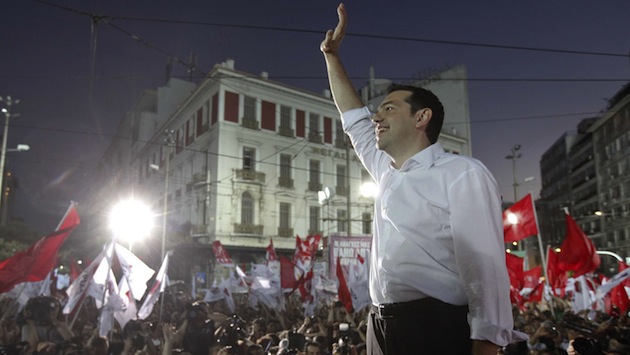
(Featured image courtesy of businessinsider.com)








COMMENTS