

GSG 9’s first real counterterrorism mission, Operation Feuerzauber (“Fire Magic”), came just over one year later, when Lufthansa Flight 181, a Boeing 737-230 aircraft, was hijacked over southern France enroute to Frankfurt by four Palestinian terrorists (two men and two women) on October 13, 1977, with 86 passengers and five crew members aboard, and flew first to Rome, Italy, for refueling, and then to Larnaca, Cyprus, and Bahrain early the next morning. Next, they diverted to Dubai, in the United Arab Emirates.
On October 17, it flew to Aden, South Yemen, where the German pilot, Captain Jürgen Schumann, age 37, was executed for trying to contact Yemeni authorities. The aircraft was then flown to Mogadishu, Somalia, landing at 6:22 AM, where the pilot’s dead body was thrown out onto the tarmac, and a deadline was set for 2:30 AM the next morning, with the terrorists threatening to blow up the aircraft and all hostages.
A team of 28 GSG 9 commandos, personally led by Ulrich Wegener, with two British SAS advisors, arrived at Mogadishu that same evening at 8:00 PM, with all lights turned off to avoid detection by the armed hijackers. The German policemen were clad in black, assault uniforms with black, soft-soled, Adidas tactical boots, with their faces blackened, and carrying black, aluminum ladders with rubber tips.
Somali special forces created a huge bonfire diversion at 1:50 AM, just 200 feet in front of the aircraft, prompting three of the hijackers to rush forward to observe the action, while the GSG 9 and SAS troopers approached the hijacked airliner from behind, in its blind spot.
The lightning-fast assault began at 2:07 AM local time on October 18, 1977, as 20 GSG 9 operators simultaneously opened the forward and aft passenger doors on the left side, led by Lt. Col. Ulrich Wegener himself near the cockpit, and stormed inside. A female terrorist was encountered immediately and was killed on the spot. Another Palestinian woman, Souhaila Sami Andrawes Sayeh, dashed to the rear toilet, barricaded herself inside, and was critically wounded by an MP5 submachine gun burst, but survived and was captured alive.
Two minutes into the surprise assault, GSG 9 commandos began evacuating the hostages as the battle still raged in the cockpit area. The male terrorist leader tossed two fragmentation grenades into the main cabin, but they rolled under the seats and did little harm to anyone. A GSG 9 trooper then killed the leader with an MP5 burst, using highly effective, Geco Action 1 ammunition.
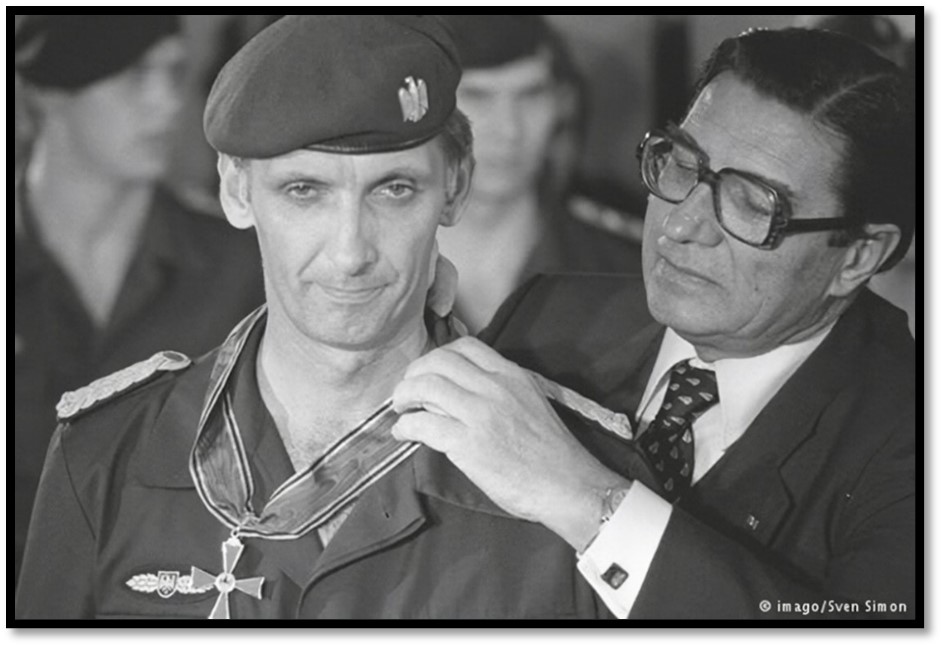
The fourth and final terrorist went down when Wegener himself placed a reported four rounds of .357 Magnum Geco Action 1 rounds into his head. He used a Smith and Wesson Model 19 Combat Magnum (blued, with a four-inch barrel) with custom, oversized, wooden stocks embedded with an American quarter as a medallion on the left side. This weapon, and Wegener’s GSG 9 green beret, are now displayed in the House of the History of the German Federal Republic museum in Bonn.
During this time, one GSG 9 commando was wounded, and three passengers and a flight attendant were also lightly wounded. Only seven minutes into the assault, the aircraft was secured, with all 86 passengers and four crew members rescued, and three of the four hijackers killed. It was an amazingly successful operation.
Afterward, all of the GSG 9 men and hostages were flown to Cologne-Bonn Airport, where they received heroes’ welcomes. Ulrich Wegener was awarded the Commander’s Cross of the Federal Cross of Merit, and the German government vowed never again to negotiate with terrorists. Meanwhile, in the United States, President Jimmy Carter asked his Chairman of the Joint Chiefs of Staff if the United States had a CT unit similar to GSG 9, and was pointedly told, “No, sir.”
So, as a direct result of Operation Fire Magic, the U.S. Army’s 1st Special Forces Operational Detachment-Delta, better known as “Delta Force,” was formed just one month later, on November 19, 1977, under the command of Colonel Charles “Charlie” Beckwith, a Special Forces officer and Vietnam War veteran who had served on an exchange tour with the British SAS.
In the decades that followed, GSG 9 completed more than 1,500 missions by 2003, firing their weapons in action only five times: at Mogadishu in 1977, in a CT raid in Bad Kleinen in 1993, during a hostage situation in Aachen in 1999, and twice more to kill attack dogs owned by terrorists in other situations. In addition to domestic incidents, GSG 9 has participated in international police and peacekeeping missions on behalf of the United Nations or European Union in Afghanistan, Cyprus, the Gaza Strip, Dubai, Georgia, Kenya, Kosovo, Liberia, Mali, Moldova, Sudan, Turkey, and numerous other overseas locations.
On July 1, 2005, the BGS was renamed the Bundespolizei (BPOL, or Federal Police, based in Potsdam, near Berlin), but the abbreviation “GSG 9” was kept because of the CT unit’s fame and stellar reputation worldwide. GSG 9 is a special unit of the BPOL, and the BPOL Aviation Group provides dedicated helicopter support to GSG 9, with a special air unit based in Sankt Augustin. These dark-blue aircraft include the Eurocopter AS332L1 Super Puma, EC 135 T2+, and EC 155B (AS365 Dauphin 2). BPOL also provides K-9 support in the form of German shepherds, Dutch shepherds, Belgian Malinois, and several other breeds of dog.
At the SWAT World Challenge in 2005, GSG 9 won all eight of the eight events, beating 17 other teams, and they maintained their championship again in 2006. In 2012, they won the Annual Warrior Competition, defeating the defending 2011 champions, the EKO Cobra police commando team from Austria.
In 2022, GSG 9 was involved in raids to arrest members of the violent, Reichsbürger movement, suspected of plotting to overthrow the German government.
Currently, all German policemen under age 34, with at least two years of service, may apply for GSG 9, followed by a medical examination, psychological examination, physical tests, marksmanship test, and final interview. If selected, there is a 22-week training process afterward, but only one candidate in eight passes the course and becomes a full-fledged GSG 9 member. The unit has an estimated strength today of 400 men.
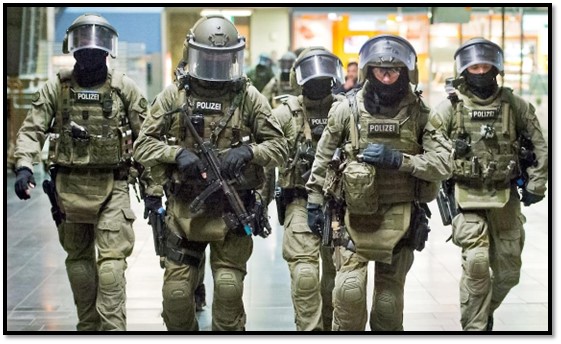
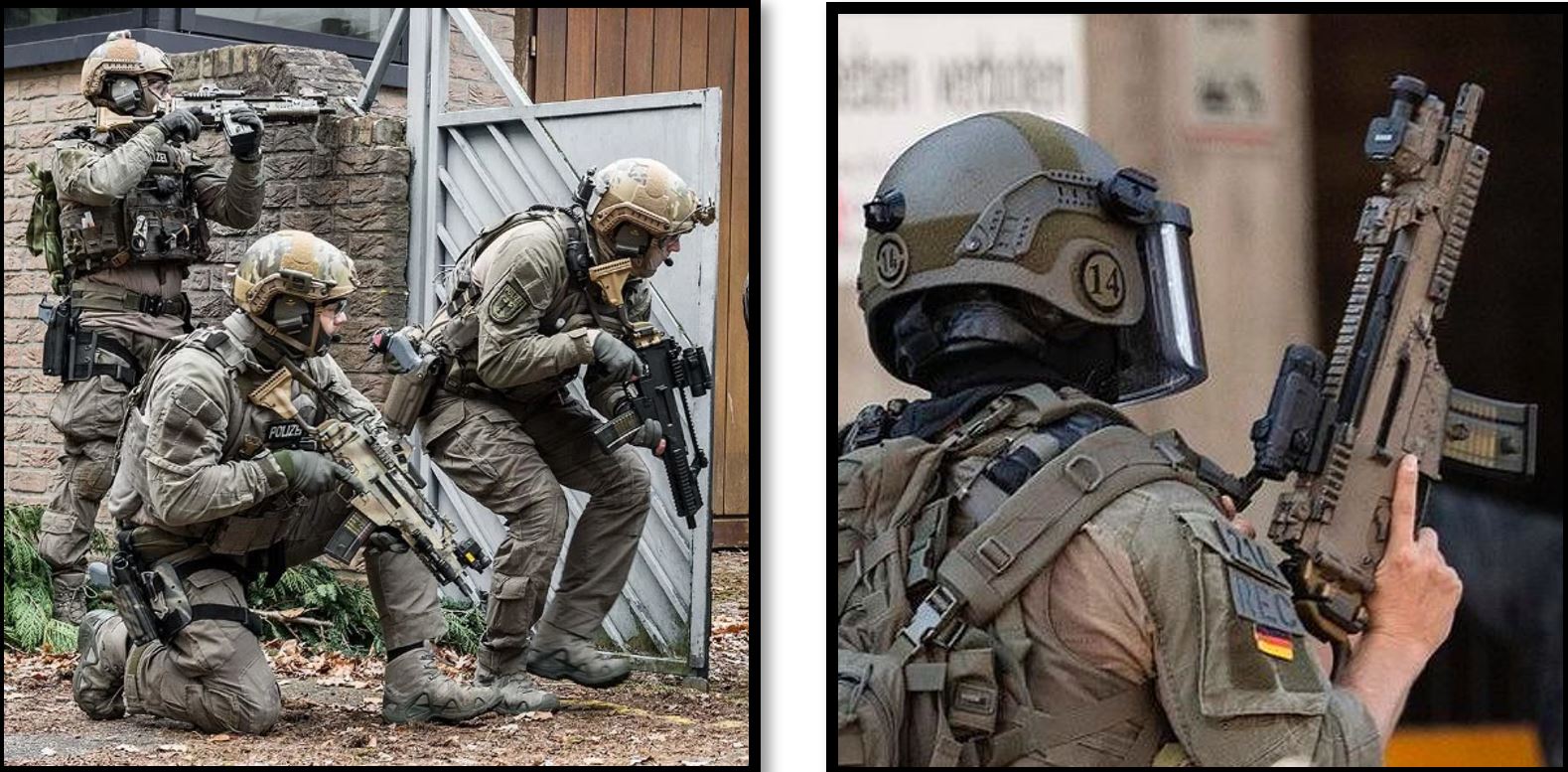
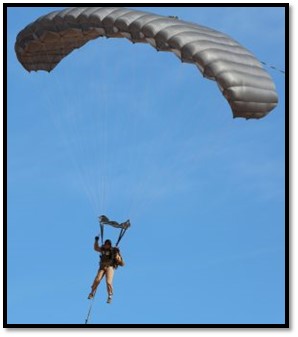
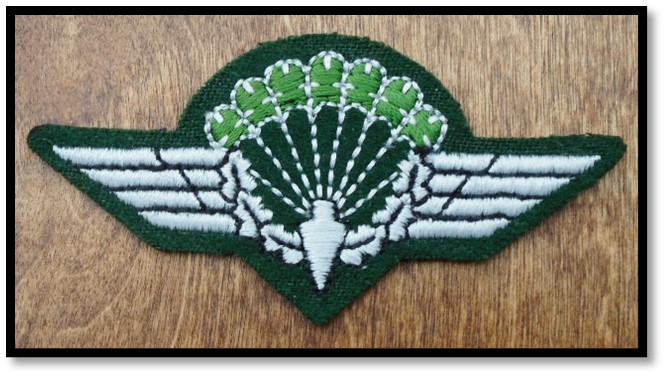
They wear either black assault uniforms or grayish-green assault uniforms, depending upon the situation, with body armor, and sometimes civilian clothes. For overseas deployments, they have worn standard German military camouflage uniforms. GSG 9 members wear a dark-green beret, bearing the Bundesadler (“Federal Eagle”) badge. Some, but not all, members are parachute qualified, wearing the unit’s distinctive, green-and-white, cloth parachute badge.
GSG 9’s standard weapons are some of the very best in the world, many of them produced in Germany by Heckler and Koch. Their assault rifles include the H&K G36K carbine and G36C Compact, the HK416A5 short carbine, HK417A2 battle rifle in 7.62mm NATO, FN Mk. 16 SCAR-L, and Steyr AUG A3-SF. Submachine guns are H&K MP5 variants in 9mm, including the suppressed MP5SD3, and the MP7A1/A2 in 4.6mm. The suppressed version often uses IMI Samson (Israeli) “9mm Carbine” 158-grain, blue-tip, subsonic rounds to be as quiet as possible, but 158-grain, black-tip, +P+ hot loads are also available when required. The Glock FM78 field knife is standard.
Sniper rifles include the H&K G28, H&K PSG1, Haenel RS9, Barrett M107A1, Erma SR100, and DSR-Precision DSR-1. This latter weapon is of special note because it has been hailed as “the most accurate, sniper rifle in the world,” a compact (less than one meter long), bolt-action, bullpup-configured rifle with a match-grade, free-floating barrel, first offered in .338 Lapua Magnum, and later in .308 Winchester or .300 Winchester Magnum. A tactical suppressor is available. It is accurate to within about one-third of an inch at 100 yards, and is in service with military or police forces in Denmark, Germany, Luxembourg, Malaysia, Mauritius, Spain, Taiwan, and the United Arab Emirates.
The standard, GSG 9 pistol is the Glock-17 Gen. 3/4/5, manufactured in Austria, but the new H&K SFP9-SF M (known in the U.S. as the VP9) or SP9-SF Tactical is offered as an optional sidearm. This is a top-quality, German-made, polymer-framed, striker-fired handgun first introduced in June 2014 for the Bavarian State Police (40,000 units), with a hammer-forged, polygonal, four-inch barrel, much like the Glock-19, but with interchangeable back and side straps to customize the pistol for any shooter’s hand, with 27 different grip configuration options available. It comes with either 15-round or 20-round magazines in 9mm Luger, from the H&K P30 pistol series.
The special, Geco Action 1 ammunition has largely been replaced by the newer Action 4 variant, utilizing a heavier, 95-grain bullet at about 1,300 feet per second for deeper penetration, and featuring a softer, copper-alloy bullet for better expansion. This is also an SCHP bullet disguised as an FMJ round, but instead of an ejecting, nylon tip, there is only a thin, plastic tip at the nose, which crushes inside the internal hollow point upon impact.
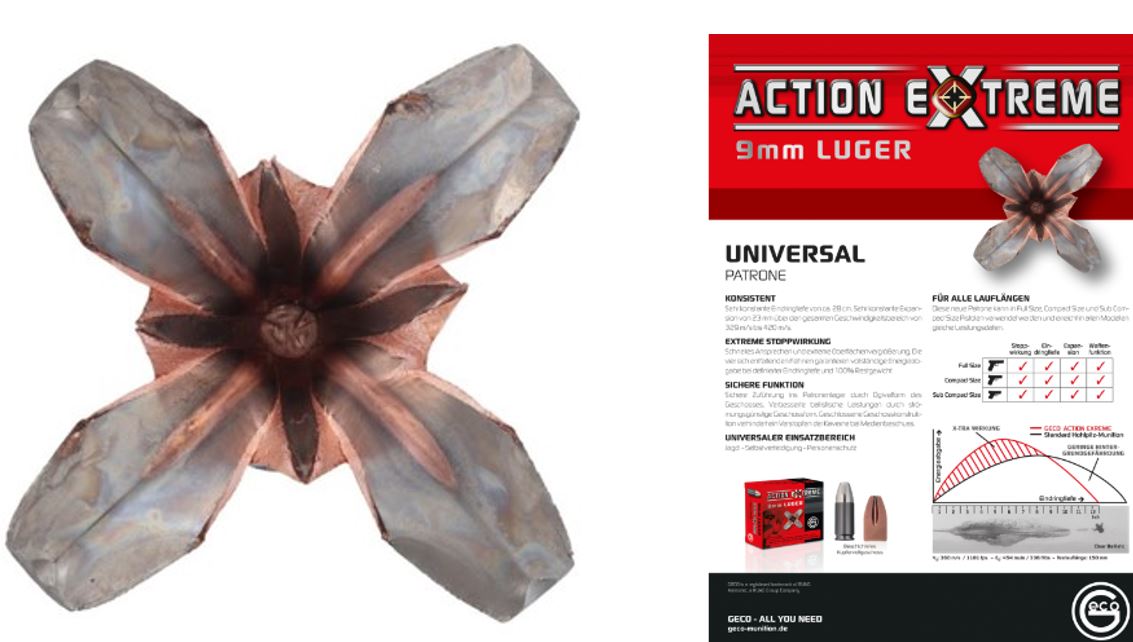
More recently, Geco introduced the all-new, Geco Action Extreme cartridge in March 2019, which is an exact, licensed copy of the new, Norma MHP (Monolithic Hollow-Point) round, a 108-grain SCHP advertised as, “The most-expanding, 9mm bullet in the world.” Now that hollowpoint bullets are no longer prohibited in Germany (since April 1, 2003), GSG 9 and other police units are free to use the Geco Action Extreme load, with a very small, visible cavity at the nose, which peels back quite a bit into four large petals, like a copper flower, expanding quite dramatically. The brass casing is dark gray (black-oxide coating), with a shiny, nickel-plated bullet. From a short-barreled pistol, muzzle velocity is 1,031 feet per second, with penetration of 10.5 inches, and incredibly impressive expansion out to .888-caliber!
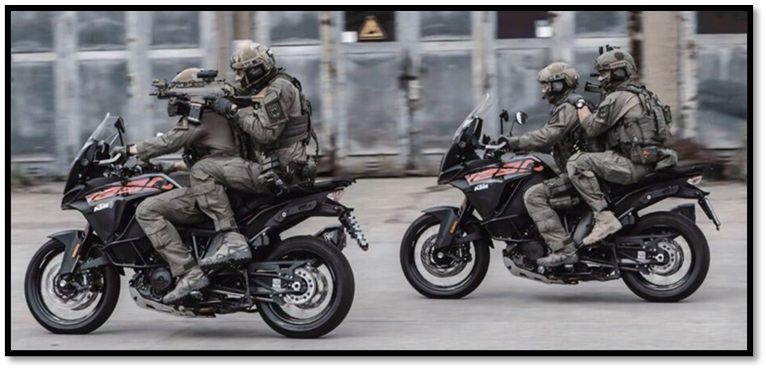
GSG 9 employs the IrvinGQ (British-made) Multi-Mission System (MMS) free-fall, parabolic, ram-air parachute, using the RA-1 Intruder canopy, with oxygen mask and oxygen tank for high-altitude drops. Other specialized equipment includes Adidas (German) GSG-9.7 assault boots, Meindl (German) all-weather, combat boots, ArmorSource (U.S.) AS-600 tactical helmets, and L3-Insight (U.S.) GPNVG-18 panoramic, night-vision goggles. Vehicles include BMW 5-series sedans and station wagons, Volkswagen Passat sedans, and Volkswagen Transporter vans.
The unit frequently trains and cooperates with other allied, counterterrorist agencies, including U.S., British, French, and Israeli forces, and India’s National Security Guards (NSG.) Since 1974, GSG 9’s sterling reputation and influence have led to the formation of other special police tactical units in each of the 16 German State Police forces. These Spezialeinsatzkommando (SEK), or Special Deployment Commandos, deal primarily with high-risk arrest warrants, barricaded suspects, hostage situations, kidnappings, and special raids.
In 2017, GSG 9 commander Jerome Fuchs (“Fox,” in English) announced that the special group would soon be expanding, establishing a new unit in Berlin, probably at Spandau, and increasing overall manpower by about one-third: “It is essential that we are better-prepared in the capital. Our aim is clear: GSG 9 needs to be capable of quicker reactions in the capital.” The most-prized characteristics in his commandos were “fitness, confidence, and teamwork,” he added, noting that GSG 9 was currently called out on approximately 50 to 60 missions per year, with some of them involving the 200 German ISIS terrorist members recently returning home from Syria and Iraq.
Today, GSG 9 stands ready to defend the Federal Republic of Germany from the twin scourges of domestic and international terrorism, armed with the very finest weapons and equipment available as one of the top counterterrorist units in the world, their reputation and capabilities are second to none, the true inspiration for America’s “Delta Force,” and a shining example for the rest of the world to emulate.








COMMENTS