

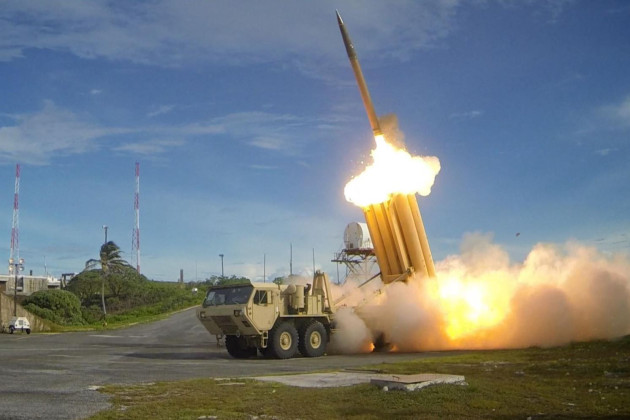
For years, missile defense in the Middle East has been sold to the public like a magic trick. Interceptors streaking skyward. Patriot batteries firing on cue. THAAD launchers parked in the desert like silent guardians of the skyline.
But every operator who has worked around air defense knows a simple truth.
Those missiles are the muscle.
The radar is their brain.
And Iran appears to have put a very expensive dent in that brain.
The Jordan Strike Was Real
The clearest case is Muwaffaq Salti Air Base in Jordan, where an AN/TPY-2 radar tied to a U.S. THAAD battery was destroyed in the opening days of the war. CNN first reported the damage through satellite-imagery analysis, and Bloomberg later reported that a U.S. official confirmed the radar’s destruction.
CNN’s imagery showed a pair of 13-foot craters near the radar site and heavy damage across the system’s five 40-foot trailer units. All five appeared destroyed or seriously damaged. The radar and THAAD battery had reportedly been at Muwaffaq since at least mid-February. Reporting on the exact strike date is not perfectly settled, but the best public reporting places the hit around March 1 to 2.
That radar is not some side piece of hardware sitting off to the edge of the fight. The AN/TPY-2 is the primary tracking radar for the THAAD system, detecting and tracking ballistic missiles and feeding targeting data to interceptor batteries and the wider missile-defense network. CNN, citing weapons expert N.R. Jenzen-Jones, described it as “essentially the heart of the THAAD battery.”
Take that radar out, and the battery’s effectiveness drops hard.
THAAD (Terminal High Altitude Area Defense) 🇺🇸
▪️Range: ~400 km
▪️Altitude: Intercepts at up to 300 km
▪️Speed: Over Mach 8
▪️Radar: AN/TPY-2 – powerful X-band tracking radar
▪️Mobility: Fully mobile, truck-mounted
▪️Warhead: Hit-to-kill (no explosives, destroys by impact)… pic.twitter.com/LKqWL5n7J3— Defense Intelligence (@DI313_) July 28, 2025
What a THAAD Battery Can Still Do Without Its Radar
There is an important technical nuance here. Losing the AN/TPY-2 does not make a THAAD battery completely blind. Without its own radar, the battery cannot independently search for or track incoming ballistic missiles, but it can still operate with cueing from external sensors in the broader network. That means the battery is degraded, not dead.
In practical terms, though, that is still a serious problem. A battery forced to rely on somebody else’s eyes is slower, less autonomous, and less effective when missiles are already in the air. Bloomberg reported the destroyed Jordan radar was crucial to directing U.S. missile-defense batteries in the Gulf.
Transportable Does Not Mean Easy to Replace
The AN/TPY-2 is a transportable radar. That is right there in the design. It is split across five large trailers and can be moved when necessary. But “transportable” is not the same thing as easy to relocate or quick to replace in wartime. Moving, emplacing, and integrating a system like that takes time, logistics, and trained crews.
That is why this hit matters. Destroying one radar does not end the fight, but it can open a real gap in coverage until another sensor is moved in or the wider architecture compensates for the loss. Bloomberg’s reporting makes clear the Jordan radar was a key node in the Gulf missile-defense picture.
Iran May Be Going After the Sensor Layer
Jordan may not have been a one-off.
The Wall Street Journal reported that Iran has targeted radar systems underpinning U.S. missile defenses across the region, and The War Zone reached a similar conclusion, describing a clear effort to hit critical missile-defense radars and related infrastructure.
The broader pattern is backed by satellite-imagery reporting and follow-on analysis showing damage at or near radar systems, satellite dishes, radomes, and communications equipment at bases in Bahrain, Qatar, Kuwait, Saudi Arabia, and the United Arab Emirates. Site-by-site damage assessments outside Jordan are still uneven, so the careful way to write this is that the pattern is strong, but not every individual hit is fully settled in public reporting.
CNN’s imagery analysis also pointed to strikes on buildings at a THAAD battery site near Al Ruwais in the UAE, including a structure used to store radar-related equipment, though it remains unclear what was inside at the time. That does not prove another radar kill, but it does suggest Iranian targeting extended beyond the Jordan site.
Al Udeid Was Hit, and the Details Are Important
One especially important target was Al Udeid Air Base in Qatar, the largest U.S. military installation in the region.
Qatar’s Ministry of Defense said the country was targeted by two Iranian ballistic missiles and that air defenses intercepted one while another struck Al Udeid without causing casualties. That point matters because the base was not merely threatened, it was hit. Separate reporting also described a later drone attack that was intercepted.
There is also reporting pointing to possible damage to the large AN/FPS-132 early-warning radar associated with the Al Udeid area, though that specific damage assessment still deserves careful wording pending fuller official confirmation. The War Zone and other follow-on reporting have treated it as a serious possibility, not as a fully closed case. It is also worth noting that the radar site is associated with Umm Dahal, near the broader Al Udeid complex, not simply a piece of equipment sitting on the runway itself.
The Kuwait Strike Showed the Same Vulnerability Problem
Iranian attacks also hit U.S. facilities elsewhere in the region.
On Sunday, March 1, six American service members were killed in an Iranian drone strike on a U.S. tactical operations center at Port Shuaiba in Kuwait. The Pentagon confirmed the strike, and AP reported the operations center was in the heart of a civilian port more than 10 miles from the main Army base. CBS reported the troops were there as part of a broader dispersal effort meant to reduce vulnerability at larger fixed bases.
Port Shuaiba was not a radar site. That is not the point. The point is that Iran has shown a willingness and an ability to hit the connective tissue of the U.S. regional posture, not just the glamorous systems that end up in recruitment videos and defense-contractor brochures.
WATCH 🔴🔴
THAAD intercepts target outside Earth’s atmosphere. pic.twitter.com/mUHXRTE9pH
— Open Source Intel (@Osint613) June 15, 2025
The Real Backbone of Missile Defense
Missile defense systems are usually described in terms of interceptors. Patriot missiles. THAAD interceptors. SM-3 launches from destroyers offshore.
But interceptors do not work without sensors.
Radars like the AN/TPY-2, and potentially larger early-warning systems, are now also under pressure, providing the detection and tracking data that allow defensive systems to engage incoming missiles in the first place. Take those sensors out of the fight, and the network starts operating with degraded awareness.
From a military standpoint, targeting those sensors is not reckless.
It is logical.
You can spend days trying to shoot down every interceptor battery in the region. Or you can try to blind the network that guides them.
A War for the Eyes
The destruction of the THAAD radar in Jordan is well supported by satellite imagery and by a U.S. official’s confirmation. Elsewhere across the Gulf, credible reporting supports a broader pattern of Iranian strikes against radar, communications, and related military infrastructure, even if not every claimed hit is fully pinned down in public yet.
That is the real story here.
Missile defense may be built on launchers and interceptors. But the fight underneath the fight is usually about something simpler and more primitive: who gets to see first.








COMMENTS